
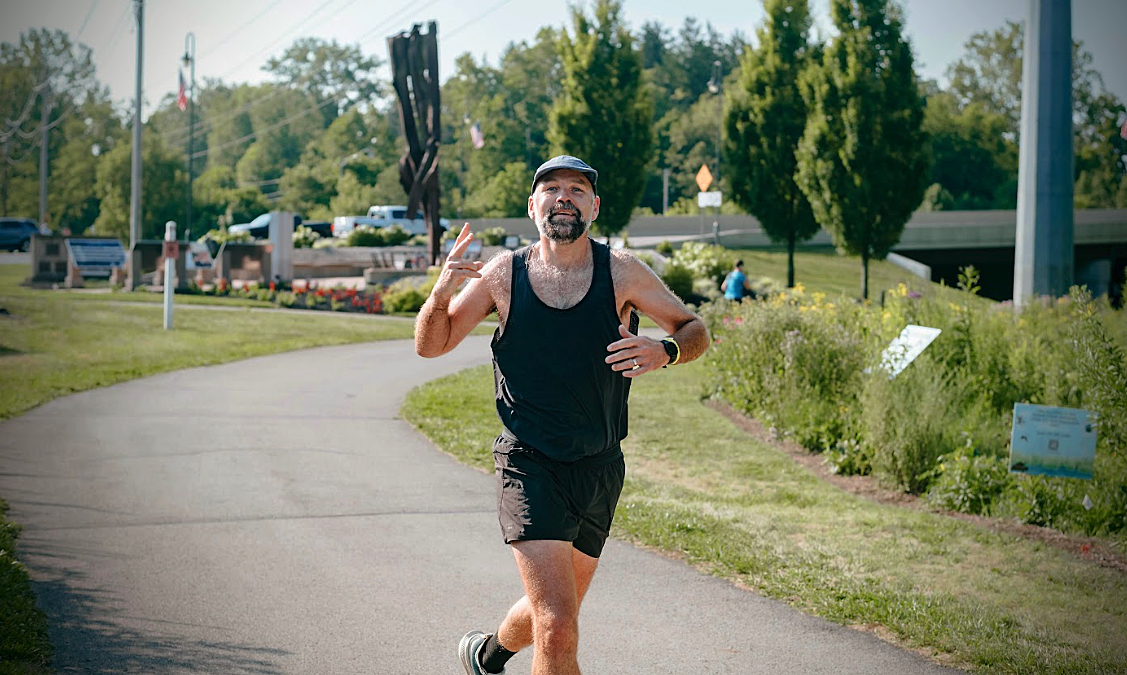

One of the things local resident Chris Westhoff likes best about running is the internal quiet borne out of putting feet to the ground, focusing only on breath and forward motion.
“It’s just being alive,” he told the News in a recent interview. “It’s pretty quiet in there — and then it’s done, and it’s live again because there’s children and work and emails and phone calls and things to do. But it’s a very great place to go for me.”
This fall, Westhoff has plans to take that internal quiet someplace he’s wanted to go for years: the New York City Marathon. When he goes, he’ll take a bit of Yellow Springs with him — he’ll be running as part of Team Komera, raising money for a nonprofit enriching the lives of girls and young women in Rwanda, whose managing director, Ashley Lackovich, also lives in the village.


The upcoming marathon — a feather in the cap of any American long-distance runner — is set for Sunday, Nov. 1.
Westhoff said he started running regularly coming out of the COVID-19 pandemic. He had grown up watching his father run, and had cousins who were accomplished runners, but hadn’t imagined distance running as his own metier until the last few years. Now, he’s completed city and trail marathons and ultramarathon distances, including a recent 50K race in John Bryan State Park.
His progress since 2020, he said, has been tangible, in that running 10 or 15 miles — distances that might once have flattened him for the rest of the day — are now the kind of thing he can complete and hop on over to the Foundry Theater, where he’s the director, and oversee a performance.
“I’m 43, but I’m in better shape mentally and physically than I have ever been,” he said. “I used to play hard and get hurt, and then recover to play hard again and get hurt again; now I run easy to keep running easy.”
Outside of its international prestige as a marathon site, New York City has a special pull for Westhoff, who grew up outside the city and spent time there as a child. He and his wife, Chloe Manor, were married at a friend’s home off Central Park — where the marathon finishes — and will celebrate their wedding anniversary in November; Westhoff, Manor and their children will stay there again when they travel to New York for the race.
And he’ll be running with his oldest friend, Conor Gleason, whom he met playing ice hockey in third grade. Westhoff said he and Gleason have kept their friendship going across miles and years, in part by running together, including marathons in Denver, Cincinnati and Moab.
Running bibs for the NYC Marathon are increasingly difficult to obtain, as tens of thousands of runners enter a general lottery for a limited number of open spots. Another option for interested runners is to sport the bib of a nonprofit — the route that Westhoff, by chance, ended up running.
Westhoff and Lackovich serve together on the Chamber Music in Yellow Springs board, and their families have also crossed paths through the Antioch School. This year, Yellow Springs synchronicity came into play, as Westhoff mentioned to Lackovich that he wanted to run the New York City Marathon. It was just his luck that Komera had a couple dozen charity bibs on offer.
“I didn’t even know he ran,” Lackovich said.
Komera’s connection to running goes back to its inception. The nonprofit’s founder, Margaret Butler, herself a runner, was living and working in Rwanda. Lackovich said Butler would take daily training runs, and nearby children would call out “komera!” — a Kinyarwanda word meaning “be strong, have courage.” In 2008, the organization held its first girls-only fun run in Rwanda, and sport has remained part of its work ever since — including a youth running club that Lackovich said now includes about 500 girls in public schools.
Komera’s primary work, however, is focused on supporting girls and young women through secondary-school scholarships, mentorship, leadership programming, health and wellness initiatives and postsecondary support. Based in Rwinkwavu, Rwanda, the organization currently supports 70 young women through its secondary-school scholarship program. It also works with parents and guardians through a cooperative program focused on financial literacy, small-business development and stronger support for girls at home.
Lackovich has worked in international girls education for about 15 years — as the News reported in April, she also heads the locally based nonprofit Enhance Worldwide, which supports girls education in Ethiopia. She’s been with Komera for two years, and said the organization’s hallmark program serves high-achieving girls from households whose families often can’t afford the costs that accompany nominally free schooling — fees, uniforms, books, supplies and other necessities.
Komera now sends its young scholars to local boarding schools, Lackovich said — a shift that grew out of seeing the limits of tuition support on its own. In Komera’s early years of covering tuition costs for public school, some girls were still waking early to fetch water or care for siblings, arriving late to school and returning home to do chores. After a full day, in homes without electricity, there was often little light left for completing homework. Boarding school, Lackovich said, gives its young students room to study, make friends, play sports and “just be girls.”
Komera’s model has grown increasingly comprehensive over the years: scholars meet with school-based mentors; leadership camps during breaks cover subjects including decision-making, reproductive health and career development; mental health counseling is available; and families are folded into the work through the parent and guardian cooperative.
Lackovich said Komera’s years of work in Rwinkwavu have also helped shift attitudes among families about educating their daughters. In the organization’s early years, she said, some parents were reluctant for their children to participate; now, during the annual application process, parents come forward to advocate for their daughters to be selected.
“Attitudes change when you see success,” Lackovich said.
The organization reports that 105 young women have graduated from its secondary school program, with a 95% graduation rate overall; Lackovich said 100% of its most recent class graduated. According to Komera’s website, 61% of its scholars have gone on to university.
Komera’s local arm based in Yellow Springs is focused on raising money, Lackovich said, but the program itself is led by a staff of Rwandan women, several of whom — including its program manager — are graduates of Komera.
“The programs and the direction that the organization is going to go — it’s all Rwandans,” Lackovich said.
Lackovich said the long view for Komera isn’t just to make sure a girl finishes school, but to ensure that she has choices after she’s graduated. To that end, Komera continues supporting scholars through university when needed, and graduates often go on to support younger siblings and their own children. This year, she said, a group of alumni began paying to send 10 local girls to school themselves.
“The whole point is for girls to live a life of their choosing,” Lackovich said.
The New York City Marathon has become one way for Komera to keep offering choices to girls and young women. Komera fields charity runners who commit to fundraising for the organization, and Lackovich said this year’s New York team of 28 runners is its largest yet. With federal grant opportunities tightening, she said, marathon teams and other fundraising opportunities have become a crucial source of support.
Westhoff’s goal is $4,800, which he hopes to raise by the end of September. According to his fundraising page, $750 can cover a year of secondary school and supplies for one scholar; $1,250 can fund a year of university; and smaller gifts can support transportation, room and board at a leadership camp or access to a Komera social worker.
Westhoff said fundraising for Komera gives a communal purpose to an undertaking that is, by nature, intensely individual — one body moving under its own power from start to finish. The chance to connect the race to what he called “a really meaningful nonprofit,” he said, will make the race especially meaningful.
“It’s cool to do it for somebody else, with another idea at heart,” he said.
To contribute to Westhoff’s run for Team Komera, go to http://www.give.komera.org/fundraiser/7185878. For more information on Komera’s work, go to http://www.komera.org