
Welcome to Fast Company Daily, our daily newsletter on LinkedIn, featuring a free article selected each day by our editors as well as a roundup of great advice on careers, hiring, innovation, and technology.
Visit fastcompany.com for our top stories and breaking news. First time seeing this? Please subscribe.
[Photo: Fervo]
For decades, geothermal was the clean energy technology that was stuck in the margins, a tiny sliver on a pie chart dominated by solar and wind.
Despite providing power around the clock, regardless of the weather, it was geographically limited and expensive to build. Over the past two decades, as wind and solar boomed across the grid, geothermal continued to make up only a minuscule fraction of the American electricity supply—more a piece of energy trivia than a viable source of power.
But in May 2026, geothermal startup Fervo Energy went public—and eventually raised $2.2 billion, making it the largest clean energy IPO ever. Later this year, the company will open the first utility-scale next-generation geothermal power plant. And this is all happening at an incredibly fraught moment for the clean energy industry.
Wind projects are being canceled—in some cases, developers are being paid by the Trump administration to pivot to fossil fuels. Solar developments are also facing cancellations, delays, and a much less certain policy environment.
As the federal government has attacked other renewables, billions of dollars in clean energy projects have been put at risk. And yet geothermal seems to be getting a pass, somehow untouched by President Donald Trump’s antipathy for other renewable power sources.
Fervo’s approach rests on a strange irony: The company realized that the oil and gas technology that helped unlock the shale boom could finally make geothermal scalable. Founder Tim Latimer, a former oil and gas engineer, saw an opportunity to repurpose the technology that others had missed—using new drilling techniques to make geothermal feasible in many more places than it ever had been before.
Can the advances in drilling that powered the fracking boom also create a new thriving sector of the clean energy economy—one that escapes the fraught politics of the rest of the sector?
For the past three years, Fervo has shown that its technology works in a 3.5-megawatt pilot project in Nevada that helps power a Google data center. Now, in a remote part of the Utah desert, the company is putting the final touches on Cape Station, a new power plant that will begin delivering power to the grid later this year. As it continues to scale up over the next two years, it will eventually deliver 500 megawatts, the equivalent of powering more than 375,000 homes.
The timing matters: Fervo has arrived just as the country desperately needs more power. As demand for electricity is surging because of AI data centers—and many projects are turning back to fossil fuels—Fervo has a renewable solution and rare political support. The question now is whether Fervo and other startups in the space can turn geothermal into a major new industry with growth curves that look like solar and wind before them.
Read more on Fast Company Premium.
A Fast Company Premium subscription offers readers full access to subscriber-only stories including exclusive reporting and trend analysis on technology, business innovation, future of work, and design.
Get the details and subscribe here.
This cheerful Brooklyn playscape is intergenerational by design
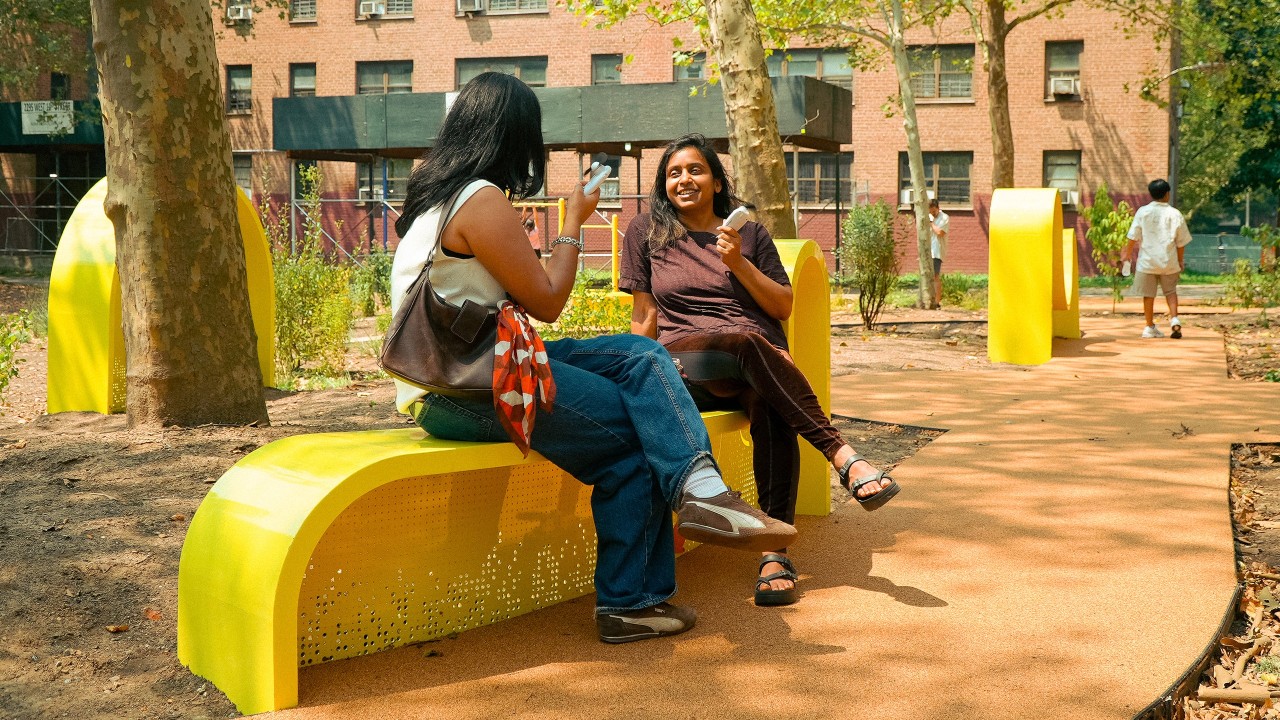
There’s really no wrong or right way to use the new playscape at Marlboro Houses, a New York City Housing Authority (NYCHA) campus in the Gravesend neighborhood of Brooklyn. The abstract, bright-yellow play structures are composed of undulating forms that can serve as benches, slides, hills to climb atop, nooks to hide inside, and portals to gaze through. Each of the forms is open to interpretation, inviting curiosity.
In addition to its abstract form, the playscape is unusual for another reason: It’s designed to be multigenerational and encourage social interaction within Marlboro’s diverse community of some 5,800 residents across 28 buildings. The open-endedness of each element means that each person who encounters the space can use it as they wish.
“We talk about this idea of a ‘playable city,’” says Maeghann Coleman, cofounder, with Ryan Swanson, of the Urban Conga, the design firm that conceived of the installation alongside the community’s residents. “How can play be layered into our infrastructure and really be these simple moments that we can engage with every day?”
The 7,250-square-foot playscape, which is divided between two separate areas on the campus, resulted from Green Space Connections. The initiative, led by the Public Housing Community Fund in partnership with NYCHA and the Design Trust for Public Space, seeks to transform underused open space within public housing into more environmentally sustainable and culturally responsive uses through participatory design.
In workshops organized by the Center for Justice Innovation, a resident stakeholder group selected the Urban Conga to help enliven their outdoor space. The residents wanted stronger connections to nature and more recreation opportunities.
For reasons that have to do with design and policing, most of the outdoor areas at Marlboro aren’t hospitable. There are large grass-filled courtyards, like the ones where the playscape is located, and mature trees, but the design tends to nudge people to keep walking. Benches face walkways, not green space. There aren’t places for groups to linger and enjoy being outside.
Read the full story on Fast Company.