 Image via Wiki Commons.
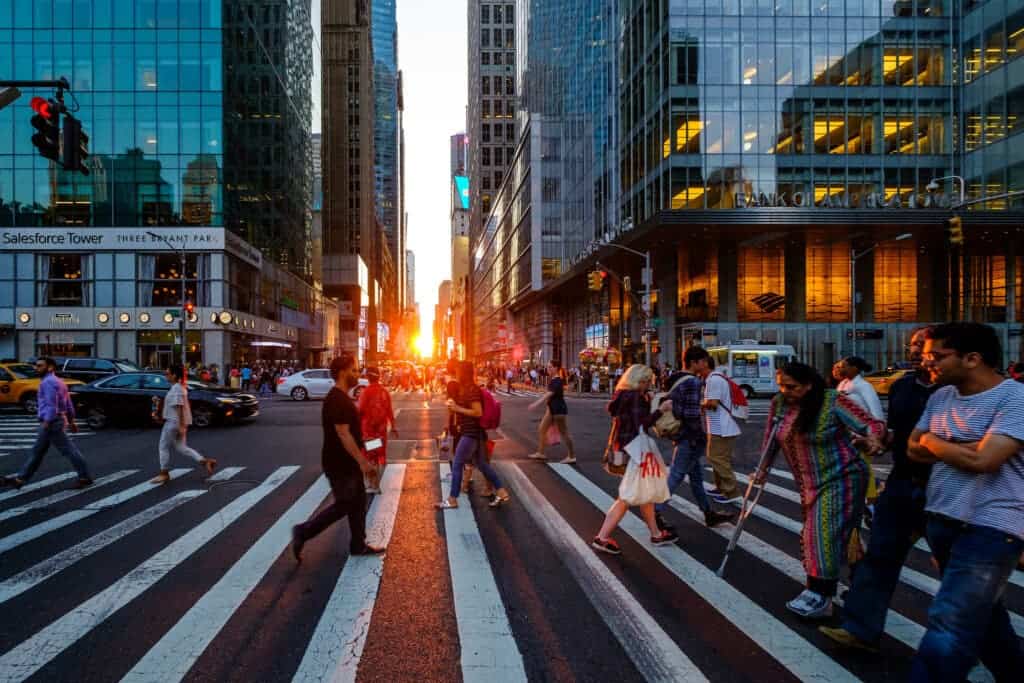
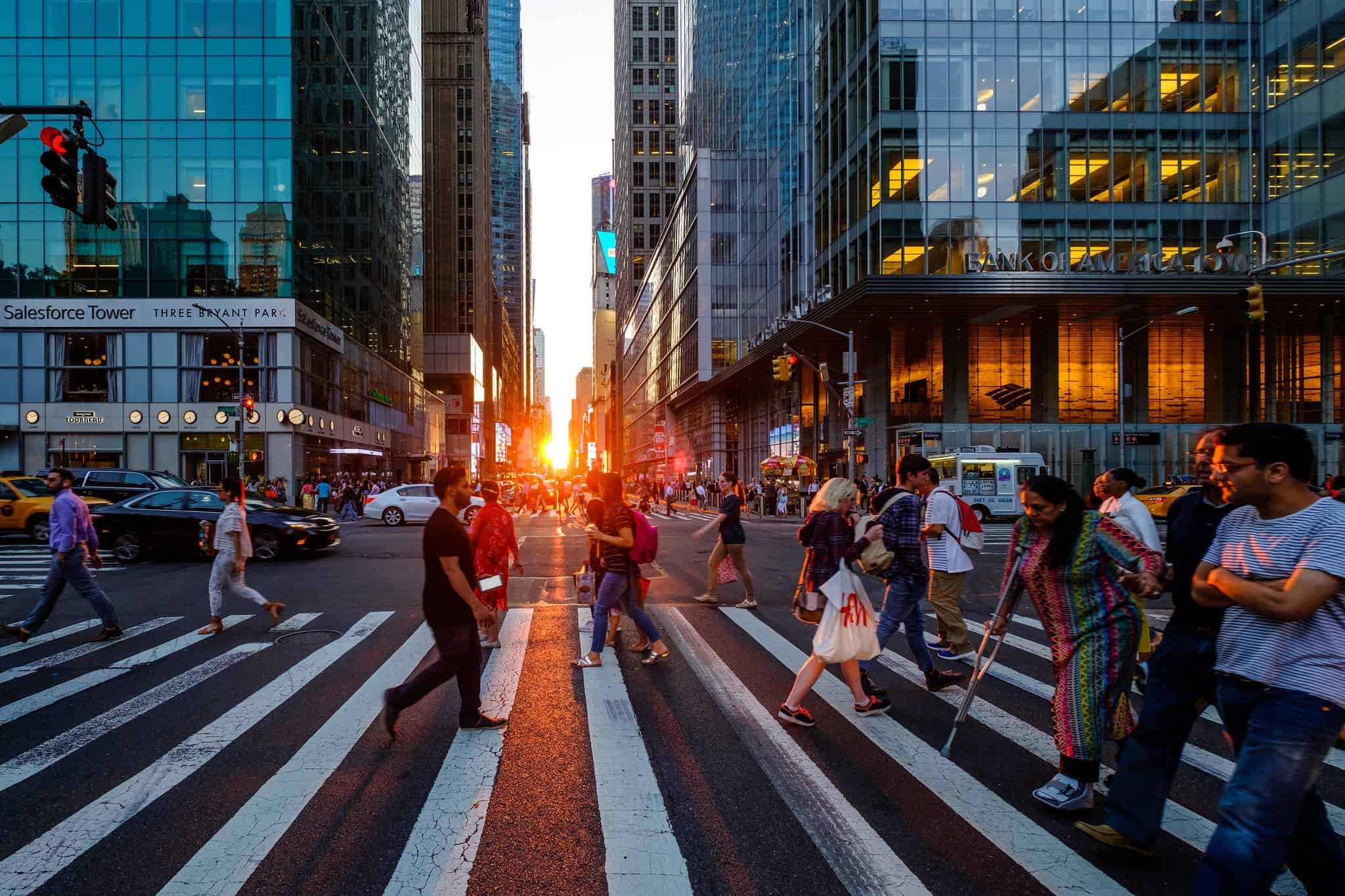
Four times a year, New York City gets one of its best sunset shows.
It’s called Manhattanhenge, and it happens when the setting sun lines up with Manhattan’s street grid, sending a bright shaft of light straight down the borough’s cross streets. For a few minutes, the city’s brick, glass, and steel canyons turn into a kind of accidental observatory.
In 2026, the official Manhattanhenge dates are:
Half sun on the grid: Thursday, May 28, at 8:14 p.m. ET, and Sunday, July 12, at 8:21 p.m. ET.
Full sun on the grid: Friday, May 29, at 8:13 p.m. ET, and Saturday, July 11, at 8:20 p.m. ET.
On the full-sun dates, the entire solar disk appears just above the horizon, framed by Manhattan’s buildings. On the half-sun dates, the horizon cuts through the middle of the disk, making it look as if half the sun is sitting directly on the street.
Weather permitting, it’s spectacular. There’s also a lot of science behind it.
Why it happens
Manhattanhenge is really a quirk of city planning meeting astronomy.
Unlike most cities, New York (and several other North American cities) have a lot of perpendicular streets. Most of Manhattan follows the Commissioners’ Plan of 1811, which imposed the borough’s famous street grid. But that grid does not run exactly north-south and east-west. It is tilted roughly 29 to 30 degrees from true north, which means the cross streets point toward a slightly offset part of the horizon.
Meanwhile, the sun doesn’t set in the same place every day. In the Northern Hemisphere, the sunset point shifts northward along the horizon until the summer solstice in June. After the solstice, it starts moving southward again.
This means that on days when the sun aligns perfectly with this direction (generally sunsets and sunrises align on dates evenly spaced around the summer solstice and winter solstice), watchers are in for a spectacle — weather allowing, of course: the sun will seemingly set exactly on the street.
 Illustrative sketch showing Manhattanhenge. Image credits: ZME Science.
The name was coined by Neil deGrasse Tyson in 1997, alluding to the famous Stonehenge monument, which also marked the summer and winter solstices for thousands of years. In recent years, the phenomenon has become more and more popular, drawing both locals and tourists.
Why it happens twice
The timing is not random. As Earth moves around the sun, the point where the sun sets on the horizon shifts a little each day. In the Northern Hemisphere, that sunset point creeps northward until the summer solstice in June, then starts moving south again.
Because Manhattan’s street grid is tilted, the setting sun lines up with the cross streets once on the way toward the solstice and once on the way back. That creates the two Manhattanhenge windows: one in late May and one in mid-July.
The “full sun” and “half sun” versions are also slightly different. On full-sun days, the whole solar disk appears just above the horizon, framed by the buildings. On half-sun days, the horizon cuts through the middle of the disk, making it look as if half the sun is sitting on the street.
 Image via Pixabay.
How to catch it
In addition to the days themselves, in between May 29 and July 12, those in New York will be able to witness the “Manhattanhenge Effect,” where the sun will appear between the grid of the city low in the sky, but not quite setting.
Of course, Manhattan isn’t the only place where this happens. Several cities have particular alignments that favor this type of phenomenon. For instance, Chicago has similar events on March 20 and September 25, Baltimore has it on March 25 and September 18, and Toronto has it on February 16 and October 25 (depending on the angle of the alignment of the streets).
For the best view of the phenomenon in NYC, arrive early and choose a wide cross street with a clear view west toward New Jersey. Longer streets give the effect more drama, which is why 14th, 23rd, 34th, 42nd and 57th Streets are often recommended.
A long camera lens can make the sun look larger between the buildings, but the spectacle is visible without special equipment. The main thing is weather: even a thin bank of cloud near the horizon can hide the sun at the crucial moment. Viewers should also stay on sidewalks and medians, since the most popular spots can become crowded quickly.
The Tudor’s City Overpass and Hunter’s Point South Park in Long Island City also offer excellent vantage points.
The best approach is to head somewhere towards the east side of these streets, so you can have a longer view towards the west.