
Unsplash / Filip Mishevski
If you’ve experienced the wrath of apartment hunting in New York City–the 100-person lines to view one single apartment, endless StreetEasy tabs open, and the seemingly impossible odds of scoring a housing lottery–any edge you can get is welcome.
Now, we have actual data to explain the city’s housing chaos.
Rental platform RentReboot just analyzed the listing histories of over 800,000 NYC apartments to pinpoint the exact time of year rents hit rock bottom. The takeaway? If you want to save thousands, make sure you don’t pack away your winter coat.
The best time of year to sign a lease in NYC
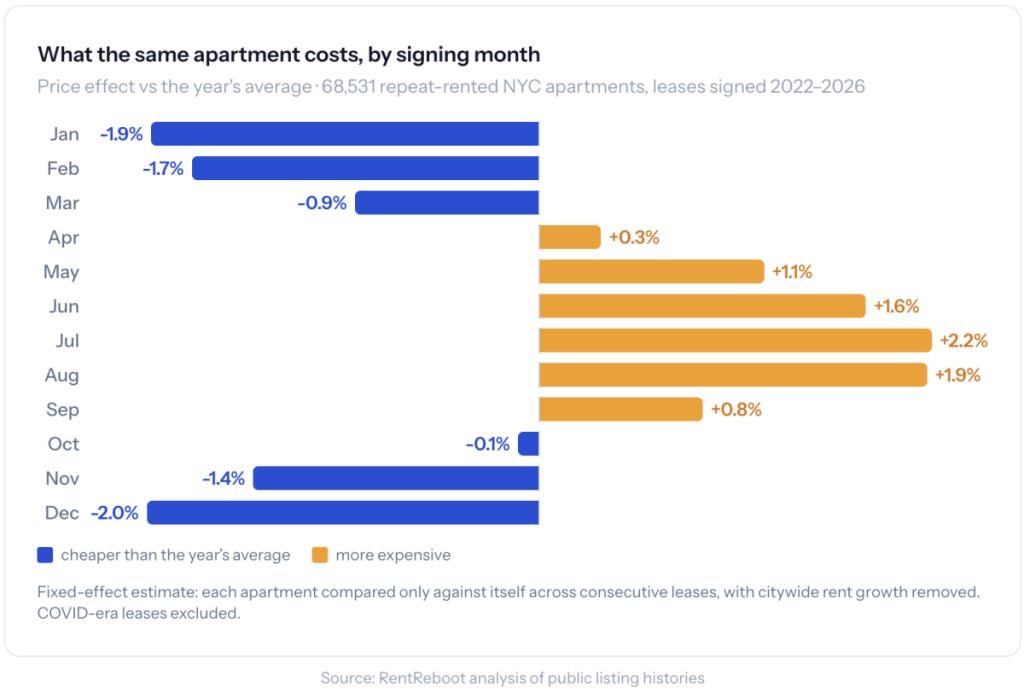
The absolute cheapest month to rent in NYC is December.
Across more than 68,000 cases where the exact same apartment was rented twice, leases signed in December ran 4.2% cheaper than leases signed in July. On a median one-bedroom apartment, that translates to saving roughly $160 a month—or nearly $1,900 over a 12-month lease.
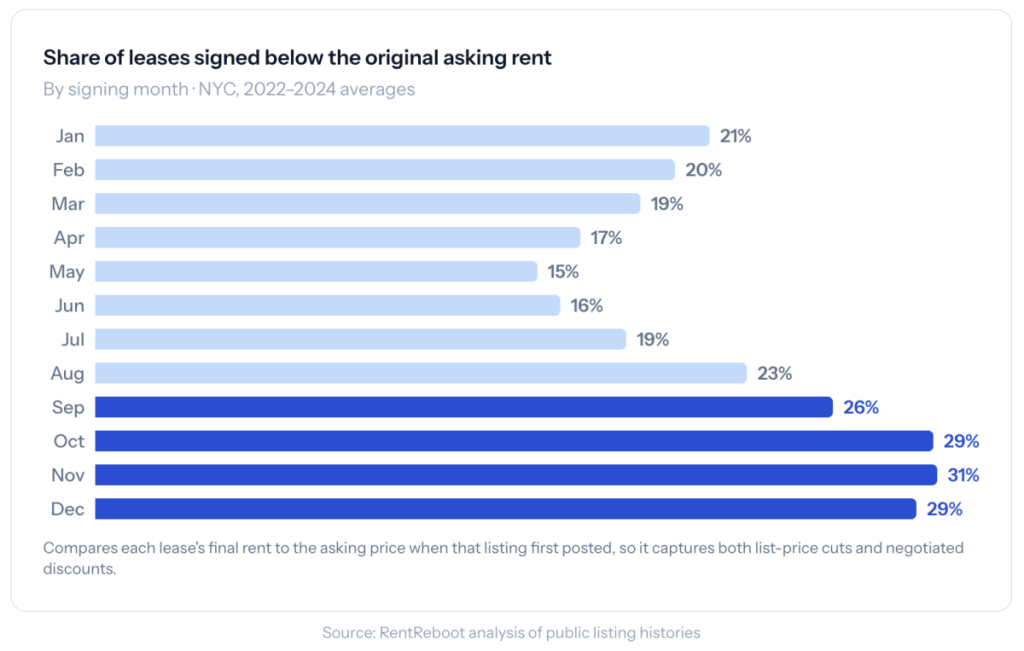
If you’re looking to bargain, November gives you the best odds. A massive 31% of leases close below the original asking price in November, compared to just 15% in May.
 Source / RentReboot
The catch: selection vs. competition
Moving in winter does come with one major trade-off: inventory.
Fewer new options: February sees 43% fewer new listings enter the market compared to July
Far less competition: The number of active renters drops even harder—cutting competition in half compared to the August peak
Longer listing times: Winter listings sit on the market significantly longer, giving apartment hunters about two-thirds of the overall selection of July, not half
In July, you’re outbidding dozens of applicants. In December, you’re often the only offer on the table.
 Source / RentReboot
The four seasons of NYC renting
Winter (December–February): Sticker-price savings. Rents hit their official floor, inventory is lowest, but prices are pre-discounted to move
Fall (September–November): Negotiation season. Summer’s leftover stock lingers, demand drops, and landlords start panicking about empty units. November sees peak price cuts
Spring (March–May): The trap. Competition ramps up quickly while inventory remains low. April listings are the least likely all year to take a price cut
Summer (June–August): Peak selection, peak price. You get 28% more listings than average, but you pay full price alongside 53% of the rest of the city
 Source / RentReboot
Where the discounts are the biggest
The size of your winter discount depends heavily on apartment size and neighborhood ownership:
Apartment size matters: Roommates splitting a 3-bedroom save an average of 5.4% in winter (around $240/month), while solo 1-bedroom renters see a 2.8% drop
Institutional neighborhoods cut deep: Areas dominated by massive management companies see the biggest winter drops—including DUMBO (-10.3%), Battery Park City (-10.1%), and Stuy Town (-8.2%)
Brownstone neighborhoods stay firm: Neighborhoods dominated by small landlords who prefer to wait out vacancies—like Greenwich Village (+3.6%) and the Upper East Side (+2.7%)—actually see prices stay flat or rise slightly in winter
The bottom line
If you have a move on the horizon, try aiming your lease end-date for the mid-October to mid-January window.
Because a standard 12-month lease resets where it starts, securing a winter lease means every future renewal negotiation happens in a buyer’s market. See the full study.