
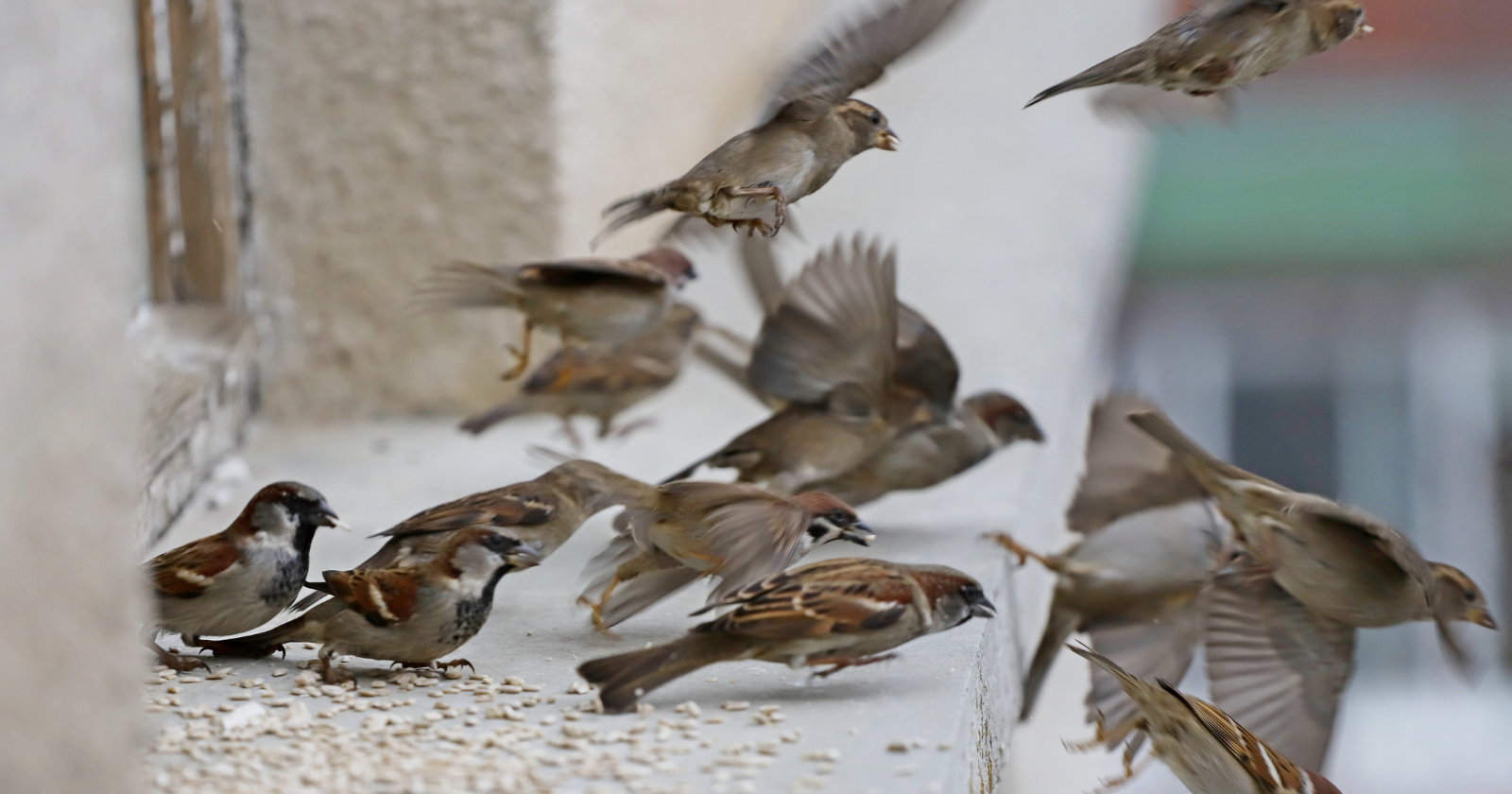
Every house sparrow in North America — every one hopping under a gas station awning, squabbling in a supermarket parking lot, nesting in a traffic light from Alaska to Panama — traces back to a pest-control scheme run by a library in Brooklyn.
The pest was real. In the mid-1800s, the shade trees of Brooklyn and New York were being stripped bare every June by inchworms, the larvae of geometer moths. The caterpillars hung from the branches on silk threads in such numbers that women reportedly carried open umbrellas down tree-lined streets on sunny days to keep the worms out of their hair.
Somebody mentioned that London didn’t have this problem. London had sparrows.
The Institute buys some birds
The Brooklyn Institute — the learned society that would eventually grow into the Brooklyn Museum — took the idea up as a civic project, led by its director, Nicholas Pike.
The first attempt failed. Eight pairs of house sparrows were shipped from England around 1850, wintered indoors in a large cage, and released in the spring. All of them died before breeding.
So the Institute escalated. A committee raised $200, and Pike arranged a much larger order from Liverpool: on the order of a hundred birds, shipped across the Atlantic, with a man hired to look after them. Half were released at the Narrows in 1852; the rest were wintered under the Institute’s care and freed at Green-Wood Cemetery in 1853.
This time the sparrows took. And what followed over the next fifty years is one of the fastest colonizations by any bird in recorded history.
The wrong bird for the job
Here is what the Brooklyn Institute had not fully absorbed: the house sparrow is not an insect specialist. It is a granivore — a seed and grain eater, a bird that evolved alongside human agriculture and eats what farms and streets provide.
Sparrows do feed insects to their nestlings, and in the early years the newspapers declared victory; Harper’s reported that within a few years of the sparrows’ arrival, the inchworms had all but vanished from the cities. But the honeymoon was short and partly illusory. Philadelphia found its inchworms replaced within five years by hairy tussock-moth caterpillars, which sparrows refuse to touch. Adult sparrows, meanwhile, got on with what sparrows actually do: eating grain — in the fields, in the wagons, and above all in the endless spilled feed and droppings of a horse-powered America.
The birds had been hired as exterminators. They stayed as tenants.
Fifty years, one continent
The spread barely needs telling because it happened everywhere at once. Cities across the country, seeing Brooklyn’s “success,” ran their own releases — at least 100 cities in 33 states and provinces, including 1,000 birds freed in Philadelphia by city officials in 1869. Acclimatization societies, devoted to stocking America with the familiar birds of Europe, shipped them west by rail.
By 1870 sparrows were established from Texas to Montreal. By the 1880s the federal government’s own ornithologists were publishing book-length assessments of the “sparrow question,” and the American love affair had curdled into what the newspapers called the Sparrow War — the bird now stood accused of devouring crops, fouling buildings, and evicting native bluebirds, wrens and swallows from their nesting holes.
None of it mattered. The house sparrow is now among the most abundant and widespread wild birds on Earth, and its North American population — every bird of it descended from those Brooklyn shipments and their imitators — stands in the tens of millions.
The experiment, graded
As a pest-control trial, the Brooklyn release scores as a near-total failure: wrong species, wrong diet, and the target pest was eventually handled by other means. As an accidental experiment in invasion biology, it could hardly have been designed better.
It demonstrated the recipe with textbook clarity. Take a species pre-adapted to live off human settlements. Release it into a continent of brand-new cities and grain-fed horses, with none of its European predators and parasites. Repeat the release a hundred times so failure is impossible. The eight pairs that died in 1851 and the hundred birds that lived in 1852 were the same experiment run twice; the only variable that mattered was numbers.
There is one late irony worth keeping. In the sparrow’s native Europe — and in the cities that imported it — populations have been quietly crashing for decades, and London, the city whose worm-free trees started it all, has lost most of its house sparrows. The bird Brooklyn bought to fix its trees is now doing better in the country that regrets it than in the one that recommended it.