
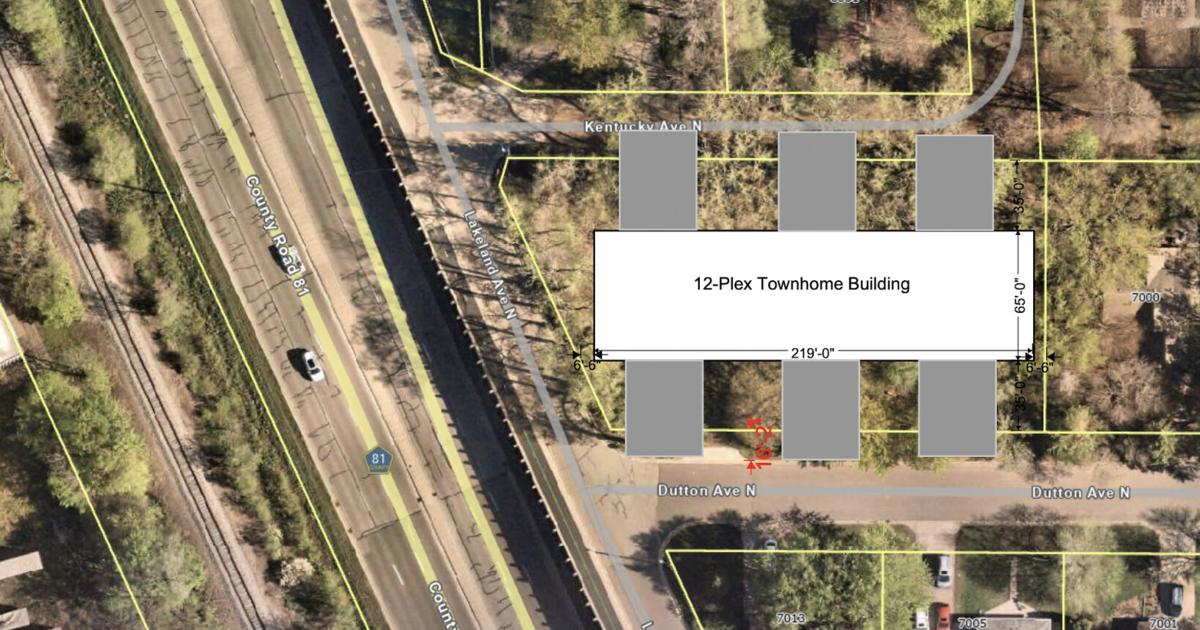

A proposed site plan included in a rezoning request for 7008 and 7016 Dutton Ave. N. shows where a 12-unit townhome development would potentially be located on the 0.76-acre site.
(Submitted image)
A rezoning request was denied by the Brooklyn Park City Council after residents voiced their disapproval for plans that would have potentially led to a set of new townhomes in the Lakeland Park neighborhood.
Paul Mogush, planning director for Brooklyn Park, detailed the request during the council’s Aug. 24 meeting.
The vacant parcels in question sit at 7008 and 7016 Dutton Ave. N., which is at the corner of Dutton and Lakeland avenues north. The Lakeland Park neighborhood sits just south of I-694 and east of County Road 81.
The properties are currently zoned R-1, in which permitted uses include single-family residences, essential services such as utilities and government facilities, and residential licensed facilities serving up to six residents.
NorBrook Construction, the applicant and property owner, requested a rezoning to R-4 (multiple-family) in their application, which would allow the applicant to move forward with plans for a 12-unit townhome development on the 0.76-acre site.
Mogush explained that the site is guided for low-density, or single-family residential, in the city’s comprehensive plan.
“The request is more in that medium-high density range for that R-4 district. So, taking just this information into account, staff would have recommended ‘no.’ And in fact, we would have encouraged the applicant to not apply,” Mogush said.
In this particular case, the planning director continued, there’s another layer of policy to consider due to the site’s proximity to the planned 63rd Avenue Station for the METRO Blue Line Extension.
Policy guidance from the Metropolitan Council encourages an increase in residential density for areas that are within a half-mile of a future light rail transit station.
Mogush noted that the city eight years ago worked to map out modified zoning in each of the five future station areas in Brooklyn Park. For this property, the zoning did not change from single-family.
“Other properties closer to the station did change to new zoning that allows denser development, mixed-use development, to take advantage of that proximity to the station,” he said. “So this is a long way of saying the council has a fair amount of discretion here in making a decision as to whether or not you want to grant this rezoning.”
Mogush said city staff did recommend approval to the planning commission based on Metropolitan Council’s guidance.
According to city staff’s report in the council packet, residents who spoke at the Aug. 12 planning commission meeting expressed concern for the neighborhood if townhomes were allowed to be constructed on the site. Issues raised related to traffic, utilities, and development of the site requiring the paving of Kentucky Avenue.
The planning commission voted 4-3 in favor of recommending the rezoning, with the majority contending that the city needs additional housing opportunities as well as increased density near the planned light rail station.
Similar public comments against the proposal were heard at the council meeting. Brad Odegard, who has lived in the Lakeland Park neighborhood for more than two decades, urged the council to implement solutions to existing issues in the area before adding more pressures to the neighborhood.
“Lakeland Park, and really southwest Brooklyn Park in general, has done its fair share in building and supporting density and providing housing opportunities. … We’re asking for equitable treatment in addressing the issues that face our neighborhood because of that density, parking, access, emergency services, traffic control, etc.,” he said.
Council Member Maria Tran said she had recently visited the Lakeland Park neighborhood to speak with residents, none of whom supported the rezoning proposal, she noted.
“It’s a question of whether 12 units can safely and responsibly fit onto 0.76 acres in an established neighborhood. … Housing is important, but density must be placed where infrastructure can safely support it,” she said.
Council Member Tony McGarvey, who lives near the site under consideration, also spoke at length about the potential resulting impacts if the 12 townhomes were added to the neighborhood. Citing 2023 census information, he noted the Lakeland Park neighborhood is 76% renter-occupied while there remains a higher density of owner-occupied homes on and near Dutton Avenue.
“This proposal is a low blow to those who have hung in there, the ones who have faithfully paid their property taxes for decades, the ones who have busted their asses to maintain their yards, their aging homes, and their beautiful, kid-friendly, working-class neighborhood,” he said.
Mayor Hollies Winston said he would also be voting against the rezoning request based on the feedback he had heard from residents.
“I think the strongest argument is that density. There’s been a serious concentration, and the Lakeland neighborhood has done more than your fair share in terms of that density,” the mayor said.
With Nichole Klonowski absent from the meeting, the council voted 6-0 to deny the rezoning request.