
Emily RussellNY’s prison system is in crisis. It’s driving staff away from the job
Kellan Livsey was 23 years old when he became a New York State corrections officer.
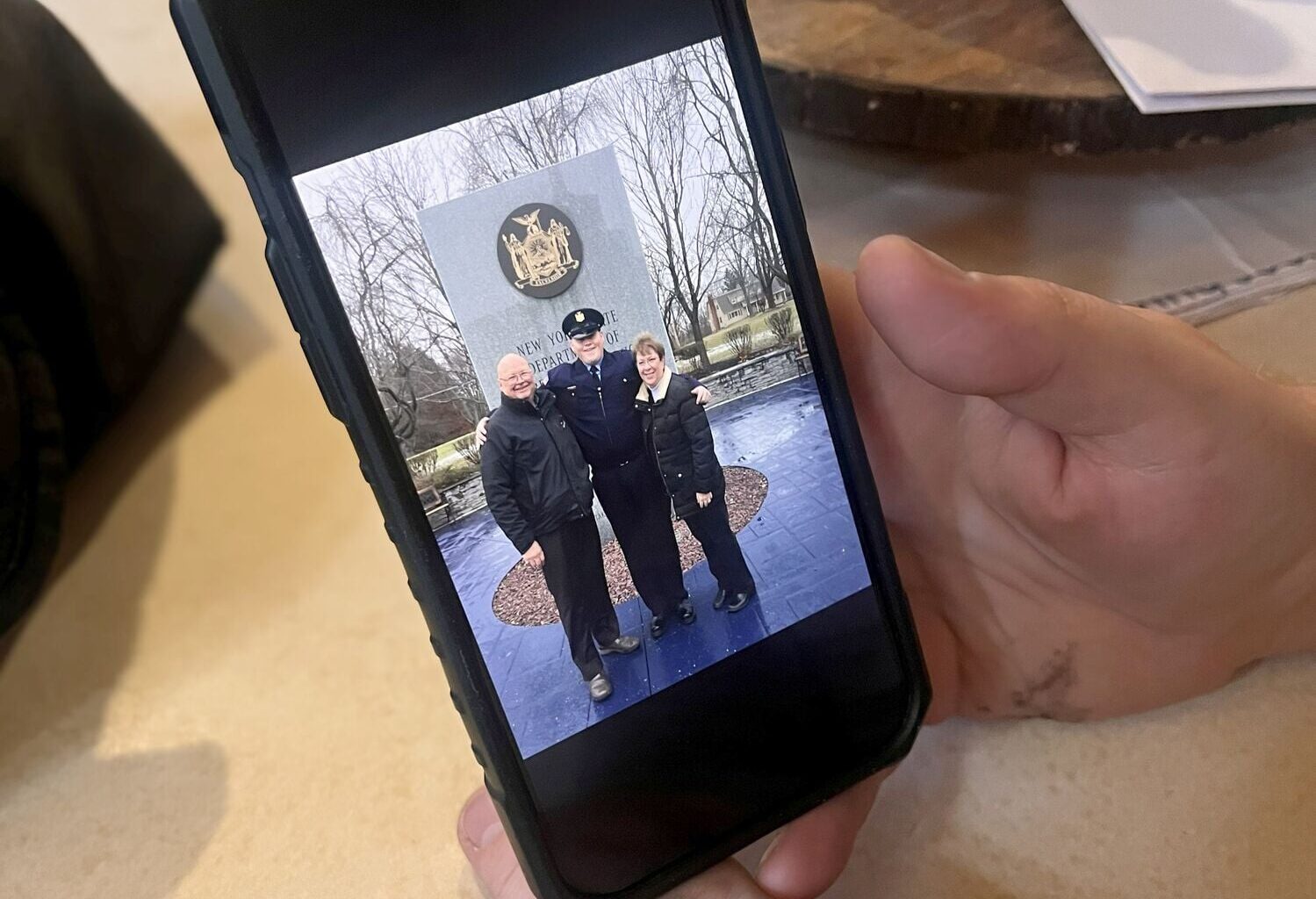
Sitting at his kitchen counter in Ellenburg Depot, Livsey pulls up a photo of the day he graduated from the Training Academy in Albany.
He’s wearing the traditional officer’s cap, a black tie, and a blue uniform. Livsey has a big smile on his face as he stands with his arms around his grandparents, both of whom also worked in corrections.
His grandfather was a corrections officer in Dannemora, and his grandmother was a prison superintendent in Lyon Mountain.

Kellan Livsey with his grandparents on the day he graduated from the Training Academy in Albany. He worked as a corrections officer for seven years before resigning this spring. Photo: Emily Russell
Livsey, who is now 31 years old, looks back at the photo and sees how the job has impacted him. “The job makes you age, I’ll tell you that,” he says.
This spring, Livsey joined the growing list of officers who have walked away from their careers in corrections.
Democrats say they’re doing the best they can to recruit and retain staff despite a confluence of forces. Meanwhile, Republicans blame laws that Democrats passed, and they’re making that case on the campaign trail.
The staffing shortage in New York State, which Gov. Kathy Hochul describes as a “crisis,” is likely to be a key issue as she runs for reelection against her Republican challenger, Bruce Blakeman.
Stability and a good retirement
When Livsey was growing up in Plattsburgh, there were eight state prisons within an hour’s drive. He felt like everyone he knew worked at a correctional facility.
In a rural region like the North Country, Livsey says it was hard to pass up a stable job that paid more than most other jobs in the area.
“It’s good money, good benefits, retirement,” said Livsey. “I looked into [it] and that’s what I wanted for myself. At the time, it was only me. I wanted to set myself up for a good retirement.”

Two prison guards stand near a lookout tower at Clinton Correctional Facility in Dannemora. Photo by Nancie Battaglia
Livsey began his career at Clinton Correctional Facility in Dannemora in 2018.
In the years that followed, a lot would change in the prison system that would contribute to the current staffing shortage. The state continued to close prisons around New York as its inmate population kept falling.
Livsey says that made the job feel unstable, like his prison could close at any minute.
The debate over the HALT Act
In 2021, the state passed the Humane Alternatives to Long-Term Solitary Confinement Act, known as the HALT Act.
Advocates and many lawmakers applauded the new limitations on solitary confinement, but many officers have said it stripped away their ability to punish inmates for bad behavior. The HALT Act sparked a statewide walkout by officers last spring.

People protesting outside of Woodbourne Correctional in Sullivan County during the prison strike in 2025. Photo provided by Patricio Robayo, WJFF Radio Catskill
After the three-week strike, thousands of corrections officers refused to return to work, so Gov. Kathy Hochul fired them, another factor contributing to today’s staffing shortage.
Hochul was recently asked about the problem at a press conference. “I am trying so hard to deal with the prison staffing shortage crisis, and it is a crisis,” said Hochul.
Part of the problem is timing.
The state’s prison population peaked in the late nineties. So, many officers are now hitting their 25-year mark and can retire with a full pension. Along with the thousands of officers who were fired last year, nearly 800 officers retired.
Hochul said she is trying all kinds of ways to close the 56% staff vacancy gap.
“I have launched a recruiting program, lowering the age for people to become corrections officers. We’ve put more incentives out there, we’ve changed pensions, we are doing a massive recruitment around the state,” explained the governor.

Malone is home to two state prisons– Upstate Correctional and Franklin Correctional. Photo: Emily Russell
The number of new officers who graduated last year from the training academy is up more than 40%, but the state is struggling to retain those recruits. More than 660 were assigned to prisons, but by the end of the year, more than 250 had resigned.
“They want to work in the prison system; they don’t want to work for Kathy Hochul,” said Bruce Blakeman, a Republican from Nassau County who is running against Hochul in the governor’s race.
Blakeman said if he’s elected, he’d address the staffing crisis by hiring back the thousands of officers that Hochul fired and get rid of the HALT Act.
“I would fully repeal it,” said Blakeman. “We got along fine without the HALT Act in New York State.”
The effects of solitary confinement
But prison advocates say rolling back the HALT Act would make conditions worse for everyone in prison and do nothing to solve the staffing crisis.
“Widespread solitary confinement worsens people’s mental health; it isolates them from their families,” said Wanda Bertram from the Prison Policy Initiative.
“It makes it impossible for them to access programs that they might have been depending on for some kind of stability or improvement, and it ultimately just makes situations worse.”

Advocates for incarcerated people rally for more prison reform. March 4, 2025. Photo provided by the Center for Community Alternatives
Instead of expanding solitary, Bertram believes the state should keep shrinking the prison system by closing facilities, condensing the inmate population, and releasing elder inmates.
Bertram has some sympathy for regions like the North Country that have relied on prisons to prop up rural economies, but she said that is not a reason to keep people locked up.
“I think it’s very sad what’s happening to a lot of towns, now that there are fewer people in prison, which, in and of itself, is a good thing,” said Bertram, “but the solution is not to go back to the days of extreme mass incarceration.”
The rising risks of synthetic drugs
There’s one more factor that’s been turning people away from a career in corrections: the new dangers associated with synthetic drugs. They’re finding their way into prisons through drug-soaked papers and letters.
Synthetic drugs are harder to trace and can be deadly. Kellan Livsey said he was exposed to a synthetic drug last year after finding two inmates unresponsive. He said he lost consciousness and was given two doses of Narcan.
“Never did I think I’d have a drug exposure, and anyone taking the job now, they need to be aware that, yeah, you could face possible drug exposure and ultimately you could die,” said Livsey.

After working for seven years as a corrections officer, Kellan Livsey resigned from the job this spring. Photo: Emily Russell
That incident was part of what led Livsey to walk away from his career, one that was steeped in his family’s history. He resigned as a corrections officer this spring. Livsey now drives a tractor-trailer for a company out of Plattsburgh.
“Yeah, I’m working more hours than I did with corrections, but I’m coming home every night,” he said.
For Livsey, the benefit of that far outweighs the job security and retirement perks offered by a job in prisons.