
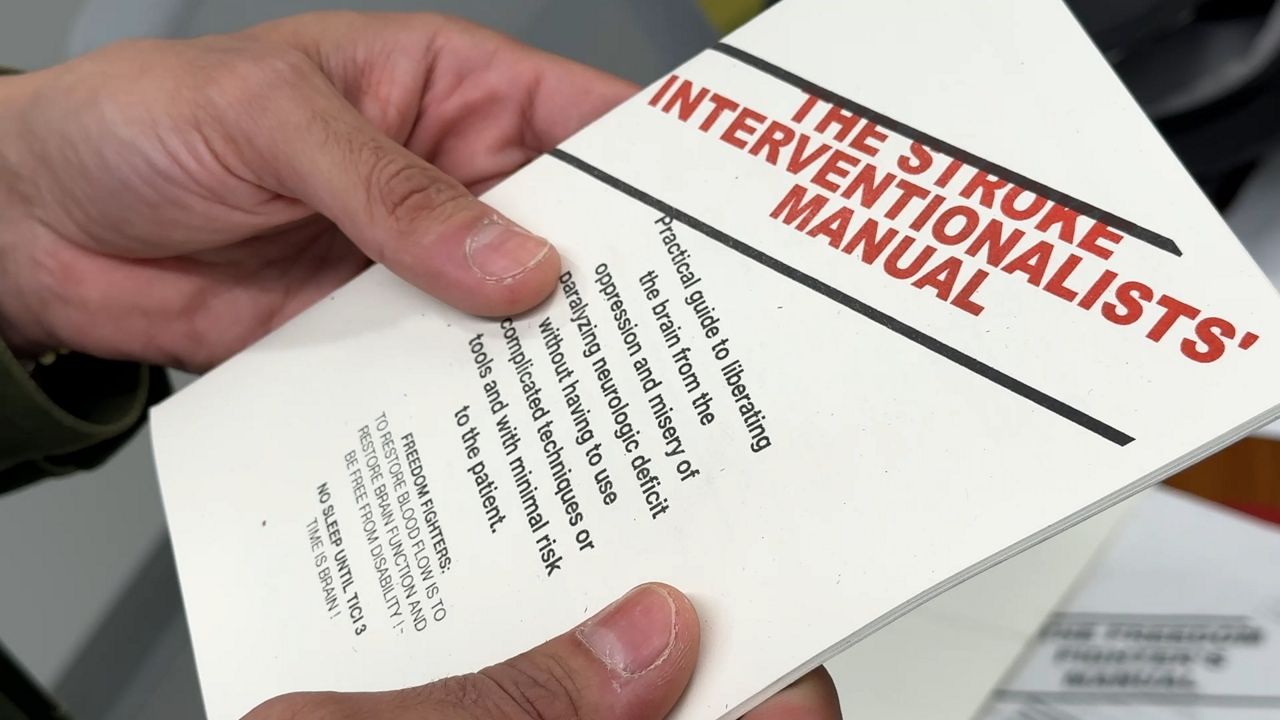
Propaganda created by the Central Intelligence Agency is the inspiration for a doctor’s efforts to better educate people about having a stroke.
Warning signs for a stroke can include loss of balance, difficulty speaking and arm weakness. Those symptoms can be a sign it’s time to call 911. But once a patient gets to a hospital, what happens next?
The executive director of a simulation center in Syracuse used his artistic talents to bring awareness to stroke care.
“It is the way learning should happen. It’s 2026. This is not going to be a novelty anymore,” said Dr. Hesham Masoud, a vascular and interventional neurologist who is executive director of the SUNY Upstate Medical University Simulation Center.
“And so, the mannequin’s on a bed here, you got the one-way glass and on the other side of that is essentially like a theater director popping up the vital signs,” said Masoud.
The lab includes a hospital wing, complete with an operating room, to immerse future medical professionals. His teaching goes beyond the lab to the pages of a book.
“[It’s] an exercise in seeing if I could take someone from zero to hero in terms of their understanding and depth of understanding as to what it means to have a stroke,” Masoud said.
He said he was inspired by the “Freedom Fighters Manual,” CIA propaganda created in the 1980s for Nicaraguans.
“Propaganda is not inherently positive or negative. It’s just a method. That’s it. So you can do with it what you want,” Masoud said.
That art style became the template for his version, the “Stroke Interventionalists’ Manual.”
“And it has this alternating red and black. And those are two visually arresting contrasting styles. It has these bold cartoon images that tell this little story,” said Masoud. “And so, the image of the hand holding the Molotov cocktail, it’s kind of like the image of a doctor holding the catheter that has a clot on the end of it.”
Not quite a comic book, he calls this version graphic medicine.
“The person has identified that there is a clot as opposed to making false hotel reservations,” Masoud said.
He had a few hundred copies printed, and they are for sale at a bookstore in Syracuse. The manual is also available online at gumroad.com for free, or for an optional donation. Any money raised will go back into the Simulation Center.