
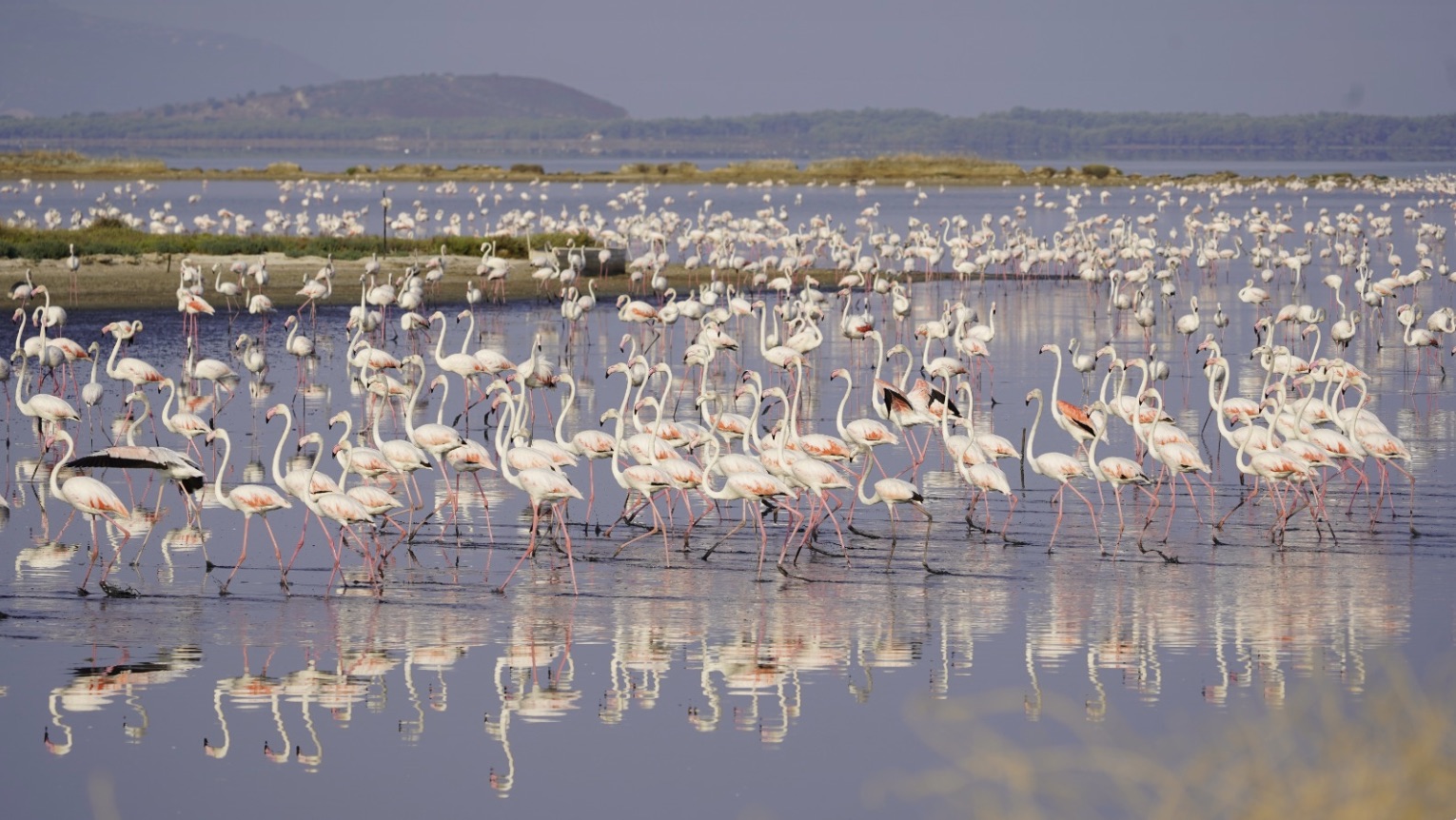
The problem, Rama concludes, is no longer the detergent; it is that “the complaint has become an identity.” By rhetorically sublimating the complaint into metaphor, Rama avoids addressing the protests altogether. In trivializing the ongoing movement as inevitable dissatisfaction and whining, he does not even bother denying the persistent historical conditions which produced it, neutering the political into pathology.
Flamingoes on broomsticks, MadLibbed wedding songs, professional and amateur swimmers swimming across the lagoon, poems translated and read, reading groups assembled. These are acts of survival. Especially in a society where democratic protest has been starkly missing, and the shadow of the past lingers closer than ever while a new flavor of dictatorship looms.
June 22
At the Square, the Protest Coordinating Group reads a list of demands, effectively calling for a new social contract that is not just metaphorical. Along with ecological protection measures to repeal the amendments to the law on protected areas, measures for the protection of cultural heritage, and the Paketa e Maleve [Mountain Package] designed to revitalize mountainous rural regions by turning unused land into active assets, it demands the abolition of the legal status of “strategic investor.”
Other demands include the unconditional resignation of the entire government; the establishment of a transitional technocratic government for a minimum of twelve months; constitutional amendments, including electoral reform and a term limit restricting the prime minister to a maximum of two terms; and changes to the law governing political party financing, which has permitted and continues to permit drug money to enter the political system.15
June 24
Albanians are familiar with slogans. During communism, Albania’s landscape was covered in huge slogans whitewashed on hillsides and buildings demanding militarization and absolute loyalty to the Party of Labor. But today protesters’ chants, slogans, and demands exceed semantics. They are not just actionable language, but languaged action, embodied again and again. They exceed geography, with protests popping up internationally.
They are happening right now, but they are also too late.
Tirana is a city of contradictions, of impassioned hospitality and confrontation, of imposing voices and tender generosity. The anticipation of the possible—or what we might call hope—is a collective translation of wishes from a past which, while hostile to the present, belongs to it. It is a reckoning of time dilated by mass emigration, forced exile, imprisonment, and disappearance.
So what if Rama doesn’t resign? We will continue to demand it.
June 25
Marching, I see Rama’s own attempts at translating the past into something else. I look up at the Stalinist apartment blocks turned into canvases of bright geometric rainbows and arrows, now faded.16 Cheap paint barely conceals the trauma of its history, serving an unexpected purpose: revealing on their facades the obsession with outrunning that history.
June 26
I meet S, who works for a government subsidiary company. As we chant “Poshtë patronazhistët” [down with patronageists]. I ask him what it means. He explains that during the regime, patronageists were assigned to spy on neighbors with gadgets by needling holes in concrete walls. Now, they collect your voting tendencies digitally, as was revealed in a 2021 leak of a database holding information on over 900,000 Tirana residents, used by Rama’s Socialist Party to secure his third consecutive term. S tells me it happened to him the other week: a coworker told his boss he saw him at the protest, and his boss threatened him. He says we haven’t come very far, that surveillance is just normalized now.
June 27
Every night, we march on a different street in a spontaneous, collective choreography. We invite people sitting in cafes and on patios to join us. Some do.
Those who cannot physically join in stick their heads out of their windows. From the crowd, a laser brings their floating heads or hanging torsos to the crowd’s attention, and we cheer “Nona!” [Granny!] or “Gjyshi!” [Grandpa]!
July 1
Maybe it is enough to have protested, to have walked the streets of the city alongside so many others. If walking through a place is reconstructing it, to have shared a banana, a cigarette, a Peja. To push across, feet in line with the shoulders, to lay my back against concrete, and return to the life to which I commit, night after night. There are as many ways of being at home as there are ways of getting there. In Tirana, like in Pishë Poro and Sazan Island, it isn’t who can get it, who buys it, who pours tons of concrete onto it, but who recognizes it; and who recognizes herself in it.
July 6
I spend the last night before I fly out with my mother. Approaching the crowd, her eyes sparkle. I know what she is thinking. How far away we are. How far we’ve been all this time, arriving now like unannounced guests, after almost three decades. Home comes to us, as life terrifies us with how alive we are. And perhaps the most terrifying thing is the possible futility of this moment—and the realization that even if nothing happens, something already has.
July 7
On the plane home, I read a poem by Ervin Hatibi:
At the beach: the sea!
Since we did not have a revolution,
Let’s swim full of anger, deeper and deeper,
The farther from land, the closer to heaven.17
Maybe it doesn’t end any differently than this. But it might.