
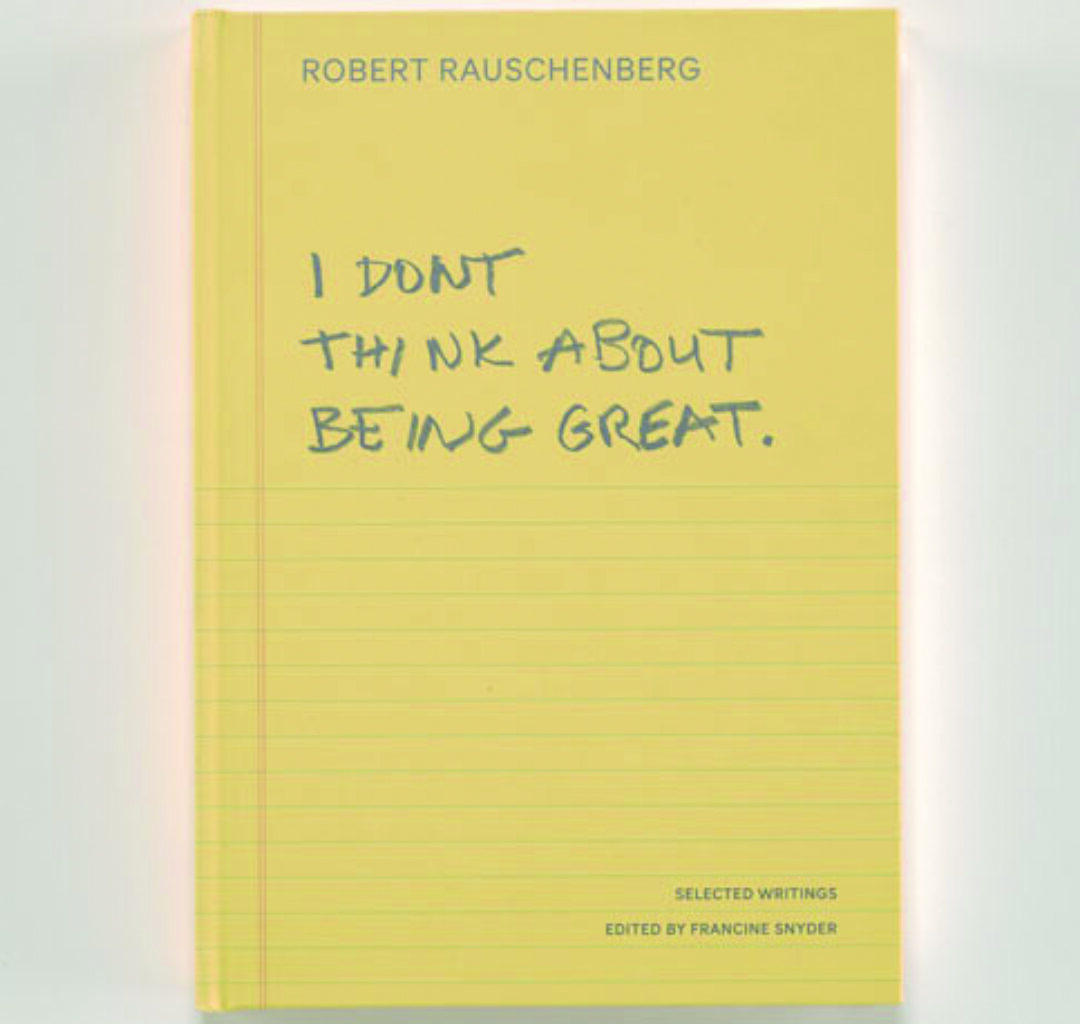
I Don’t Think About Being Great: Selected Writings
Robert Rauschenberg, edited by Francine Snyder
Yale University Press, 2025
I Don’t Think About Being Great: Selected Writings is the first volume dedicated to the writings of Robert Rauschenberg (b. 1925; d. 2008). Released on the occasion of the artist’s centennial, one hundred modest texts ably constitute a primer on the artist’s approach to craft, relationships with peers, and passions as an activist. Rauschenberg’s writing is characterized by a succinct and sometimes homespun immediacy that often belies his astute powers of observation and deeply-informed viewpoints. One brief statement posits, “ANYONE CAN MAKE ART LOOK DIFFICULT AND INTERESTING. I WANT IT TO BE/LOOK EASY AND UNNESARY.” From the outset, it is essential to note that profound dyslexia demanded that Rauschenberg follow a non-traditional engagement with writing, yet his love for word play and abilities with language as a whole energizes the balance of his texts (speaking of conservation issues, for example, he forwards, THERE IS NOTHING WRONG WITH LIVING WITH A CHERISHABLE PERISHABLE).
The volume concentrates on selections from the artist’s papers, compiled and edited by Francine Snyder, director of archives at the Robert Rauschenberg Foundation. Rauschenberg primarily took up his pencil to respond to formal queries and offer support for projects—especially those of colleagues—and his use of all caps on lined yellow paper is a signature identifier of his hand. In 1993, when Esquire solicited thoughts on the theme “60 Things Every Man Should Know,” the artist supplied, “STOP REMEMBERING SOMETHING THAT YOU ARE SURE OF EVERY DAY TO MAKE SPACE FOR THE NEW MISTAKES.” Reflecting upon the chronology for his 1997 retrospective at the Solomon R. Guggenheim, he offered: “THE EVIDENCE OF MY EXISITENCE SEEMS TO ME LIKE AN INTERESTING ADVENTURE HAD BY A STRANGER THAT I WOULD LIKE TO MEET.”
I Don’t Think About Being Great is organized into three sections, commencing with “Art and Practice,” which includes statements and notes from the early 1960s through the early 2000s on topics ranging from specifics about works of art to musings on the artworld and theater to insights on studio practice and disparate mediums: “I take photographs to give me an excuse to stare into any shadow and celebrate any highlight in an act of discovery.” Rapidly the reader comes to appreciate the ebullient energy and spirit of egalitarian exchange that drives Rauschenberg’s universe; there is no harping on the objectionable when wonderment, personal celebration, and social betterment are otherwise possible. This is especially evident in the second section, “Friends, Peers, and Collaborators,” in which genuine affection and enthusiastic letters of praise are tendered on behalf of longstanding colleagues such as Trisha Brown, John Cage, and Jasper Johns, as well as to the habitués of his larger orbit (i.e. Marcel Duchamp, Josef Albers, Jean-Michel Basquiat, David Byrne).