
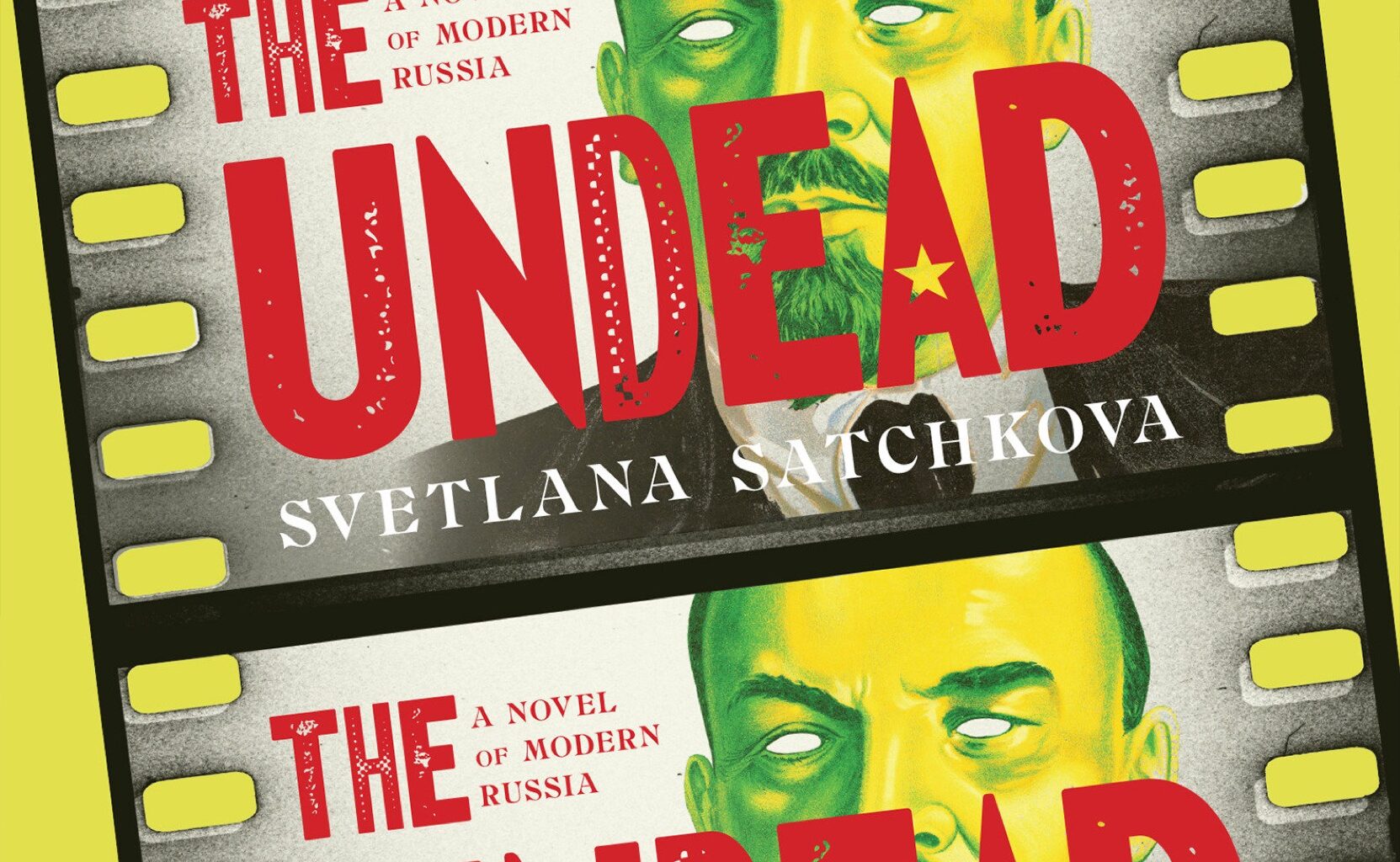
Svetlana Satchkova
The Undead
Melville House, 2026
Svetlana Satchkova’s work came recommended to me by writers Paula Bomer and Julian Tepper, both discerning and voracious readers whose opinions I trust implicitly.
Satchkova’s new novel The Undead, released through Melville House in January, follows a Russian filmmaker. The protagonist, Maya, shies away from politics as she focuses on balancing her creative ambitions and a robust, artistic social circle in modern Moscow. Her life upends when the zombie film she’s making draws the attention of Vladimir Putin’s authoritarian regime, and she’s accused of terrorism.
The Undead accomplishes a rare feat: it illuminates the complexities of Russia’s fraught political climate through an engaging narrative and highly relatable characters.
Satchkova and I caught up over email for this interview.
Jackie Corley (Rail): Maya’s film is a zombie movie. With any zombie movie, once a person is infected, there’s no hope for them. There’s a sense with authoritarianism that once your life is touched by it, there’s no returning to a simpler time. Were you consciously thinking of authoritarianism as contagion?
Svetlana Satchkova: When I first started writing the novel, I came up with the idea of a zombie film because I thought it would make the book more fun for me to write and for readers to read. At that point, I didn’t think of the zombies as a metaphor. But then I got to the scene where Lena, Maya’s best friend, explains why she is emigrating to the United States. Lena is partly modeled on me. Just as I did in that situation, she says that Moscow has been seized by ghouls. That was the word I originally used when explaining my own decision to leave Russia. By “ghouls,” I meant people affiliated with the state’s repressive apparatus: the security services, the police, the courts. When I wrote that scene, the implications of Maya’s subject became immediately obvious to me. I tried not to push the metaphor too hard. In fact, I’m not sure I mention it anywhere else in the novel. But many readers picked up on it. Some said that all people living under authoritarianism and not seeing it for what it is can be seen as zombies.
Rail: Your initial entry point into this novel was a friend experiencing a traumatic turn of fortune in a creative project. How did the story evolve from a highly personal story to a political one?
Satchkova: Yes, the novel began with a very personal story. Like Maya, my friend shot a debut movie, and everyone thought she was one of the best hot new directors. But, for various reasons, the movie was never finished and never came out, and this became a failure she couldn’t overcome. She cut contact with everyone from the industry and retreated into family life. I couldn’t wrap my head around the fact that she never tried doing anything else creatively, and I wanted to explore that in a novel.
Incidentally, in all the years I’d known her, she had never shown any interest in what was going on in Russia at large—living in some kind of bubble and not following the news. This started showing up in the draft, because it proved impossible to write about Russia without touching on what was staring me in the face: the fact that the country was turning into a dictatorship, that there was no civic freedom to speak of, that dissenters were being sent to jail or killed on the orders of the regime.