
Una Vita
Gallerie D’Italia
May 29–October 18, 2026
Milan
We live in Arnaldo Pomodoro’s world, but it’s not the one he hoped for.
This year marks the one-hundredth anniversary of the Italian sculptor’s birth. (He died last year at ninety-eight.) He spent much of that century exploring the origins of language and formal creation. In his unfinished masterwork Entering the Labyrinth, which he began in 1995, Pomodoro sought to create an environment in metal and patinated fiberglass that would lead viewers back to the most ancient systems of communication, with incised glyphic panels mounted in rooms that resemble an imagined Hittite temple. This is carried forward with elements of a geometric and industrial futurism. It was all to awaken a profounder sense of time and memory, even as it inspired a reverence for human creative capacity. What it resembles, to contemporary eyes, is a combination of stage sets for the Indiana Jones, Alien, and Predator movie franchises.
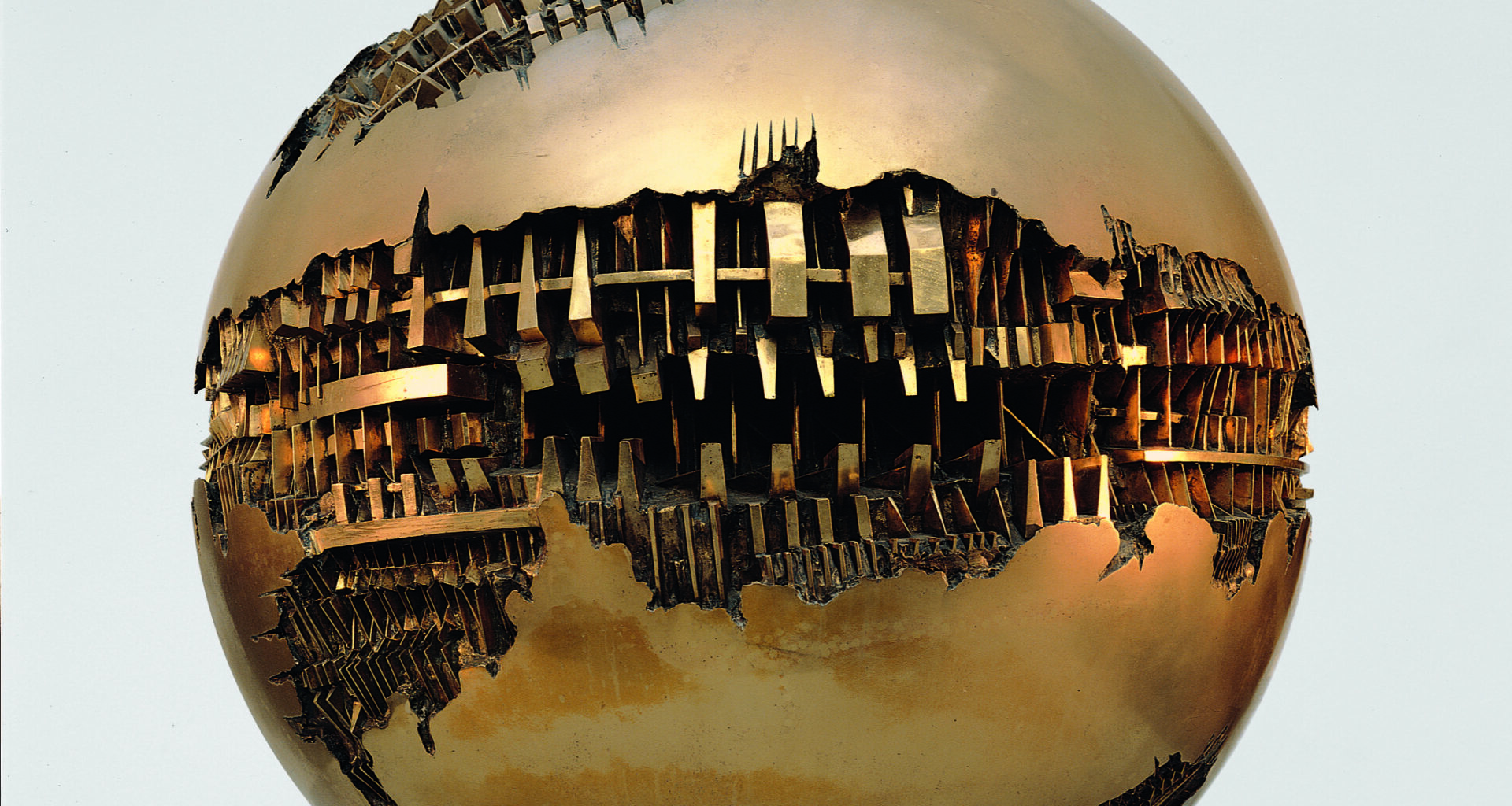
The forty-five works from the Collezioni della Fondazione Arnaldo Pomodoro and Intesa Sanpaolo, placed throughout the elegant former Banca D’Italia building, were like an exploded version of the Labyrinth. The majority were sculptures, often large-scale, involving geometric forms—cubes, spheres, and standing ellipses—modified by structural additions or fracturing to reveal complicated interiors. The largest suite, occupying the Banca’s center, were prototypes in white fiberglass, but what captured the attention were the many works in bronze. At once primitive and futuristic, their gleaming, totemic incongruity in the elegant setting made them all the more imposing—ominous even. Unprecedented. Critic Guido Ballo once referred to Pomodoro’s work as “slices of infinity,” and when infinity intrudes into the halls of history, it can’t help but look alien.
After spending a decade or so trying out abstract paintings on rough, primitive surfaces that resemble those of Alberto Burri, and reliefs that flirt with Paul Klee’s fussier mechanical drawings, Pomodoro concentrated on increasingly ambitious freestanding sculptural casts in bronze and developed the language for which he is best known. It is epitomized by some forty-five versions of a large broken sphere (many of them titled Sfera con Sfera [Sphere Within Sphere]) installed in sites from Vatican City to the United Nations. A fiberglass prototype from 1966, Sfera grande, is permanently installed in the Gallerie’s courtyard. In each of the finished spheres, the burnished surface is torn open to reveal an unpolished, highly-structured interior. Pomodoro’s casting presents a stunning contrast between shining minimalist perfection and dark, almost chaotic intricacy. Before dedicating himself to art, Pomodoro worked at restoring important buildings damaged during World War II. That surely was on his mind, but the high point for this imagery was the 1960s when the large spheres first began to be installed. The first appeared in 1967 at Expo 67 in Montreal. They seemed to symbolize a compromised planet in the nuclear age and the limits of all schemes of perfection—scientific, aesthetic, or otherwise. When I first saw a smaller one of these at MoMA many years ago, the obviousness of its symbolism struck me as bordering on kitsch. Despite the spheres’ darker implications, Pomodoro himself came to see the work more as a celebration of the stubborn persistence of an ideal. “In this sculpture,” he remarked at the United Nations installation, “I lay my hopes and dreams.”