
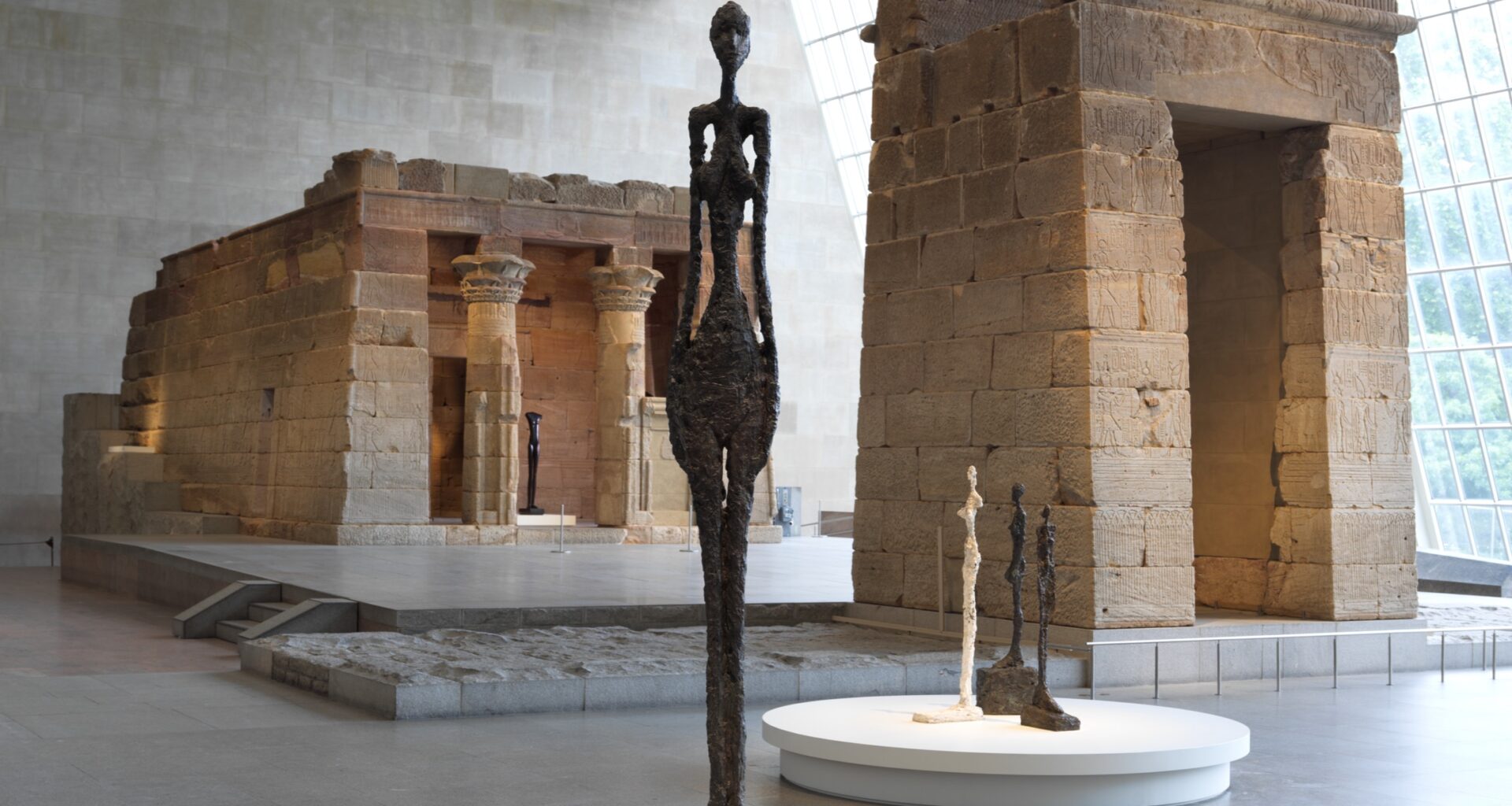
Two years after the end of WWII, Giacometti began working on these full-scale, hieratic sculptures, their exceedingly attenuated proportions and agitated, roughly textured surfaces recalling the survivors of and witnesses to the traumas of war with its unspeakable horrors. By merging the rigid frontality, stillness, solemnity, and spiritual intensity of ancient Egyptian art with the emaciated, expressionless features of modern, decomposing corpses, the figures’ manipulated, pockmarked surfaces evoke objects long buried underground and recently unearthed. The totemic forms emerge from an inchoate mass that their physical presence intensified the more Giacometti took away from and condensed their surfaces. Inextricable from the space they occupy, the volume of quavering material dissipates into the surrounding space even as it seemingly eats away at the mass.
Tall Figure (1947), in bronze, is the earliest standing woman in the exhibition and is placed, solitary, on a low, round, white plinth. Groupings of three or four sculptures are set on similar low bases that in a stirring departure from more distancing museum installations, invite viewers to go up to and around the art, sharing the physical and psychic space with these venerable and vulnerable figures. Nine of the figures are from the group of works, “Femmes de Venise,” that Giacometti made for his exhibition at the 1956 Venice Biennale, which has become regarded as the pinnacle of his career. With barely a transition between front and side views, in profile, they present as thin lines from top to toe while the frontal view imparts an impression of gaunt flatness. Small heads with conspicuous eye sockets stare straight ahead, mirroring back our own gaze, protruding breasts and curvaceous pelvises accentuated by long, emaciated, deteriorating arms and hands plastered to each side, and exceptionally elongated, spindly legs adhered together merging into two huge jutting feet on blocky, often sloping pedestals—these standing women are the penultimate distillation of human form and twentieth-century existential angst. Straddling divine and human realms, Giacometti in the Temple of Dendur is a poignant meditation on both the fragility and endurance of the human race that resonates powerfully three quarters of a century later.