
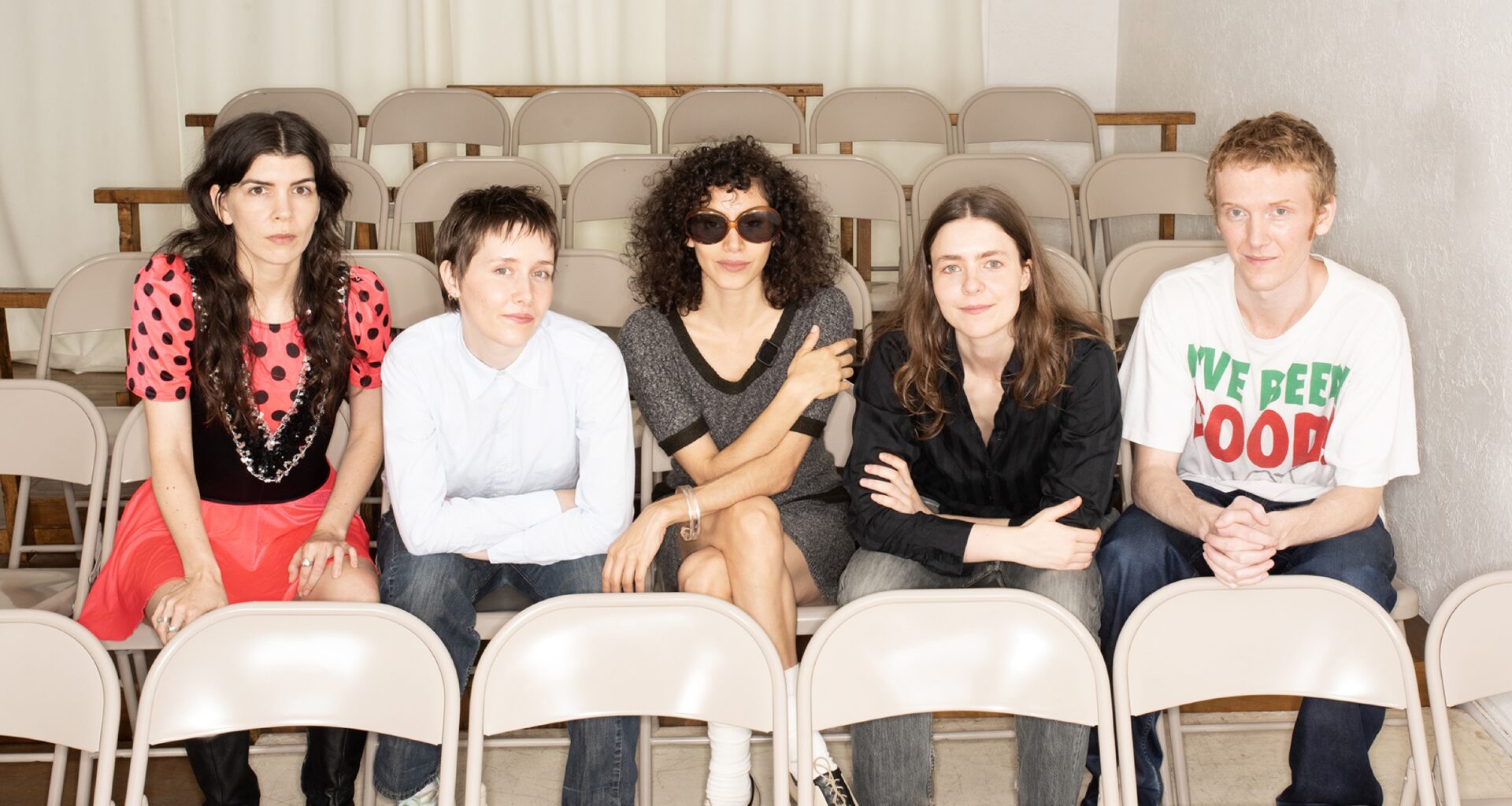
For over four years, Pageant has produced and hosted at least two performances per month at 70 Graham Avenue in Brooklyn. Sharleen Chidiac, Lili Dekker, Jade Manns, Owen Prum, and Alexa West founded the performance space in April 2022 in an effort to create a venue for their own work within the context of the artists they cared about. In the time since, Pageant has grown far beyond its stated goal: not only have the founders and the artists in their orbit consistently pushed each other to create new, sharp, engaging work, but Pageant has become the ecosystem from which new artists and practices emerge. This August, the Museum of Modern Art hosted Pageant for the museum’s 2026 Kravis Studio Residency. On Friday, August 21, the residency culminated in Pageant Presents Pageant, a daylong marathon featuring twenty-five artists (including all five founders) showcasing ten minutes each—six hours total—of independent performance. On the day tickets were released, the marathon sold out within twenty minutes. I spoke with the founders in late July, in advance of the residency.
Tyhe Cooper (Rail): I’m thinking about what “Pageant at MoMA” means when Pageant is itself a kind of room—when you put that room somewhere else, what happens?
Alexa West: What you’re saying about the room—that’s what we used to say, but I think more recently, it’s not about the room. It’s about the extended community of people who have either influenced or been influenced by Pageant, and how that cyclical network of different influences comes into the work.
Owen Prum: It’s about who shows up and the aesthetic dialogue happening in the space.
Lili Dekker: I think the cool thing about the residency has been, at least for me, finding out what Pageant is by having this thing that’s taking us out of our space and making us confront what we are.
Sharleen Chidiac: What do you feel like you found out Pageant is?
Dekker: Hm—love. [Laughter]
Chidiac: People? [Laughs] Maybe.
Prum: I think Pageant is the people who show up. When we were trying to figure out what we were gonna do for the residency, we were like, “Is it the five of us who show work, or is it some of the expanded community—twenty-five of us—who show work?” And the twenty-five felt right, although it didn’t really make logistical sense. It was what made the most logical sense, or “spiritual” sense.
Rail: How do you feel like you’re coming up against the institution and the status of MoMA? Are you thinking about that new audience and how to represent Pageant to them?
Jade Manns: When we’re doing Pageant, we’re not thinking about framing it really. We’re just going. But with MoMA, we have to frame it a little bit, which feels different. We’re thinking about who gets included, what kind of work they do. It’s a representation of us—it doesn’t feel like we’re doing “Pageant at MoMA.” The Pageant spirit is insisting on doing something without any resources—showing up and doing it together—whereas at MoMA, we have all these resources available to us.
Dekker: Initially when we got this opportunity, I thought we were gonna do something different, but we actually did end up doing exactly what we do at Pageant, but at MoMA. Because we decided to split those resources with twenty-five people.
Manns: It’s true, we gave it all away. [Laughter]
Dekker: Right, the idea of having more resources is actually not apt, because we ended up putting a lot of limitations on the actual format of the marathon.
Manns: We inflicted austerity on ourselves. That’s true.
Chidiac: And we really didn’t have to. We could have done two talks. We could have done a talk and an open rehearsal. We could have done a workshop. But the whole essence of Pageant is putting on a show.
Manns: When they invited us, there was a question of whether we wanted to contextualize for the audience what it is that we’ve been up to all these years—what it means, what it has done to the culture, etcetera. Instead, we just did another show.
Rail: If I can think of one way to represent Pageant to people who don’t know what it is, it’s to put them in the room to watch twenty-five people do ten minutes each of completely different work. A “characteristic” Pageant show could be anything from a balletic trio about the desire and envy among dancers (Anna Thérèse Witenberg’s Heat), to a scholarly investigation of the chicken as archetype (Pei Pei Barth Wu’s Chicken), to a raucous play about an apocalypse “sparing only the heavily melanated” (Joel Watson’s BO DIDDLEY WUZZA STEEL DRIVIN MAN!!).
I think you guys getting this money from MoMA and then immediately finding a way to distribute it and put yourselves back into the precarity that you had in the first place is interesting. What happens to something that was made to exist at a certain scale when it starts getting more attention and press and institutional support? Sometimes that thing gets bigger and changes, and sometimes it happens like this: it gets distributed among more people and stays the same at its core.