
New York’s landmark law compelling oil companies to pay for state efforts to address climate change has been struck down. And the ruling casts new doubt on a similar New Jersey bill that had been gaining momentum in Trenton.
A federal judge invalidated the New York law Monday, handing Gov. Kathy Hochul a defeat and sending her administration back to the drawing board. Opponents of New Jersey’s bill say it’s a sign that the measure wouldn’t stand up to scrutiny in the courts — urging legislators to put it aside.
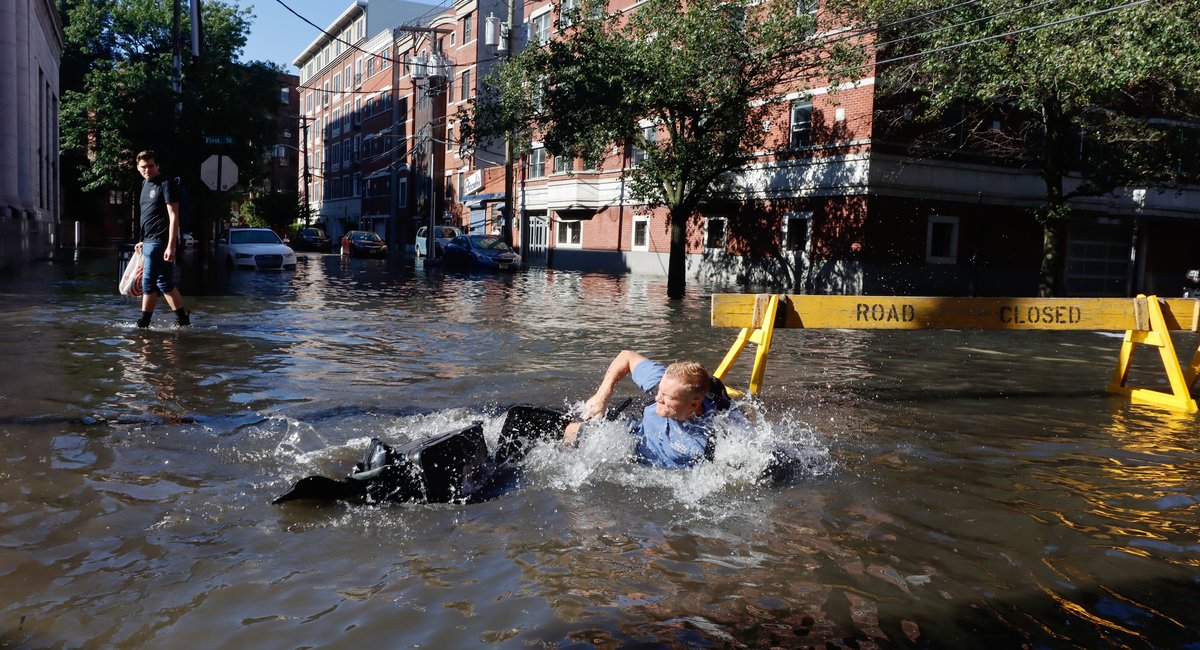
The decision comes as the region marks the fifth anniversary of Hurricane Ida, which brought devastating flooding to both states, leaving 31 people dead in New Jersey and 17 dead in New York while causing tens of billions of dollars in damage. It’s a stark reminder of why state leaders are looking for funding sources to protect their residents from future storms.
The New York law would have charged fossil fuel companies up to $75 billion over 25 years, with that money meant for infrastructure projects to make the state more resilient to natural disasters. It was signed by Hochul at the end of 2024; the Trump administration, Republican attorneys general and industry groups sued to block the law almost immediately.
Judge Brenda Sannes, an Obama appointee, ruled that the New York law attempted to do what New York City had sought to accomplish when the city previously sued oil companies over climate damages. The New York City lawsuit was tossed by the Second Circuit Court of Appeals, and Sannes applied that precedent.
Sannes also found that New York’s law would be preempted by the federal Clean Air Act and the Foreign Affairs Doctrine. The issue, she said, is simply “beyond the limits of state law.”
“It is precisely because the Climate Act operates within an area of law ‘in which the federal interest is so dominant’ that it cannot be enforced,” Sannes wrote in her opinion.
The Department of Justice celebrated the ruling.
“The court held that federal law preempts New York’s attempt to regulate global environmental concerns, marking a significant step in advancing President Trump’s energy agenda and lowering energy prices for Americans,” Associate U.S. Attorney General Stanley Woodward said in a statement. “We will continue to fight to uphold the rule of law, unleash American energy, and protect our national security.”
The Hochul administration is now weighing how to proceed.
“Taxpayers shouldn’t have to foot the bill for damages caused by polluters,” Ken Lovett, a Hochul spokesperson, said in a statement. “We are reviewing the decision to determine possible next steps.”
The fate of New York’s law is being watched closely across the Hudson in New Jersey, where state lawmakers have been considering a similar measure that could bring $50 billion to the Garden State for climate resilience work.
New Jersey’s climate superfund bill made major progress through the spring and summer, clearing key committee votes in both houses of the state Legislature. The bill’s sponsors, and the supporters that have spent years campaigning for it, have been optimistic that it could win final passage later this year.
The bill’s opponents now hope New York’s law being struck down will cause the New Jersey bill’s supporters to reconsider. State Sen. Mike Testa, a South Jersey Republican, said the decision in New York means New Jersey’s bill should go no further.
“It’s a waste of time and resources,” Testa said in a statement. “Democrats in Trenton should focus on what matters most to New Jersey families: affordability.”
New Jersey’s largest business lobby has vehemently opposed the bill as unfair to fossil fuel companies, and has warned that any costs levied against them are likely to be passed on to customers.
“We urge the supporters of this legislation in New Jersey to recognize that this bill is unfair, punitive to consumers, damaging to New Jersey jobs, and now, clearly unconstitutional,” Ray Cantor, the deputy chief government affairs officer for the New Jersey Business and Industry Association, said in a statement.
But the bill’s sponsors and its supporters say they remain confident that they’ll still get the measure over the finish line. And they believe it will stand up in court, especially because New Jersey is part of the federal Third Circuit so the state is not bound by the precedent that was used to block New York’s law.
“I see it having little relevance on our act as we’re in a whole different circuit,” said state Sen. John McKeon, a Democrat representing the Essex County suburbs and a primary sponsor of the bill.
McKeon said the New Jersey bill is similar to and modeled on the New York law, but it also takes inspiration from a similar law in Vermont.
“We tried to take the best of all worlds out of the Vermont approach and the New York approach and put something together that was, in our view, even that much more defensible, if not impregnable,” McKeon said.
Matt Smith, the New Jersey state director for environmental advocacy group Food & Water Watch, said he’s confident the New Jersey bill won’t lose supporters because of the New York decision.
“Our supporters share our commitment to enacting smart, common-sense legislation that makes polluters responsible for a portion of the costs that are driving the affordability crisis in New Jersey,” Smith said.
New Jersey state Senate President Nick Scutari did not respond to a request for comment, and Assembly Speaker Craig Coughlin declined to comment. The two powerful Democrats would decide if the bill gets floor votes in their chambers.
New Jersey Gov. Mikie Sherrill also did not respond to a request for comment. Sherrill has previously said she supports the spirit of the bill, but that her administration was weighing the measures’ likelihood for surviving legal challenges.
Editor’s note: This story has been updated to reflect Sherrill’s previous statement.