
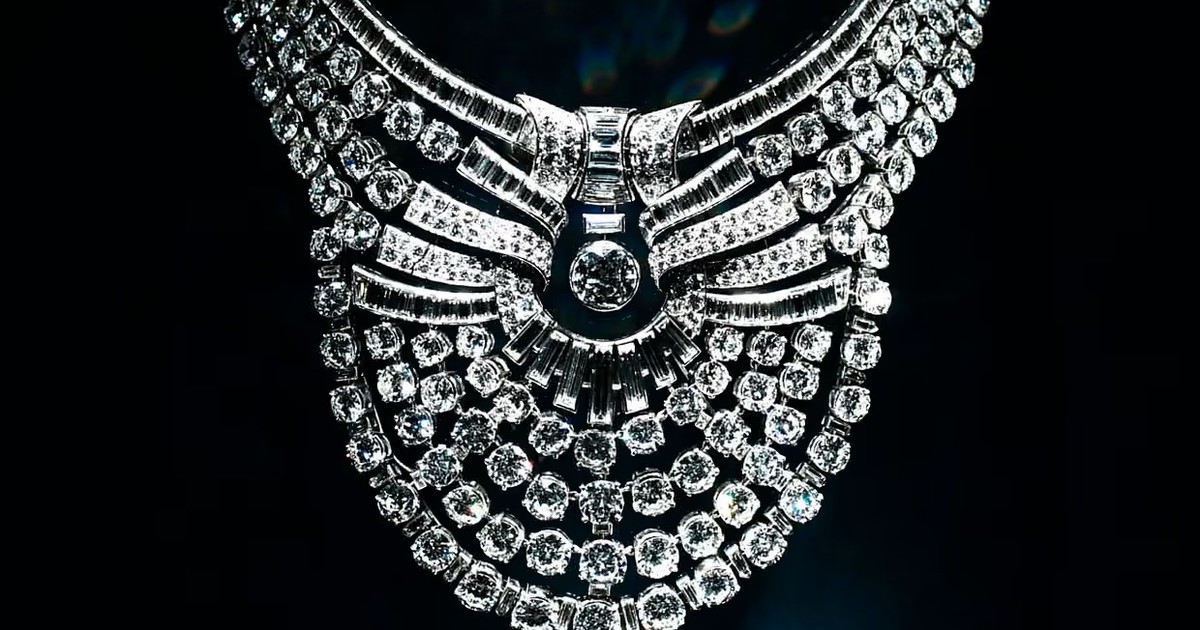
The platinum necklace, which contains more than 200 carats of diamonds, was stolen from the Museum of Applied Arts, known as MAK, at approximately 2 p.m. on August 27.
According to the Guardian’s report, the unmasked men bought admission tickets before entering an exhibition containing more than 300 pieces by French luxury jeweller Van Cleef & Arpels.
They broke the display case with a hammer, removed the necklace and escaped while witnesses were still inside the exhibition room. No one was injured.
Austrian police deployed officers and a tracking dog before releasing security-camera images of the suspects. The necklace has not been recovered.
A necklace made for an Egyptian royal wedding
Van Cleef & Arpels produced the necklace for Egypt’s royal family in 1939, the year Princess Fawzia married Iran’s Crown Prince Mohammad Reza Pahlavi.
Pahlavi later became Iran’s final Shah.
Queen Nazli, the wife of King Fuad I and mother of Fawzia and King Farouk, wore the necklace during the wedding celebrations.
The elaborate piece follows a sunburst pattern and is composed of 673 white diamonds.
According to National Jeweler, it includes a central articulated diamond weighing approximately six carats, about 134 carats of larger round diamonds, 27 carats of smaller round diamonds and approximately 50 carats of baguette-cut stones.
Published descriptions place its total weight between 200 and 217 carats. “More than 200 carats” is therefore the safest figure.

From the Egyptian palace to Sotheby’s
The jewellery survived the fall of Egypt’s monarchy but did not remain with the royal family.
Queen Nazli left Egypt for the United States before King Farouk was removed from power during the 1952 revolution.
She later experienced serious financial difficulties and sold important pieces from the family collection.
The necklace was offered by Sotheby’s in 1975 and returned to the auction house in 2015, when it sold for $4.3 million in New York.
That amount is its last publicly confirmed auction price. It is not necessarily the necklace’s current market or insurance value.
Diamond prices, ownership history, rarity and the costs associated with recovering stolen art can all affect a modern valuation.
![A selection of Baume & Mercier luxury wristwatches on display, highlighting the Swiss brand’s nearly 200-year heritage before its sale by Richemont to Italy’s Damiani Group. [Getty Images/AI Images]](data:image/svg+xml;charset=utf8,%3Csvg%20xmlns%3D'http%3A%2F%2Fwww.w3.org%2F2000%2Fsvg'%20width%3D'790'%20height%3D'527'%20data-ring-placeholder%3D'1'%3E%3C%2Fsvg%3E "A selection of Baume & Mercier luxury wristwatches on display, highlighting the Swiss brand’s nearly 200-year heritage before its sale by Richemont to Italy’s Damiani Group. [Getty Images/AI Images]")
The African billionaire connection behind Van Cleef & Arpels
Van Cleef & Arpels is now owned by Richemont, the Swiss luxury group controlled through family interests by South African billionaire Johann Rupert.
The company also owns Cartier, Montblanc, Piaget, Vacheron Constantin and several other luxury businesses.
Jewellery has become central to Richemont’s growth as wealthy consumers continue purchasing high-value pieces despite weakness in other areas of luxury spending.
The robbery therefore connects two periods of African wealth: Egypt’s former monarchy and a modern luxury empire controlled by one of Africa’s wealthiest business figures.
The museum has not disclosed who currently owns the necklace, its insurance value or the detailed security arrangements protecting it.
Austrian media reported that investigators were examining whether the men acted for an organised criminal group. Police have not publicly established who ordered the theft or whether the suspects had assistance.