
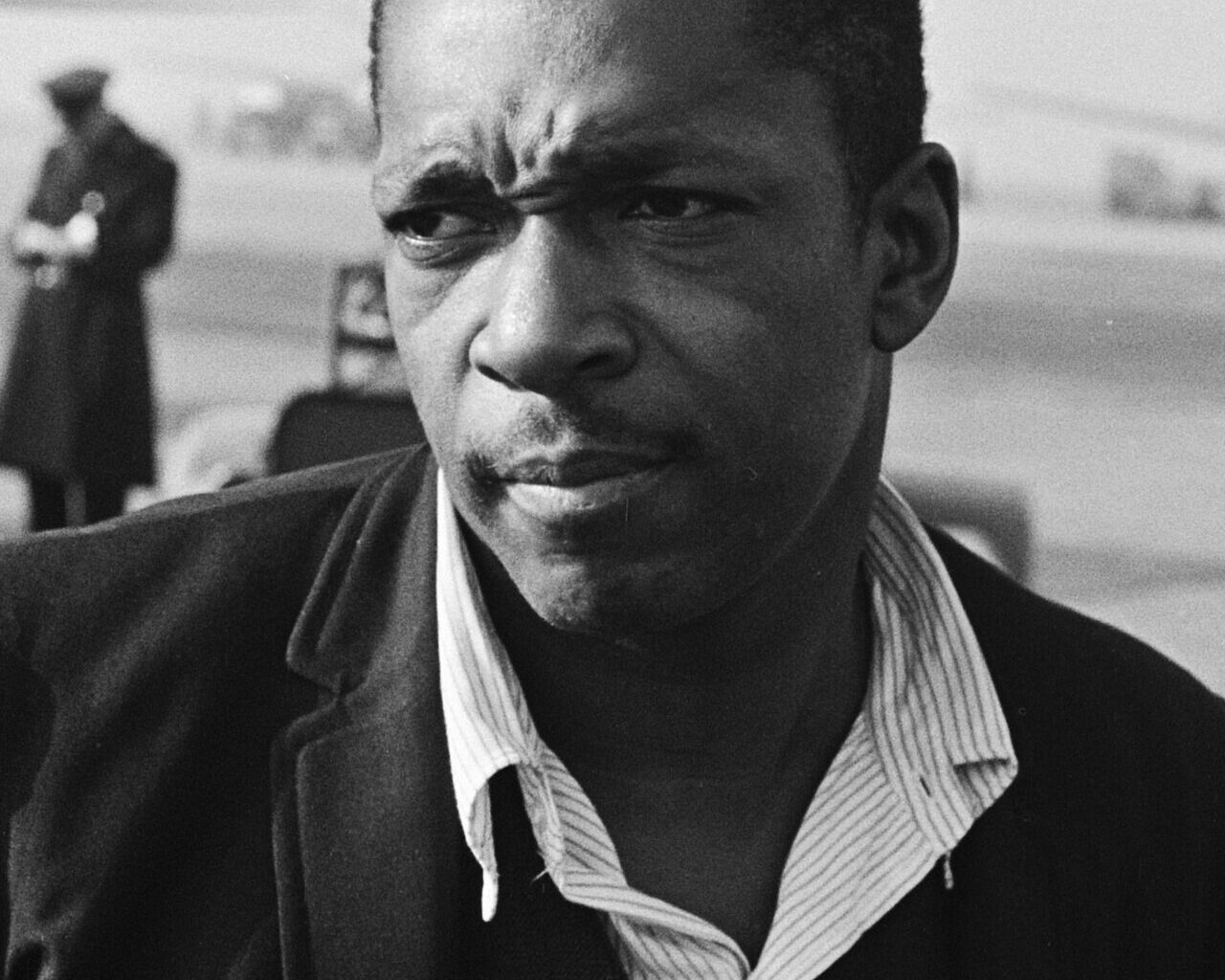
Ralph J. Gleason: ‘Cause you’re an explorer, this is obvious, right?
John Coltrane: … ! don’t know, man. I’d like to … at the moment, I don’t really know
– May, 1961 interview
John Coltrane had essentially left the Miles Davis Quintet in 1959, but Miles asked him to join him for the 1960 tour. The two were already in conflict. Although the same age (Miles was born four months earlier), the trumpeter always seemed the older man, more experienced, more mature, more organized, with a better sense of direction, while Coltrane seemed to have an adolescent confusion and willfulness—musically at least—that came out in his playing as fervor and a kind of forgetfulness, like he was always just about to run away from the context of what the band was playing.
The Final Tour, Bootleg Series, Volume 6, compilation shows this in vivid, even uncomfortable, detail. The Quintet swings into familiar material like “All of Me,” “So What,” and “All Blues,” Miles plays a sharp solo, and then Coltrane just goes off in what can seem like endless, rapid arpeggiated explorations of the chord changes, his “sheets of sound” style. Isolated from everything else, this is often exciting. But he wasn’t playing solo concerts, he was in a band, and what he plays has almost nothing to do with the point of everything else the Quintet is laying out. The rhythm section often seems to just be impatient, because Coltrane is so disconnected from the group context that there’s no way they can interact with him, and it doesn’t seem like he’s listening to anyone other than himself.
Those records are musically unsatisfying, but also deeply fascinating and historically important. They are the start of Coltrane’s 1960s, a decade in which he would be the dominant public figure in jazz while not seeing the end of it. He was a jazz star, and underneath and beyond this, what made him so compelling—and what remains his posthumous aura in the public consciousness—is that he was more than just a musician. He was a hero, and the sixties was his (unresolved) journey.
Coltrane wasn’t the first free jazz musician, and in an important sense he was never really a free jazz musician. His improvisations never left the idiom, and he never worked with absolute, indeterminate freedom. There is a common confusion that someone screaming through a saxophone is playing free, while Keith Jarrett using chords to build large scale forms over an hour is traditional—but Jarrett never had any prepared material nor even any ideas in mind when he would sit at the piano and start playing in front of an audience. Freedom isn’t a style, it’s a practice.
Coltrane was trying to break free, so he first presented a structure as a constructive antagonist. The Live Trane: The European Tours (Pablo) collection documents his quartet in 1961–1963 (Eric Dolphy joins on a few tracks). These are some of the best Coltrane recordings, the saxophonist pushing through standard language that comes out of harmonies and song forms. But he was always deeply embedded in harmony, working through chord changes and extensions and substitutions, still locked into vertical arrangements and tonal intervals. In a 1963 interview, Michel Delorme and Jean Clouzet of Jazz Hot magazine ask him, “After your ‘chordal’ and ‘modal’ phases, you said you wanted to go further. Where are you at with this now?” He answers: