
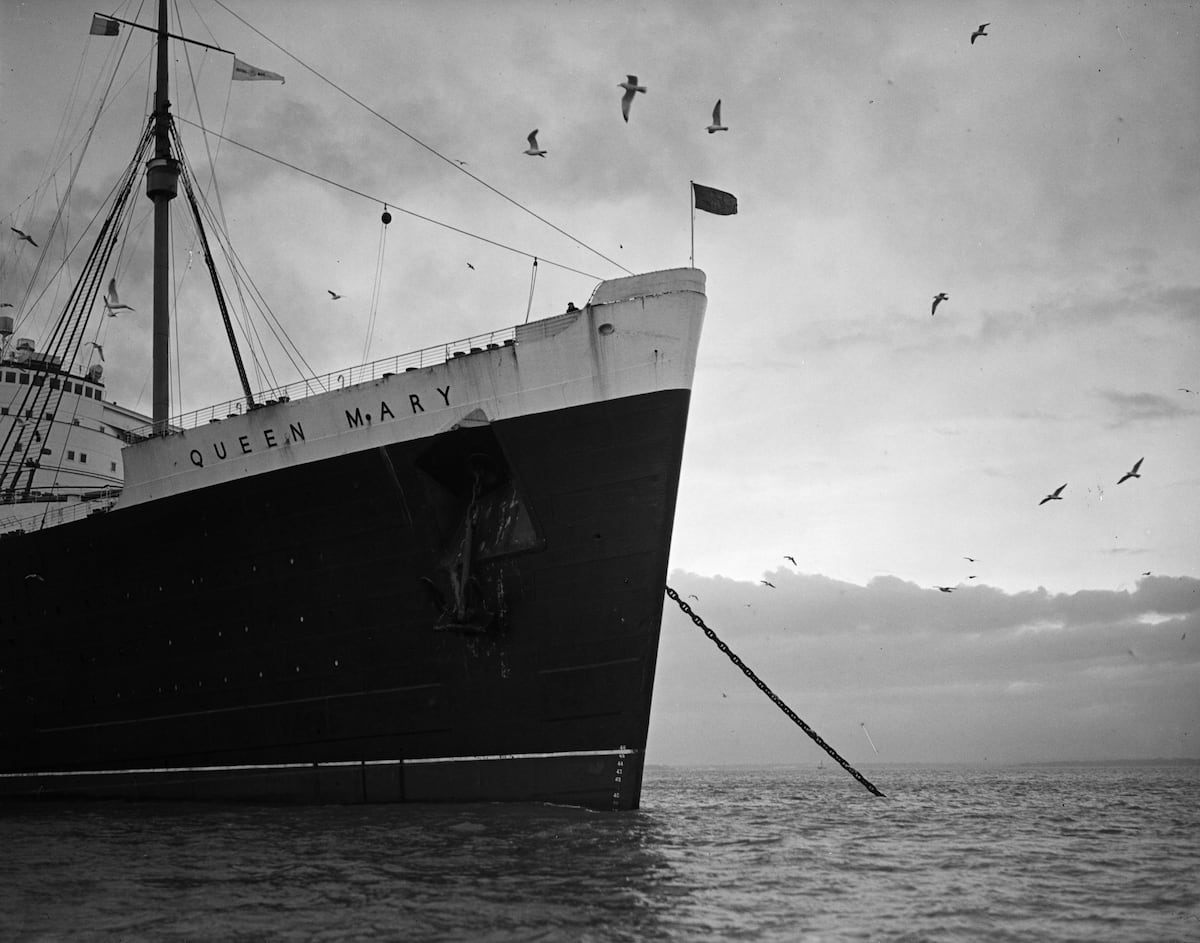
In 1937, the renowned 40-year-old American journalist Paul Gallico made the bold decision to stop writing sports news to reinvent himself and dedicate his life to what he loved: fiction. He had just divorced his second wife, and that year he began this uncertain new personal and professional chapter by indulging in the luxury of traveling first class on the RMS Queen Mary, the newly launched British ocean liner that, over the course of about four days, covered the route between New York and Southampton (in southern England) and vied for the title of the world’s fastest ship with the French SS Normandie. One morning, at breakfast, his destiny and that of the ship became permanently intertwined, far beyond the European port they were heading for.
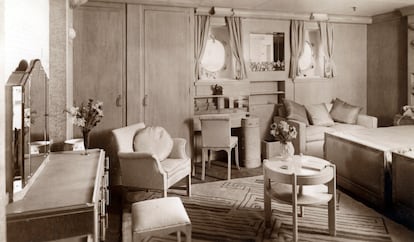 One of the cabins of the ‘Queen Mary’ ocean liner, inaugurated in 1936.Apic (Getty Images)
“To the musical sound of plates, knives, forks, and glasses clattering against the wooden stands at the edge of the tables was added the faint tinkling of ornaments as the large Christmas tree, planted in a tub filled with sand and firmly bolted to the dining room floor, began to lean dangerously. Listing much more than it had ever been before, the ship seemed suspended and gave the impression that it would never right itself.” Gallico didn’t write that paragraph in a memoir, but in one of the most celebrated novels of the disaster subgenre, The Poseidon Adventure (1969), made more popular by its 1972 film adaptation starring Gene Hackman and Ernest Borgnine; partly filmed, in fact, on the Queen Mary.
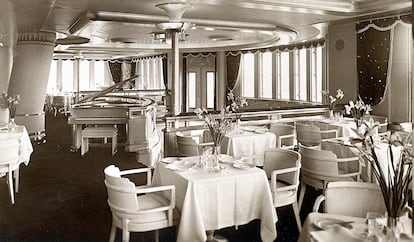 One of the dining rooms of the iconic ship.Apic (Getty Images)
The writer completed the voyage unharmed, but the powerful impression left on him by the heeling of the colossal ship — 310 meters long and weighing over 81,000 tons — as it was struck by a massive wave planted the seed of what would become the greatest success of his career. The discovery that, in 1942, while transporting Allied troops, a 28-meter wave tilted the ocean liner at a 52-degree angle (just three degrees from capsizing) further fueled his nightmares.
The story of the Queen Mary is astonishing enough without needing fanciful embellishments: this incredibly expensive jewel in the crown, born from the merger of the two rival British shipping companies, Cunard and White Star Line (the one that built the Titanic), with a generous government loan, boasted 12 decks, swimming pools, paddle tennis courts, nurseries, libraries, a monumental lounge, and capacity for over 2,000 passengers, along with another 1,000 crew members.
In 1941, its austere Art Deco ornamentation had to be removed and urgently replaced with bunks to transport between 10,000 and 15,000 soldiers per voyage during World War II. Along with its sister ship, the RMS Queen Elizabeth, Prime Minister Winston Churchill said that the two vessels had helped hasten the end of the war by at least a year. Adolf Hitler had offered $250,000 and the Iron Cross to whoever sank the Queen Mary, a symbol of hope and an exceptional asset to his enemies.
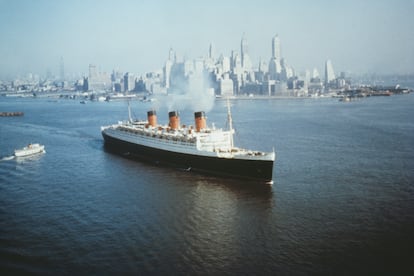 The RMS ‘Queen Mary’ ocean liner in New York in 1965.Harvey Meston (Getty Images)
Operational until 1967, when it was decommissioned following a drop in revenue after the golden age of ocean liners had ended, the legacy of the Queen Mary was far from over. “The ship today and its continued appeal owe a great deal to film and television. If it had ended up anywhere other than Southern California, it’s unlikely its star status would shine as brightly as it does now,” Jonathan Quayle, a maritime enthusiast specializing in the ship’s history, tells EL PAÍS.
Quayle gives talks about the Queen Mary and the Cunard fleet, collects ship artifacts and previously unseen photographs, and is a leading authority in his field. The U.S. city of Long Beach has been home to the ocean liner for almost 60 years, now without most of its machinery and adapted to house a restaurant, tourist attractions, and even a hotel. And, of course, film shoots.
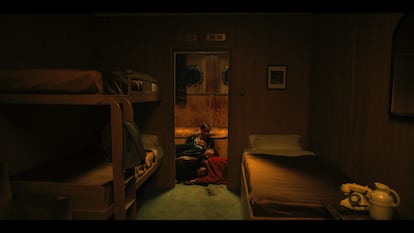 Queen Mary cabins.
“Being located just outside Hollywood, it was the natural choice when a crew needed a location for an episode of Murder, She Wrote [1984], Charlie’s Angels [1976], The X-Files [1993]… The list of productions filmed on board is enormous. The ship is unique; there’s nothing else like it in terms of size, both inside and out, making it an incredibly rare resource for the film industry. There’s nowhere else where you can rent a huge, three-story English ballroom, built in the 1930s and decorated with the finest woods,” Quayle explains.
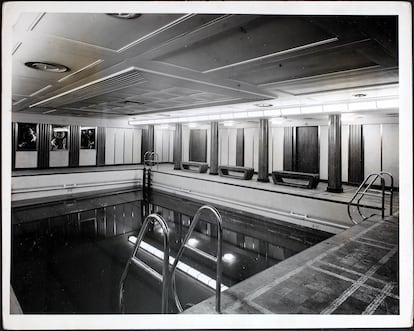 The tourist class swimming pool during the vessel’s final phase of construction in Scotland.Hulton Archive (Getty Images)
In the case of The Poseidon Adventure, only some parts were used, although the lounge where passengers and crew celebrated the fateful New Year’s Eve in the famous capsizing scene was a replica of the dining room of the Queen Mary, an exponent of the romanticism of glorious ships that the film sought to capture. Due to the complexity of the impressive special effects, the lounge was reconstructed in sections so that it could be rotated.
The ship has featured in many other on-screen moments. In Pearl Harbor (2001), the characters played by Ben Affleck and Kate Beckinsale culminated their first date with a kiss while hanging from a platform on the Queen Mary, even though, in the year in which the film is set — 1941, the year of the Japanese bombing of the U.S. base in Hawaii — the ship was neither there nor did it look that way: it had been painted gray to camouflage it, which led to it becoming popularly known as “the gray ghost.”
Martin Scorsese used it in The Aviator (2004). In Assault on a Queen (1966), Frank Sinatra led a gang of thieves who, taking advantage of the discovery of a sunken Nazi submarine, tried to sneak onto the ship (which, at the time, still had a year of service remaining) at sea to steal the contents of its safe. The British master of suspense, Alfred Hitchcock, also took the opportunity to pay homage to an emblem of his country, opening Dial M for Murder (1954) with the arrival of the conspiring husband aboard the ocean liner.
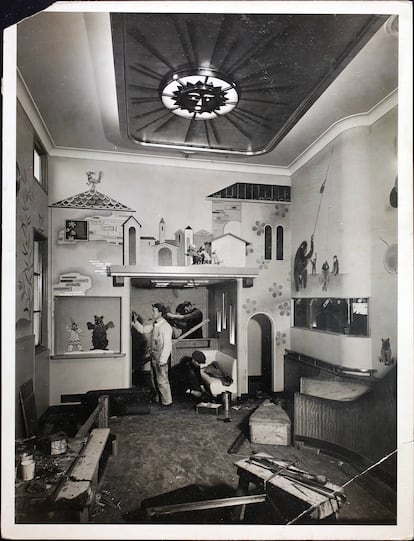 General view of the ocean liner’s nursery.Hulton Archive (Getty Images)
Not forgetting, of course, the episode of The X-Files referenced by Quayle, where Agent Mulder boards a ship lost in the Bermuda Triangle, which is none other than the Queen Mary — renamed Queen Anne — and travels back in time to the day the United Kingdom declared war on Germany.
For Quayle, the key lies in the “iconic status” that the Queen Mary has held since its troubled and protracted birth, marked by the ravages of the Great Depression, as it represents “what Great Britain could offer,” as well as a light at the end of the tunnel for the population after years of hardship. And, on the other hand, there are those “imposing and beautiful interiors” that The Poseidon Adventure revealed to later audiences, about which Quayle is preparing a book. “The ship’s interiors were pioneers of British design in the 1930s, but their place in that history has been largely forgotten,” he laments, “with specifically commissioned artworks, fixtures and decorative elements.”
Furnished primarily by the Bromsgrove Guild, the Queen Mary featured exclusive pieces by artists such as Edward Wadsworth and the landscape painter Algernon Newton. Woods from various colonies of the then-British Empire were used, while the first-class dining room was dominated by a gigantic map depicting its transatlantic voyage, complete with a small motorized model of the ship to mark its position along the route.
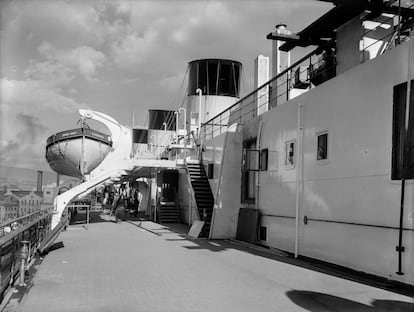 The promenade deck on board the ‘Queen Mary’ in 1936.Fox Photos (Getty Images)The mystery ship
The map of the grand dining room plays a significant role in La maldición del Queen Mary (in English, The Curse of the Queen Mary), a horror film released this year in Spain via Amazon Prime Video. A change in the model indicates that, as in the episode of The X-Files, a time jump has occurred, leading a married couple of audiovisual creatives in crisis to become entangled with a gruesome parricide committed aboard the ship (with no known basis).
The film, with a touch of self-aware humor, satirizes the carnival sideshow status the ship has acquired in recent decades, particularly for horror fans. Filmed on board, it’s not the only B-movie production to become associated with the once-luxurious vessel. Two terrible exploitation films by the shameless production company The Asylum, Titanic 2 (2010) and Titanic 666 (2022), have also been released using the sets of the Queen Mary.
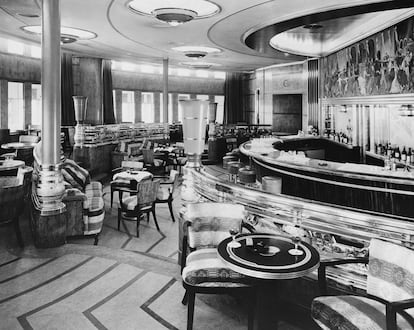 The vessel’s cocktail bar.Hulton Deutsch (Corbis via Getty Images)
It seems to have become what it is in popular culture: a haunted mansion on the water. The culmination of years of legends and ghost stories that have surrounded the ship since it ran aground in Long Beach, to the point of making it a place of pilgrimage for followers of the supernatural, which, in the eyes of its owners, is a serious commercial goldmine.
Quayle admits to having a complicated relationship with it. “While I have no problem with these events, or with the revenue they generate when it is reinvested in the ship’s upkeep, I don’t like that half of the facilities are inaccessible due to shows that could be located anywhere on the property, nor that historic spaces that could otherwise be restored, opened up, and enjoyed are kept untouched,” he says, referring to horror tours, mazes, and other attractions whose appeal lies in the fact that they take place in normally unusable areas of the ship, which are deliberately kept in their original state to give the impression that the visitor is walking through eerie ruins.
Quayle recalls that this transformation of the Queen Mary into a supposedly haunted enclave took place under Disney, when the company briefly owned it in the 1980s. With an eye toward developing a future DisneySea theme park (which it would eventually build in Tokyo in 2001), Disney created a Ghosts & Legends tour.
“Before, nothing related to ghosts or demons was mentioned in the promotion,” says Quayle. “Disney, with its magic wand, took elements of history and exploited them to create macabre tales that had no connection to events, purely for entertainment. It was in poor taste, as the ship had decades of incredible stories to share, and Disney didn’t need to invent things or embellish the truth. For better or worse, it was a resounding success.”
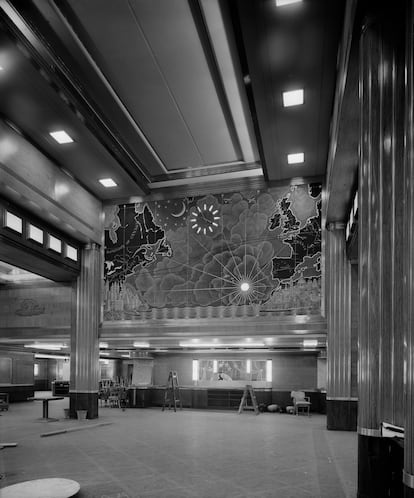 The enormous mural map, designed by Macdonald Gill, located in the first-class dining room.Fox Photos (Getty Images)
Rumors have been circulating ever since: accounts of German or Italian prisoners who died there, of the souls of the HMS Curacoa (which the Queen Mary sank in an accident) wandering the corridors, of children’s voices heard in the old nurseries… The official website offers up to three different paranormal activities, as well as a form for tourists to submit their video or audio recordings of unexplained experiences recorded on board.
Quayle, who insists he is not opposed to this type of entertainment, despite calling it “poisoned candy,” now hopes that, with the ship’s return to the control of the city of Long Beach for the first time in 40 years, the general approach will change. Steps are being taken in that direction, further encouraged by recognitions such as the Queen Mary’s designation as one of America’s Historic Hotels. “Those in charge seem to appreciate that the ship is more than just a handful of stories. Its history of war and peace far surpasses any macabre spectacle.”
Sign up for our weekly newsletter to get more English-language news coverage from EL PAÍS USA Edition