
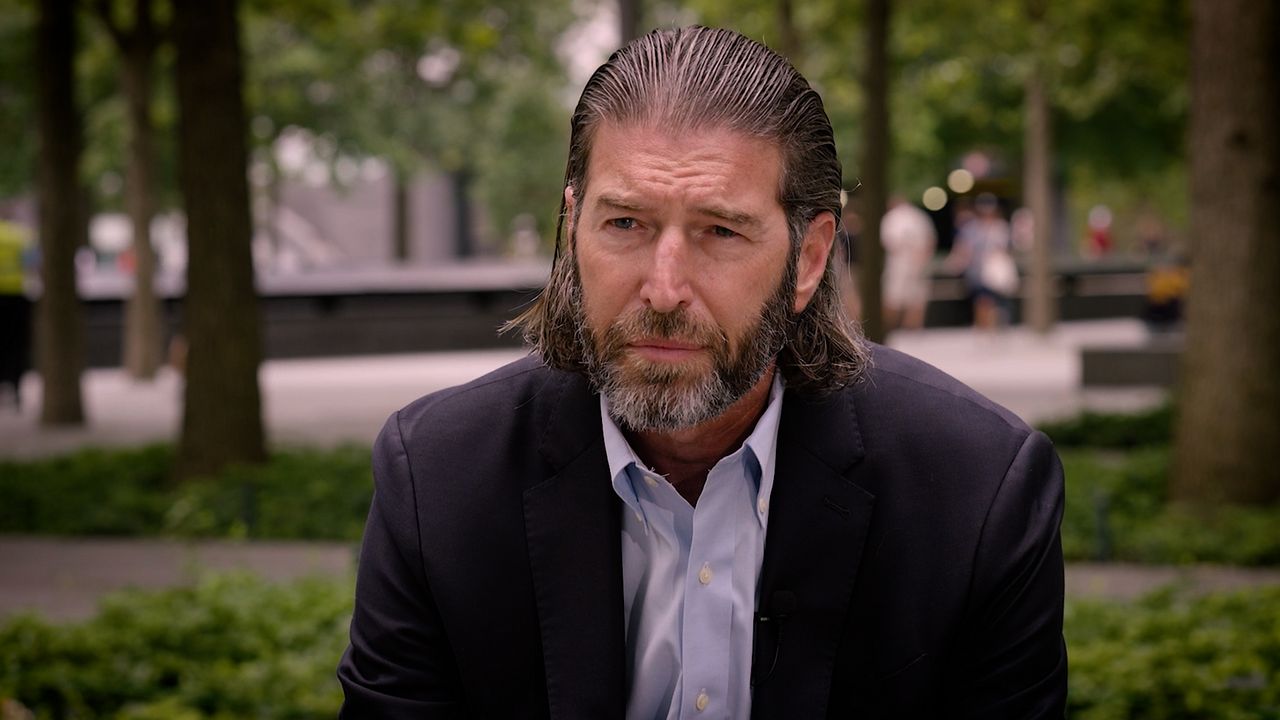
Michael Arad went up to the rooftop of his East Village apartment building to see what had happened for himself.
He’d heard on the radio that a plane had hit the north tower of the World Trade Center.
That’s when he said he saw United Airlines 175 come down the Hudson River, turn around and ram into the south tower of the World Trade Center.
“It’s a sight seared in my memory,” he said.
He got on his bike and rushed downtown because his wife worked blocks away from the World Trade Center, and he couldn’t reach her by phone.
“You could see the people down on First Avenue walking, completely oblivious to what had just happened. And then like for a second, you almost wish you didn’t know what just happened,” he said.
He was able to find her outside her building, both towers still burning. By the time they got back home, both towers had collapsed.
“It was a completely different world,” he said.
Arad said he had trouble sleeping in the days after, so he would walk around the city. That’s when he stumbled upon a vigil at Washington Square Park.
“There’s no ceremony, there’s no speech. There was just people standing together,” he said.
Arad, who had moved from Israel just a few years before, said the moment left a permanent mark on him: the moment he felt he became a New Yorker.
“I think that was the sort of quiet and stoic determination,” he said. “There was compassion and a sense of loss.”
Arad was working as an architect for Kohn Pederson Fox at that time. He started sketching what he believed would be a place in lower Manhattan for New Yorkers to gather, just as he had in Washington Square Park.
“New York City provided us with a place to come together and respond, as a community,” he said. “And that’s really what I wanted to create here.”
His first design, which he kept, included two distinct reflecting pools, surrounded by green space.
“One of the reasons I was drawn to water here is because I feel that, in a way, it marks the passage of time and this emptiness remains so present,” he told NY1.
“The water flows into these voids, but it will never fill them up.”
He had already created an initial mock-up when the Lower Manhattan Development Corporation announced the design competition for the memorial at the World Trade Center site.
Out of the more than 5,000 submissions, the LMDC selected Arad’s design in 2004.
What followed was an eight-year journey to make it a reality — one that Arad said at times didn’t even seem possible.
“We share this site with many other parties. This might be the floor of the Memorial Plaza, but it’s also the ceiling of the chiller plant that the Port Authority is operating,” he said.
He said there were fights over inches on the memorial’s height and whether certain columns were necessary.
“We shared a lot of infrastructure and structure and utilities, and figuring out how to not just pay for it all, but share those costs was a major struggle,” he said.
He said, looking back on it, he learned the fights about specific parts of the design were less important, if the central ideas to the memorial remained.
One example, he said, was the decision to bring the names of the victims from the base of the waterfalls to the top, overlooking the reflecting pools.
“It’s a big change from a design standpoint, but I think it is not a change from, you know, fulfilling the mission,” he said, thinking about that debate when he was a young designer.
From 2004 to 2006, fundraising was another problem, with money drying up, Arad said. At the same time, costs for the project were only rising, according to media reports.
Part of that had to do with what he said was understandable frustration from the families of the victims.
They considered listing the victims alphabetically, which would bring some family members together. But it would separate family members who did not share a last name. Further complicating that possibility, what to do about people with the same names.
“There are three Michael Lynches whose names are inscribed on this memorial,” Arad said. “If we were just to write Michael Lynch, Michael Lynch, Michael Lynch, how would you know which name belonged to which person?”
The working assumption for a couple years, as a result, was that the names would be randomly placed.
“The families were so upset about that, rightly so,” Arad said.
Eventually, Arad said the team decided to have the names arranged in a way called meaningful adjacency, so people could request their loved one to be named next to someone else.
“And by reaching out to all the families, we got, actually, 1,200 requests. Can you put this name next to that name? They might have been friends,” Arad said. “They might have been colleagues. They might have gone to the same college. They might be siblings or a father and son. I mean, there are all sorts of incredible relationships that have been woven into this, invisible tapestry that connects all of the names.”
Ten years after the terrorist attacks, the memorial opened, a moment that Arad said he personally felt uncomfortable attending. But his feelings were different when it came to seeing everyone who came.
“It felt really gratifying to see families and friends gather here on this plaza for the first time for that memorial ceremony,” he said.
Now, the memorial has thousands of visitors every day from all over the world.
“I think the reason people are drawn here is to express our shared humanity that, you know, you look at these names that you might not know these people, but you’re looking at close to 3,000 names,” Arad said. “And you understand, I think, this loss.”