
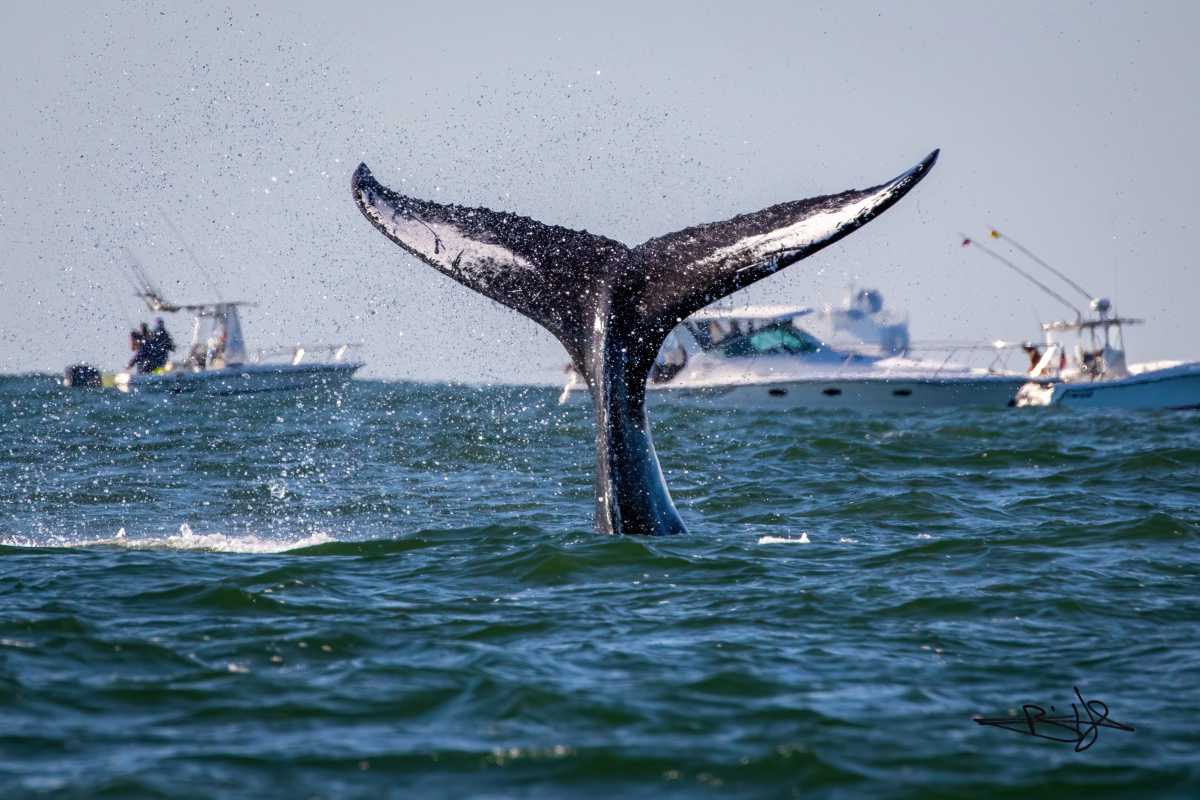
Whales have made a remarkable comeback off New York City’s coastline. In July, Staten Island-based nonprofit Gotham Whale documented the 500th individual humpback whale in the waters surrounding New York City, marking a significant milestone in whale sightings for the region.
Each whale sighting is registered in the New York City Humpback Whale Catalog (NYCHWC), and Gotham Whale has recorded 80 to 100 individual whales each year since 2018. Prior to 2018, the organization cataloged just 10 to 30 humpback whales each year.
The organization, which focuses on marine mammal research, education and advocacy in New York, collects data through partnerships with local whale-watching companies, such as the American Princess, as well as through sighting submissions from the general public. Its communications and outreach director, Chris St. Lawrence, told Brooklyn Paper that the organization maintains the largest marine mammal sightings database for the New York City region. Researchers identify individual whales by their fluke prints.
“We’re able to tell the whales apart using the patterns on the underside of their tail, known as the fluke prints, just like humans have their own fingerprint; every whale’s got their own fluke print,” St. Lawrence explained. “We don’t always see the tail; we might only see the dorsal fin — that’s the fin on the back of the body — but those are also unique as well. They have unique shapes, scratches, markings and colorations. And so, if we don’t always get that tail, we’re able to use the dorsal fin. But the tail is a little more reliable.”
The Port of New York-New Jersey is also the busiest port in the nation, and commercial vessels and increased recreational boating pose a significant threat to whales and are a leading cause of injury and death for many whale species. Many whales in the NYCHWC have propeller injuries from vessel interactions or have been victims of ship strikes. According to the National Oceanic and Atmospheric Administration (NOAA), about 40% of humpback whales have died from either vessel strikes or fishing entanglements. New York ranks among the top states for whale mortality caused by vessel strikes. Between December 2023 and February 2024, 12 whales washed up dead in waters off New York or New Jersey.
“A lot of whales in our catalog actually have evidence of interactions with vessels. A number of them are likely from smaller vessels,” St. Lawrence said. “We don’t have an exact number, but it’s probably around 20% of our catalog that actually shows evidence of things like propeller scars. So those would be the chop marks from propellers when they actually run over a whale.”
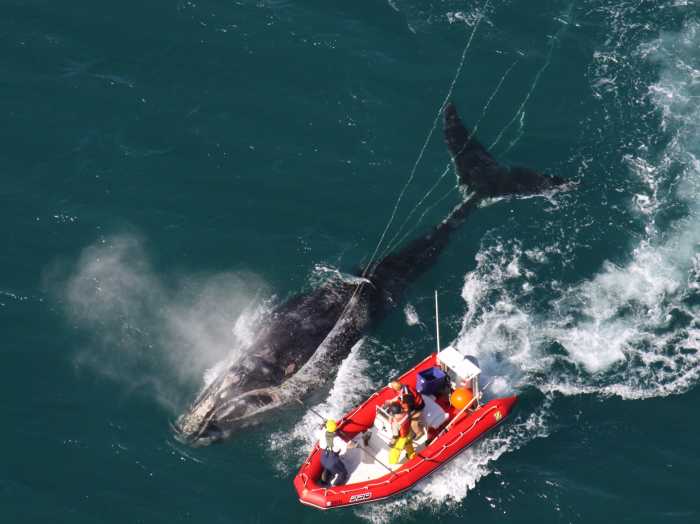 A NOAA team attempts to disentangle a North Atlantic right whale.Photo courtesy of NOAA
 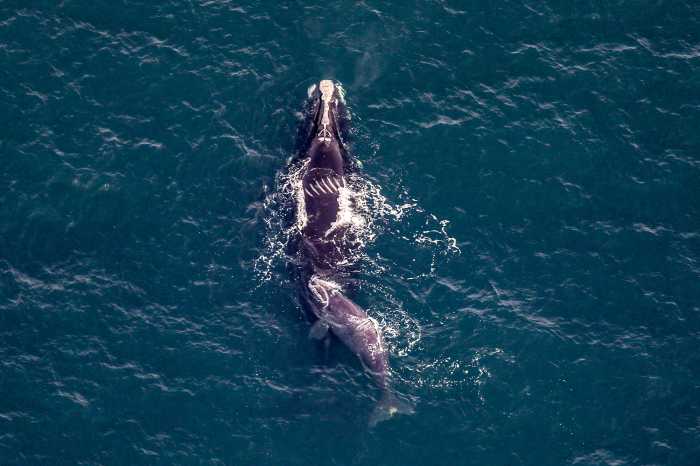 A North Atlantic right whale with calf shows propeller scars.Photo courtesy of NOAA Northeast Fisheries Science Center
In order to reduce marine mammal interactions and prevent vessel strikes, Gov. Kathy Hochul signed the New York Whale Awareness Act (A.8515A/S.2292B) into law on Aug. 1. The law integrates whale-safe boating education into existing state boater safety courses and vessel registration processes, equipping boaters with standard best practices and collision-prevention techniques.
The initiative aims to encourage safer navigation habits and prevent accidental injuries and deaths among local marine life, including humpback whales and the critically endangered North Atlantic right whale.
“New York’s ocean waters are cleaner and more vibrant than they have been in decades, drawing extraordinary marine life back to our shores,” Hochul said. “However, a higher concentration of whales navigating one of the busiest regions in the country creates serious risks for both boaters and marine mammal populations. The New York Whale Awareness Act ensures that everyone enjoying our state’s waterways has the tools and knowledge needed to navigate safely, avoid dangerous collisions and protect these special creatures.”
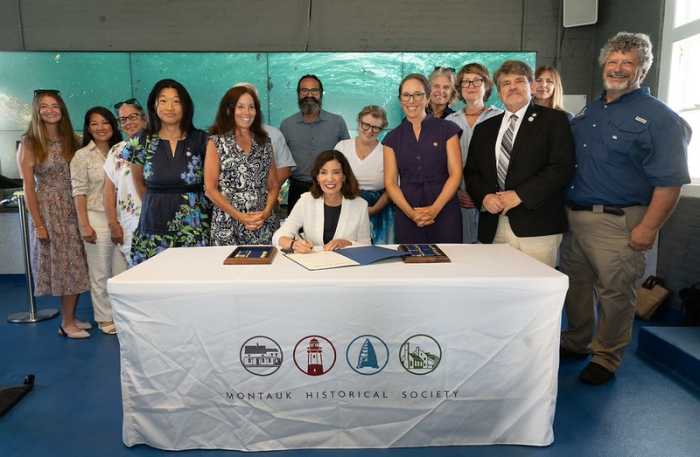 Gov. Hochul signed the New York Whale Awareness Act to protect marine mammals and enhance boater safety on Aug. 7.Photo courtesy of Gov. Hochul’s office
The legislation integrates whale-safe boating education directly into vessel registration processes and existing state boater safety courses, such as “Eyes On The Water: Boating with Whales,” a free course developed by the Nature Conservancy and its partners to protect boaters and marine life. The course equips boaters with standard best practices and collision-prevention techniques and aims to encourage safer navigation habits and prevent accidental injuries and deaths among local marine life, including humpback whales and the critically endangered North Atlantic right whale.
Carl LoBue, the ocean and fisheries director for the Nature Conservancy in New York, credits legislation such as the Marine Mammal Protection Act and the Endangered Species Act with helping bring marine mammals back to New York’s shores. Additionally, because of fishing restrictions, schools of Atlantic menhaden, marine wildlife’s favorite food, are surging in local coastal waters, attracting whales, dolphins and even bluefin tuna.
LoBue noted that vessel strikes are one of the leading causes of whale mortalities, with entanglement in commercial fishing gear being the second. While the New York Boating Safety Certificate, implemented in 2025, covers foundational maritime skills, state laws and emergency protocols, it doesn’t address how to identify when whales might be in the area or how to boat safely around them, he explained.
“What the Well Awareness Act does, it does a couple of things. One, it requires that that curriculum be included in the much larger boating safety class. It also charges the Department of Motor Vehicles to send out information when people get their boats registered, and they live in the Marine District of New York,” LoBoe explained. “They’ll get some information about safe boating with whales, and it requires DEC to put some information up on their website.”
For St. Lawrence, the New York Whale Awareness Act is an important step toward protecting whales and boaters in New York waters. He noted that, particularly during fall migration, whales sometimes swim right up to the beach, feeding on fish that also attract striped bass, which fishermen are in turn looking for.
“It can create quite literally a traffic jam, just a bunch of boats all in one place with whales swimming up in between them, and those are the kinds of places where situations can get a little bit more dangerous for boaters and whales,” St. Lawrence explained.
With more whales returning to New York’s waters, he said educating boaters about how to safely share the water with them will become increasingly important.
“A lot of fishermen and boaters might not know that they should keep a minimum distance from a whale. They might think that they might be able to swim out of the way, but we want to make sure that everybody has all of the necessary information to keep themselves safe and to keep these whales safe, because you know we have been documenting an increase of these animals in our waters, and if that continues, this is going to become an even bigger issue that we need to tackle.”