
by Michelle Mullen
The United Federation of Teachers challenged Mayor Zohran Mamdani’s lawsuit against the city council over its move to award $10,000 payments to paraprofessionals, who remain among the lowest-paid employees in the nation’s largest public school system.
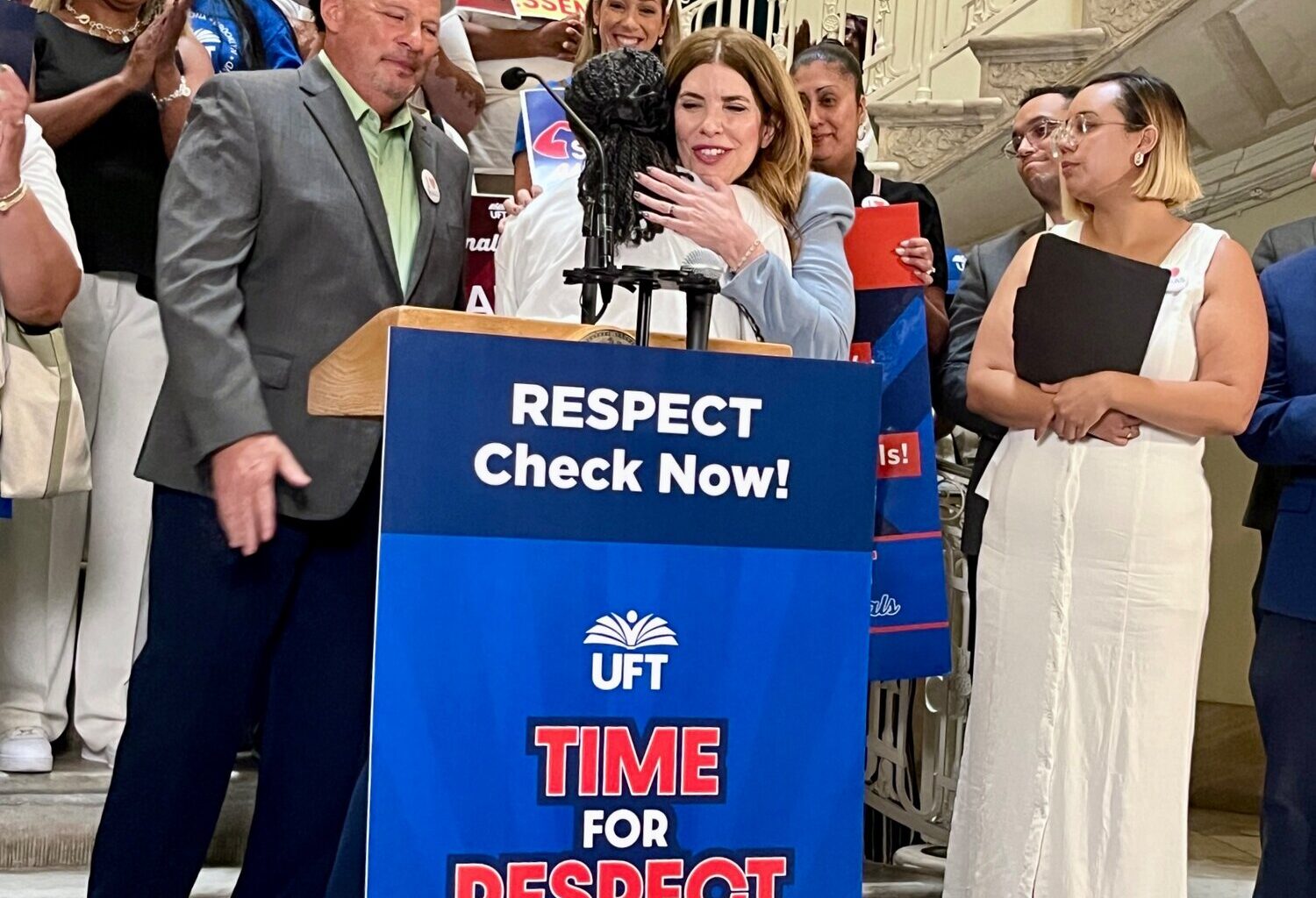
The union filed a motion Aug. 25 seeking to intervene in the case and defend the RESPECT Check Act, which would provide roughly 26,000 New York City paraprofessionals with a one-time payment during the 2026-27 school year, including workers in Bronx School District 10, which includes greater Riverdale. The filing came six days after the Mamdani administration sued the city council in an effort to have the law struck down.
Although Mamdani shared support for a previous version of the bill as a mayoral candidate, his administration is questioning whether the council can authorize temporary payments to paraprofessionals, and argues that doing so intrudes on matters reserved for collective bargaining.
For paraprofessionals and students, however, long-standing concerns over low wages and staff retention, as well as the ability of schools to provide adequate support for students with disabilities, remain the central concerns.
John Perez, 46, an educational paraprofessional in Bronx School District 10, has spent nearly half his life working with the New York City Department of Education. Even after two decades, he said, his salary remains in the $40,000 range.
“I cannot fail these students,” Perez said. “I cannot put these students on the back burner because the city of New York decides, ‘Oh, you know what, you guys aren’t gonna get paid a little bit more.’”
Perez, like other paraprofessionals who spoke with The Press, has to work multiple jobs to make ends meet, taking on after-school work and driving for Uber to supplement his income.
His school day starts before 8 a.m., when he meets his assigned student in the cafeteria. Throughout the day, Perez works alongside the student, breaking down lessons, clarifying instructions and adapting material to the student’s pace. He entered the profession thinking it might be a stepping stone toward becoming a teacher, but the one-on-one relationships he formed with students convinced him to stay.
“But people leave, and people don’t want the job because by the time you make it up the pay scale, it’s not enough,” Perez said.
The RESPECT Check Act passed the city council unanimously July 16 and became law Aug. 19 after Mamdani declined to sign or veto it. His administration filed the suit that same day, arguing the measure is pre-empted by the Taylor Law, the state statute governing collective bargaining for public employees.
The roughly $325 million program would distribute payments of up to $10,000 to paraprofessionals during the 2026-27 school year. It would end after the final installment in August 2027, or earlier if a collective bargaining agreement provides paraprofessionals with an increase in compensation at least equal to the stabilization payment.
Perez said he viewed the $10,000 as meaningful relief for workers balancing housing, food, child care and other expenses. Mamdani’s decision to challenge it was particularly frustrating, he said, because the mayor had supported that kind of aid as a candidate.
Although Mamdani backed the RESPECT Check Act on the campaign trail, the proposal he backed called for annual payments to paraprofessionals, rather than the one-time payment included in the law that ultimately passed.
“At the end of the day, he’s the mayor,” Hernandez said. “We voted him in. He’s accountable. We’re going to hold him accountable. He made the promise to us. He made it to us publicly.”
Council member Eric Dinowitz, chair of the city council’s education committee and a former special education teacher, similarly pointed to Mamdani’s campaign position. Dinowitz spent nearly 14 years working alongside paraprofessionals and said inadequate compensation has contributed to vacancies while students with disabilities remain dependent on the services those workers provide.
“This is about an emergency stabilization fund to ensure we’re not losing even more paraprofessionals,” he said. “Our students, our teachers need our paraprofessionals.”
Kathryn Kearns sees that dependence both professionally and as a parent. Both of the Riverdale resident’s children are on the autism spectrum, and Kearns works in special education as a behavior analyst for the department of education.
Kearns works with educators in the city’s Acquisition, Integrated Services, Meaningful Communication, and Social Skills, or AIMS, program, a specialized public school initiative that gives kindergarten through second grade students with moderate to severe autism a setting where they can learn and receive more intensive support.
Paraprofessionals are embedded in that work, Kearns said. In AIMS classrooms, they can lead small-group instruction, work with students on communication and visual perception skills, collect data on their progress and communicate observations back to teachers.
“I think that there’s this misconception that paraprofessionals are like glorified babysitters, or that they’ll just sit next to the kid with severe behaviors and, you know, be their buddy,” Kearns said. “I’ve never witnessed that.”
Staffing levels in programs, she said, can also quickly change how much individual attention students receive.
Kearns also pointed to burnout. Like employees in any profession, paraprofessionals benefit from clear expectations and recognition when they are doing demanding work well, she said. Without them, she said, “the whole puzzle isn’t complete.”
The Mamdani administration maintained that its lawsuit is intended to protect collective bargaining rather than prevent paraprofessionals from receiving higher compensation.
Matt Rauschenbach, a spokesperson for the mayor’s office, acknowledged that paraprofessionals have long been inadequately compensated and said the administration is in discussions with the United Federation of Teachers about a permanent solution. But the administration argued that allowing lawmakers to determine compensation outside the bargaining process could undermine unions’ authority.
“A one-time payment does not solve the underlying, long-term pay inequities facing paraprofessionals,” Rauschenbach said. “We will not allow the political process to replace the collective bargaining table.”
The federation, however, is seeking to join the case on the side defending the payment. In its Aug. 25 motion, the union said it wants to “protect the interests of the paraprofessionals who stand to benefit from the workforce stabilization payment” and rebut the administration’s contention that the Taylor Law prohibits the city council from providing it.
The department of education did not respond to a request for comment by press time.
Keywords
United Federation of Teachers,
UFT,
Mayor Zohran Mamdani,
paraprofessionals,
$10,
000 paraprofessional payment,
RESPECT Check Act,
NYC public schools,
New York City Department of Education,
Bronx School District 10,
greater Riverdale,
Eric Dinowitz,
Taylor Law,
collective bargaining,
special education,
students with disabilities,
paraprofessional pay,
school staffing,
teacher support,
educational paraprofessionals,
Kathryn Kearns,
John Perez