
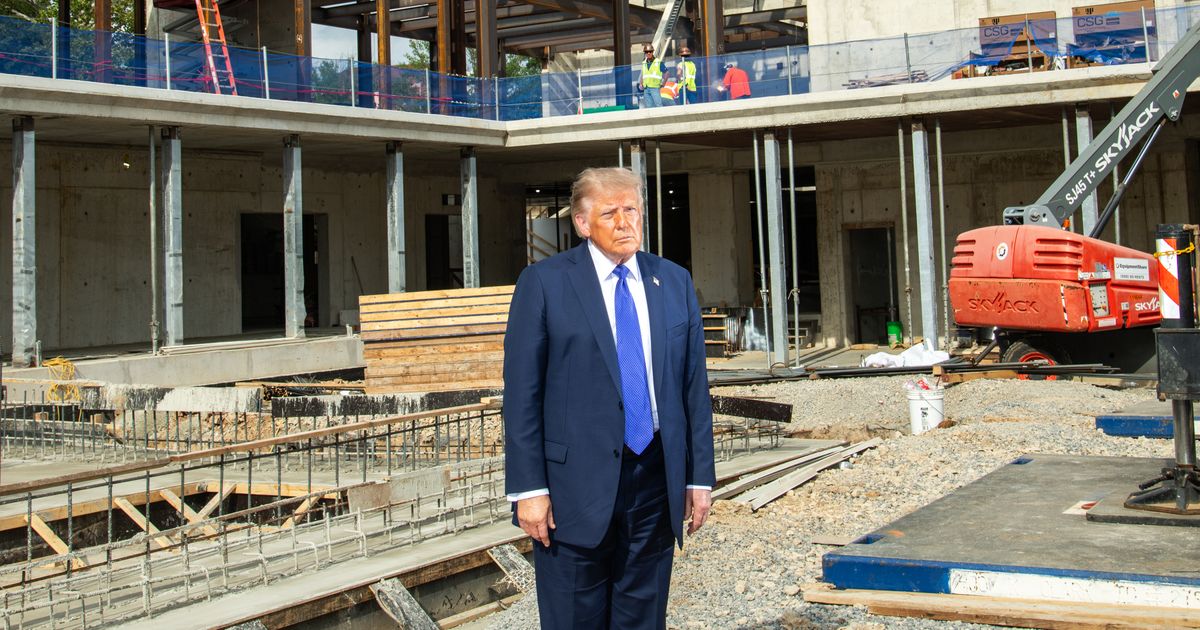
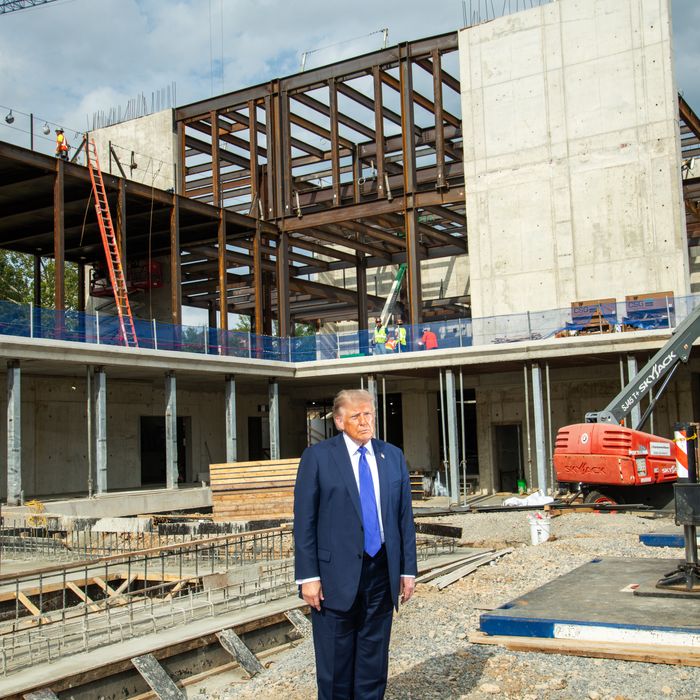
At the ballroom construction site on August 26.
Photo: Brian Finke for New York Magazine
These are Corinthian columns,” President Donald Trump tells me as he sits behind the Resolute Desk in the Oval Office in late August, a stack of printed renderings spread before him. The images show aspects of the ballroom he is building on the site of the now-demolished East Wing of the White House. “That’s your highest level,” he continues. “There are levels of columns: Corinthian, Doric. And to be honest with you, the White House should have used Corinthian. It’s a luxury house, a house of luxury, and they used Doric, which is not as nice. Maybe I’ll fix that, too.”
The White House exterior actually has Ionic columns, but the extent of the president’s architectural ambitions is clear enough. The ballroom is set to be a gold-adorned Roman temple of a building with 40-foot ceilings and 22,000 square feet of space, big enough to hold around a thousand guests. (The structure overall will occupy some 90,000 square feet, nearly twice the size of the main White House building.) The printouts include close-up shots of the ornate carvings — dense layers of leaves guarded by two open-mouthed lions — meant to top the building’s formidable colonnade. Trump says the ballroom shares design aspects with the Palace of Versailles but is in many ways going to be “more beautiful.”
He tells me that advancements have made concrete stronger than ever (“There’s probably no material where there’s been more progress made than good old concrete”), that he is using the best marble in the world for the ballroom’s floor (“I know more about stone than anybody imaginable”), and that the portico will have columns four rows deep (“The Supreme Court is three deep. No other building has it, and I did it because it’s incredible”). He smiles, gazing dreamily into the distance as he describes the cocktail parties and conferences that could soon be held in the ballroom, where no one will have to worry about security. “If you’re making a speech and bullets start getting aimed at the windows, all you’ll hear is ‘ping ping ping,’” he says. “I would suggest you probably stop the speech, but you actually wouldn’t have to, if you want to know the truth.”
There is nothing Trump enjoys more than talking construction — a topic that has defined his second term in office. In less than two years, Trump has nearly finished a new White House helipad, turned the Rose Garden into a sculpture-laden patio, regilded statues standing sentry on the Arlington Memorial Bridge, added his name to the Kennedy Center, and battled with imagined vandals and actual algae blooms in a disastrous attempt to refurbish the Reflecting Pool on the National Mall. He has plans to turn a federally owned public golf course into a championship-caliber destination and to build an arch — a Trump-size version of the Arc de Triomphe — near Arlington National Cemetery. Since Trump’s return to the White House, his administration has made changes to more than 100 structures in Washington, D.C. The total price tag: somewhere north of a billion dollars. The biggest project, in terms of both cost (estimated to be $800 million when done) and presidential mindshare, is the ballroom and the military bunker that will be tucked underneath.
Trump hopes it will one day bear his name. “It should,” he says. “I don’t know if it will, but it should.” In the meantime, the project has become entangled in questions that range far beyond architecture. Construction has been tied up in legal battles that have reached the Supreme Court. Donors are fretting about whether they could be called in front of congressional panels should Democrats win majorities in the House and Senate in the midterms. And Trump’s record may ultimately be judged by what he has demolished and what he leaves standing in its place. A senior White House official tells me Trump views all this building as part of his legacy. “His rush to get it done in this term is so important because it’s something the Democrats would have a hard time taking away or getting rid of,” he says. “When the ballroom is built, everyone will always know in perpetuity that it was built by Donald Trump. Are Democrats going to come in and rip it down? I have a hard time believing that.”
“I don’t think they could, physically,” Trump says. “It’s made with the most powerful steel welded together and concrete that is so hard and so strong it’s used in nuclear-power plants. You could take a jackhammer and go to those columns and stand there for two days at full blast and you wouldn’t even see a mark. It’s nuclear concrete. I think it would be very hard. It’s meant for if there’s a nuclear attack. I’m not sure you could take it down.”
It can feel as if the 80-year-old president has become obsessed with building something that will outlast him — a literal cementing of his place in history. For opponents, the ballroom threatens to permanently taint the White House with Trump’s petty despotism, spoiling the austere façade that is meant to be a democratic rebuttal to the gaudy trappings of Versailles and other monarchical displays of power. It is also a test of whether anyone — Congress, the courts, the opposition party — can stop a president who has become even more unbound in his second term.
Jon Ossoff, the Democratic senator from Georgia who is considered a potential presidential candidate, made headlines earlier this year for positing that Trump is building monuments to himself because he knows no one else will do it once he’s gone. When I put that idea to Trump, he does not dispute it.
“That’s true,” Trump says. “Nobody will do it once I’m gone. When I leave here, nobody will.”
Trump peers out the window of the Oval Office overlooking the Rose Garden, behind which two enormous cranes rise high above the ballroom construction site. “If you want,” he says, “I’ll take you over there.”
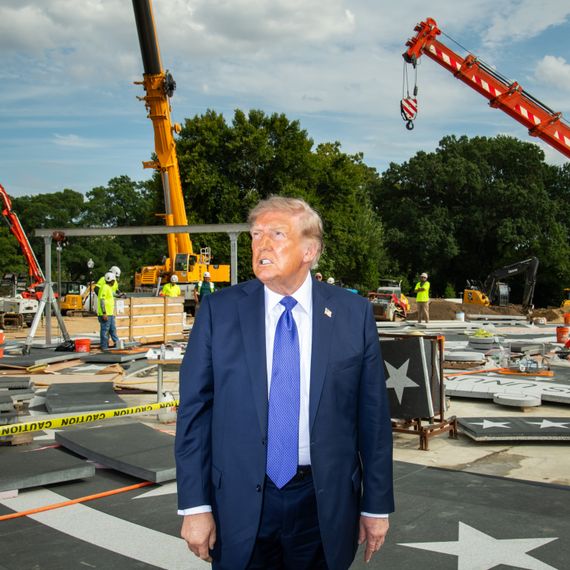
The helipad had to be redone after the original was deemed too slanty.
Photo: Brian Finke for New York Magazine
In the spring of 2010, David Axelrod, then the senior adviser to President Barack Obama, got a call from Trump. “I build ballrooms,” Axelrod recalls Trump telling him. “I build the greatest ballrooms in the world — come down to Florida and see for yourself. You have these state dinners, and you have them in these shitty little tents in the back. It’s not befitting. Let me build a modular ballroom for you. You can put it together, take it apart.” The idea struck Axelrod as preposterous. “We were just coming out of the worst recession since the Great Depression, and I’m pretty sure no one in America thinks our priority should be a ballroom for the White House,” he tells me. Still, he passed on the message to the White House social secretary, believing that someone would get in touch with Trump. For whatever reason, no one called Trump back. “He was owed a call,” Axelrod says. “I have no excuse for that.”
Fifteen years later, Axelrod has occasionally wondered whether history might have gone differently had they humored him. Would a few shoulder-to-shoulder photographs at a groundbreaking ceremony have been enough to prevent Trump from spearheading the birther movement and descending the golden escalator in 2015? Axelrod thinks not, but there is one counterfactual he entertains: “If we had let him build his modular ballroom, perhaps we wouldn’t have had to demolish the East Wing. And in that sense, I kind of regret not doing it.”
Trump tells me he holds no grudge about the matter but says he learned something about the Obama administration. “They’re not good businesspeople,” he says. “If somebody offers you a free ballroom, take it, right?” If Obama’s aides forgot about Trump’s proposal, he did not. By January 2016, he had incorporated it into his presidential campaign. In Sioux City, during a campaign event before the Iowa caucuses, Trump explained what his administration would bring to Washington. “We’ll get the top people, top everything — we’ll have the best ballroom,” he said. “Because I notice they always put tents up on the lawn. No. 1, it’s not a good security thing. No. 2, the guy that owns the tents is making a fortune.”
Trump says during his first term, he learned just how badly the White House needed a ballroom. It was embarrassing, he says, to bring foreign dignitaries over, but the timing never felt quite right to undertake a construction project. “In the first term, I was under siege,” he tells me. “I didn’t feel it was the atmosphere.” Now, he says, “is a much more powerful time.”
The first step — raising money — proved incredibly easy. Millions poured in from Apple, Amazon, Google, Meta, Lockheed Martin, Coinbase, Microsoft, and Comcast, to name just a few. The Winklevoss twins donated, as did Commerce Secretary Howard Lutnick and Republican megadonor Miriam Adelson. “People were unbelievably enthusiastic and honored to have a part in an American legacy project,” says Trump’s chief fundraiser, Meredith O’Rourke. “It took literally a matter of weeks.” One Republican lobbyist who raised money for the ballroom tells me the pitch he gave his clients was simple. “You’re either on the team or you’re not, and if you’re on the team, there are certain benefits to being on the team,” he says. “If he has a project he cares about, make a decision to be a part of it.”
Breaking ground on the project proved easy too. The demolition of the East Wing occurred without forewarning in October. To start building, Trump then needed to submit plans to two relatively unknown commissions: the National Capital Planning Commission and the U.S. Commission of Fine Arts. He appointed three loyal aides to the NCPC: Will Scharf, Stuart Levenbach, and James Blair. The shake-up at the CFA was even more dramatic. In October, the White House fired all six commissioners and replaced them with people more “aligned with President Trump’s America First policies.” When plans for the ballroom got to the CFA, it took just 12 minutes to deliberate before unanimously approving them.
There was supposed to be one more step: approval from Congress, which according to the Constitution has jurisdiction over all federal property, including its buildings. In May, Trump pushed for $1 billion in funding from Congress for “security adjustments and upgrades” to the White House, $220 million of which was earmarked for the ballroom. Had that passed, the Trump administration could have argued that Congress had given it permission for the project. But after the Senate parliamentarian ruled that the legislation broke budgetary rules, Republicans dropped the bill, thus saving themselves from having to decide between taking an unpopular vote and angering the president. Trump didn’t seem too concerned: Building was well underway.
When the plans were made public, experts and civilians alike were aghast. “Trump Is the Biggest Threat to D.C.’s Architectural Splendor Since War of 1812,” read a Washington Post headline atop a story by the paper’s architecture critic, Philip Kennicott, referring to the British troops who torched the White House. “The ballroom seems to violate very basic rules of classical architecture,” says Neil Flanagan, an architect and a scholar in residence at the Heurich House Museum in Washington. Some chief concerns: The ballroom was way too big, overwhelming the scale of the rest of the White House. There were stairs that seemed to go nowhere. And those Corinthian columns? They didn’t fit the restrained style of the complex.
Barbara Res, a former executive at the Trump Organization in charge of construction, says Trump’s building prowess was only ever as good as the people surrounding him. Left to his own devices, she says, “90 percent of his ideas were terrible. Was he a good builder? Yeah, he was a good builder because he hired good people. Now all he has are ridiculous ideas and people who are afraid of him.” The rushed nature of the project has led to ever-changing designs. The stairs that went nowhere on the building’s south side were removed, then added back. Long after the planning commission had approved one set of designs, the Trump administration provided courts with new ones that included a golden presidential seal above the main entrance.
All of this has caused consternation among some devotees of classical architecture who have been working with Trump since his first term. Back then, with the help of a nonprofit called the National Civic Art Society, Trump signed an executive order stating a preference for classical architecture for new federal buildings. Trump even brought on a member of the NCAS, James McCrery, to be the ballroom’s original architect. But he butted heads with Trump over its size, and McCrery was replaced by another longtime Washington architect, Shalom Baranes. “It’s standard, you always fight it out,” Trump tells me, calling McCrery a “good guy.”
Flanagan says this was a wake-up call for anyone who considered working with Trump: “This classical group made a deal with the Devil, and they all know it now.”

The ballroom is set to be nearly twice the size of the main White House building.
Photo: White House
In November, Trump stood at a lectern in the East Room of the White House in front of an audience of foster parents and children. He was meant to speak about an executive order to address the broken foster-care system. But first he gave a site briefing. “Right behind me, by the way, in about two years from now, we’ll use a much bigger room because we had to turn away a lot of people, and it’ll be right here,” he said, pointing to a wall of the recently demolished East Wing. “This will be the entrance. That’s a knockout panel — it’s called a knockout. It looks pretty nice right now, but it’s going to look a lot better in a little while. And we’re going to go from this room into a room that seats a few more people and it’s going to be beautiful. They’ve wanted it for 150 years and they’re getting it and they’re getting the best. It’ll be the best anywhere in the world.” Without so much as a pause, he continued, “Each year, more than 15,000 young people age out of the foster-care system. And unfortunately, too many struggle to become self-sufficient.”
This is one of the stranger features of Trump’s second term: No matter the subject (child-rearing, public policy, baseball, death) or the audience (billionaire businessmen, Cabinet secretaries, children who have faced housing insecurity), he’s probably going to bring up the ballroom. In September 2025, a day after the conservative commentator Charlie Kirk was assassinated, Trump was asked outside the White House how he was coping. “I think very good,” he said before pointing to a herd of nearby construction vehicles and saying, “And by the way, right there, you see all the trucks? They’ve just started construction of the new ballroom.”
He talked about the ballroom when announcing the federal takeover of D.C. police (“I’ve never seen a crowd like this,” he said to the press in the White House briefing room. “I think we need a ballroom — and that’s happening”) and at a meeting with oil-and-gas executives to discuss the situation in Venezuela (“We’re ahead of schedule on the ballroom and under budget!”). In March, during a Medal of Honor ceremony, he noted that the First Lady didn’t like all the noise from the construction site. “She says, ‘Will the pile drivers ever stop?’” he said. “You know they go from six in the morning until 11:30 in the evening. Can you imagine?” Just two hours after a wannabe assassin shut down the White House Correspondents’ Dinner in April, Trump gave a press conference arguing that the attempt on his life was proof the ballroom needed to be built for his safety.
In late August, I attended a Rose Garden event about school choice, where he regaled an audience primarily of school-age children with tales of his building expertise. “We’re building a military complex and ballroom that will be second to none,” he said as kids dangled off their seats, trying to keep cool in the baking sun with paper cups of water. “I was over in China two months ago, and we saw the Great Hall of China; well, now we’re going to have a great hall too.” Trump later led the children like some sort of Pied Piper to get a closer view.
How much time, exactly, does the president devote to his construction projects? Trump tells me he meets with representatives from the ballroom construction crew once a week to discuss their progress, and his official calendar is peppered with meetings about other projects around Washington that can often last an hour or longer. (White House officials say he used to meet about the ballroom as much as twice a week, but that number has decreased recently.) The day after the State of the Union address earlier this year, before U.S. and Iranian officials convened in Geneva for a third round of diplomatic talks, Trump met with Secretary of Transportation Sean Duffy and various companies bidding to redevelop Dulles International Airport. “He cared about the things most people would not even get in the weeds about,” says a former administration official familiar with the meeting. “He had strong thoughts on the parking garage — even though he doesn’t drive. He was also really obsessed with taxiing times.”
Joshua Fisher is the director for management and administration in the White House, a role that has essentially made him Trump’s construction czar, despite his having a background in accounting and politics, not building. “We joke that he is the busiest senior staffer,” another senior staffer tells me. Trump meets with Fisher four or five times a week on all manner of renovation projects, but he is hardly the only administration official who weighs in on the ballroom. “I’ve been in countless meetings on various subjects where he will ask the attendees what they think — the vice-president, secretary of War, secretary of State, myself,” the senior staffer tells me. “He’ll ask, ‘Should we put columns on the ballroom? Which floor do you like?’ Sometimes he has samples of different flooring, different chandeliers.”
For Fisher, these spontaneous focus groups can be a little discombobulating. A stray suggestion from a Cabinet secretary or a visiting dignitary can mean real work for everyone downstream. “Sometimes I smirk in the back of the room because a little bit of design choice or change might cause a ripple effect for the construction team and the design team and the architectural firm,” Fisher says. He claims he can tell when another project is about to be born just by watching the president’s expression. “I watch him when he’s on-camera,” Fisher says. “He’ll go over to the Indian Treaty Room and I’ll watch his eyes and I’ll see him looking around and I’ll say, Oh my God, I’m about to get a new project.”
Trump can see the construction site from the residence at the White House and often starts and ends his day by gazing out the window to check the progress. “He will call me at 9:30 at night and say, ‘I’m going to walk over and check the construction of the new ballroom,’” says Eric Trump, who claims his father is having “more fun building this ballroom than I can possibly tell you.” At the Rose Garden event in August, Trump told the audience, “I love the sound of construction. When I hear all that banging out there, some people say, ‘Oh, that’s too bad.’ I say, ‘I love it.’” He brings around unsuspecting guests. In July, Jensen Huang, the billionaire head of Nvidia, came to the Oval Office for a discussion about artificial intelligence but was treated to a tour of the helipad and ballroom construction sites first.
The obsession with Washington’s appearance is top of mind wherever Trump goes. A senior staffer describes Trump as a “hawk in the car” when he travels around town, sending photos to staff when he sees homeless encampments and trash and demanding they fix things up. On a recent helicopter ride to Joint Base Andrews, Trump ordered the pilot to circle around Hains Point so he could review the golf course he’s planning to redevelop from a bird’s-eye view. A recent Associated Press analysis found that Trump has brought up the topic of grass during 45 public events, or about once every 12 days.
Trump’s loyal staffers swear the many hours spent thinking about this stuff doesn’t interfere with his actual job. Instead, they claim it’s beneficial. “The fixation on decorating and the building and all that — other people knit, and that’s what he does,” a senior White House official tells me. “He can do anything while he’s doing that: talk to a foreign leader, meet with members of Congress.”
“To me, it’s like Winston Churchill and his painting,” suggests Will Scharf, the president’s newly minted White House counsel, who recently stepped down from the NCPC.
“Each president before Trump exercised to take their minds off of things,” offers a former administration official. “His routine is construction. He doesn’t work out. This is his thing.”
“For me, it’s good,” Trump tells me. “Most of my time is doing other things, like the markets, Iran, Venezuela, the military. A lot of people who don’t do construction, it drives them crazy. For me, it’s actually relaxing because I’m really good at it.”
And yet even Trump’s most loyal lieutenants will admit it can be something of a time suck. Secretary of State Marco Rubio told me late last year that when a meeting with a foreign leader is scheduled to end at 2 p.m., he assumes the timing is aspirational. “It’s going to last until four,” Rubio said. “Because he’s going to want to show them the Walk of Presidential Fame, then he’s going to want to show them the Cabinet, he’s going to want to show them designs for the ballroom, he’s going to take them back to the gift room to have them take whatever they want, he’s going to spray them with the cologne that he has. He’s going to invest four-to-five hours in that.” Put another way, “it doesn’t keep him from doing the things he needs to do,” a former administration official tells me. “It’s just instead of a 30-minute conversation, it’s an hour-and-a-half conversation.”
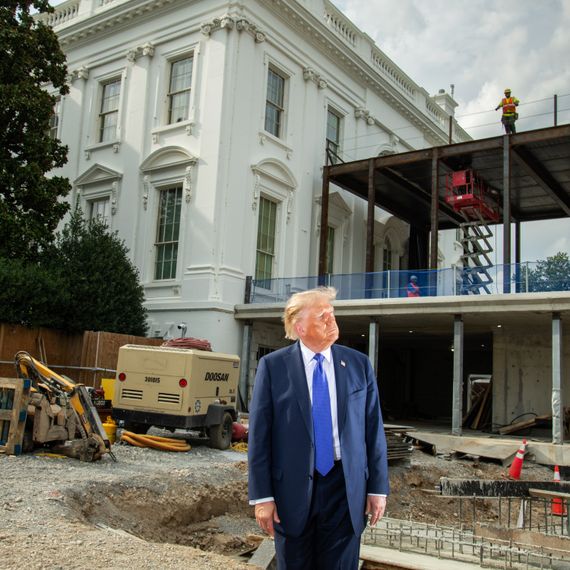
The White House says the ballroom is 65 percent complete, though independent estimates suggest it’s closer to 33 percent.
Photo: Brian Finke for New York Magazine
This is where the East Wing is buried.” Norm Eisen, the public-interest lawyer, is gesturing at an enormous pile of dirt rising above recently erected fences adorned with RESTRICTED AREA signs. Just a chip shot away, between the fourth and ninth holes of the East Potomac Golf Links, sits a grove of cherry trees. “It’s the toxic grave of the East Wing,” Eisen says. “Look at the size of it!”
In October, the government, in need of a place to dump debris from the demolition, chose the federally owned East Potomac. “They used bullying to barge in, they did not get the proper approvals, they did not accord with Congress,” Eisen says. For six months, trucks showed up on the course to off-load somewhere between 30,000 and 37,000 cubic yards of excavation soil and demolition rubble onto the course. Rubble that, according to tests, includes lead, chromium, and arsenic and has now been lying off the fairway long enough to have grown a patchy coat of billowing grass. “The toxic dirt blew everywhere,” Eisen says as we circle the mound, occasionally glancing up for shanked golf balls.
East Potomac is the inexpensive, beloved, but slightly shabby municipal course Trump wants to turn into a destination for pros. Norm Eisen objects. Eisen, who became a resistance hero for his stint as the special counsel to the House Judiciary Committee during Trump’s first impeachment in 2019, now runs an organization called Democracy Defenders Fund that has co-filed a federal lawsuit with the advocacy organization Democracy Forward and Washington superlawyer Abbe Lowell to stop the overhaul of the golf course. He calls its renovation emblematic of Trump’s disregard for the Constitution and the rule of law, arguing that Congress has jurisdiction over the land. The day we meet, Eisen is fresh off a different legal battle, having successfully defended his client David Hearn, a 67-year-old former Olympic canoeist, from spurious charges that he vandalized the algae-haunted Reflecting Pool. “Donald Trump accuses people of vandalism,” Eisen says, stopping again to point at the dumping ground. “This is the vandalism.”
These battles may seem like small beer compared with Trump’s other undertakings: immigration crackdowns, threats to the electoral system, war. But Eisen sees it differently. He has talked to experts around the world about how to deal with backsliding democracies in places like Turkey, Brazil, Hungary, and Russia. The lesson he learned was that there are a “very small” number of things you absolutely must do: Protect the rule of law. Protect elections. Expose corruption. “The illegal construction all over D.C. is the single best vehicle to do that,” he says.
The fight is coming from many angles. The National Trust for Historic Preservation filed a lawsuit aimed at shutting down construction on the ballroom. At the center of the suit was Alison Hoagland, a retired professor who has written books about rowhouses in Washington, log cabins, and the history of the bathroom in the American household. A volunteer with the National Trust, she used the fact that the construction had disturbed her walks around the White House as legal standing for the suit. The move angered Trump, who posted on Truth Social that the “ridiculous Ballroom lawsuit, brought by a woman walking her dog, who has absolutely No Standing to bring such a suit, must be dropped, immediately.” Getting called out didn’t bother Hoagland much. “I’m old and retired, so I can’t be fired, which made the risk less for me than for others,” she says. Also, “I don’t have a dog.”
In March, U.S. District Judge Richard Leon issued a preliminary injunction stopping much of the construction, ruling that the president needed congressional approval to build the ballroom. But the U.S. Court of Appeals for the D.C. Circuit intervened before Leon’s ruling could go into effect, agreeing to consider an appeal. In June, administration lawyers made the case that because the East Wing had already been demolished, they had no choice but to continue building. “When did it become a fait accompli?” D.C. Circuit Judge Patricia Millett said. And how far could this argument go, hypothetically? If the government decided to bulldoze the Statue of Liberty, Millett asked, and if they moved quickly, could nothing be done about that? “I think that’s right, yes,” Yaakov Roth, a Justice Department lawyer, replied. The case went all the way to the Supreme Court, which in late August ruled 5-4 to allow the construction to continue while the litigation plays out, saying the National Trust likely lacks standing. The unsigned opinion held that the administration would suffer “irreparable harm” if building stopped but did not rule on the ballroom’s legality; Chief Justice John Roberts, joining the Court’s liberals in dissent, said the White House’s actions were “likely unlawful.”
If Democrats take control of the House or Senate, or both, subpoenas are expected to fly. Senator Sheldon Whitehouse, a Democrat from Rhode Island, wants to investigate Trump’s “vanity projects” for potential pay-to-play and bribery schemes, telling me it would be “very wise and prudent” for ballroom donors to prepare for hearings. Public Citizen, a watchdog nonprofit, found that 14 of the 27 publicly listed donors to the ballroom received new or increased government contracts totaling more than $50 billion over a six-month period and that many of the corporate donors have issues, like potential mergers, currently in front of the administration. “First you demand records and then you dig into what those records reveal,” says Whitehouse, who is the ranking member of the Committee on Environment and Public Works, which technically has jurisdiction over Trump’s ballroom and other projects. “There’s always the question in a bribery case whether the culpability lies more in the entity that is pressuring for the bribe or lies more in the entity that is offering the bribe.”
Heading into the midterms, Democrats have intuited that Trump’s renovation projects are good politics for them. When I tell Andrew Bates, a former Biden spokesman now working as a consultant on congressional races, that I have been talking to Trump for a story about the ballroom, he says, “Make sure you thank the president for me.” Ambitious Democratic politicians have crafted their messaging on the ballroom to fit their specific brands. Ro Khanna, the California representative who has been toying with the idea of running for president as an economic and anti-pedophile populist, says the ballroom “should be turned into an economic war room to lead the renewal and deindustrialization of our nation — a room to support the working class instead of entertaining the Epstein class.” Representative Alexandria Ocasio-Cortez told the news site NOTUS the ballroom should be turned into a “soup kitchen,” while Senator Ruben Gallego of Arizona, who is trying to fashion himself as a Democratic pugilist, told them the whole thing should just be torn down and sold “piece by piece.”
Liberal pundits are also clamoring for the ballroom’s destruction. New York Times columnist Jamelle Bouie suggested it should be leveled by drone attack, arguing that if it’s allowed to stand, then a gaudy symbol of Trump’s authoritarianism will be forever embedded in what is supposed to be the people’s house. But it is also tough to see an incoming president taking the trouble to embark on yet another expensive construction project, presumably at a time when they will be facing any number of urgent matters. Axelrod tells me that the question of what to do with the ballroom, which includes the possibility of a Democratic-controlled Congress suing to halt construction, is a “metaphor for the dilemma Democrats will face.”
“Like whether impeachment of Trump, the case for which could surely be made, is wise given that you know the outcome,” he says. “One of the reasons Trump and the Republicans are in such a jam is because voters perceive that he is obsessed with retribution and building monuments to himself rather than addressing the pressing economic concerns he promised to address. Dems shouldn’t fall into the trap of looking like they’re principally focused on retribution against him and tearing down the monuments to the exclusion of focusing on fixing a rigged economy.” (Axelrod’s recommendation: Get rid of all the gold and name the ballroom after John F. Kennedy.)
Tommy Vietor, a co-host of Pod Save America, says, “My knee-jerk reaction is that Democrats have bigger fish to fry than the ballroom. But I’m probably 100 percent wrong on the politics and we’ll end up spending half of the 2028 primary debating the best demolition techniques.”
Still, the politics of the ballroom are objectively bad for Trump. A poll from the Washington Post in July found that 65 percent of respondents feel “dissatisfied or upset” with Trump’s projects for the ballroom, Reflecting Pool, and arch. With affordability a major buzzword of the midterm elections, being associated with a president building himself a gilded ballroom modeled after Versailles can make life difficult for Republicans. It doesn’t take a history buff to see the Marie Antoinette parallels. Also complicating things, despite Trump’s constant claims that the ballroom is fully funded by private donations, taxpayers are footing a chunk of the bill — some $300 million for security enhancements and underground infrastructure, according to documents obtained by the Washington Post. It has reported that Trump is set to spend more than $900 million on White House renovations in total and that taxpayers will cover most of the cost.
“This is creating political headwinds for members of Congress on a decision that the executive branch has made,” Republican senator Thom Tillis of North Carolina tells me. It’s a message some of Trump’s advisers have tried to relay to the president, knowing full well it can be difficult to keep him on message. “It gets in the way of the administration’s ability to tell the story of everything they’ve accomplished in the first year,” one Trump adviser tells me. “If you spend your time talking about the ballroom and not talking about tax cuts … You’ve accomplished so much, but you’re not talking about what you’ve done for the people. You’re talking about what you’ve done for a building.”
Trump is aware of these concerns. He just doesn’t really care. “I think the people should be thankful for it,” he says. “A lot of people said, ‘Don’t do this interview.’ But I’m proud of the work I’m doing.” In early September, the administration announced it would start on the arch in two weeks.
We had asphalt going into here,” Trump says, standing on the pathway leading to the residence of the White House. “Now you have the best stone.” He points at a pile of square-cut granite — the type being used to replace the asphalt walkway — and looks to his communications director, Steven Cheung, who is accompanying us on this impromptu tour of the White House grounds en route to the construction site.
“That’s some stone, huh, Steven?” he says.
“It’s incredible,” Cheung concurs.
“Look at the thickness of it,” Trump says. “Normally, you use one inch, as thin as you can. It’s the White House — I said, ‘Fuck it, what’s the best you have?’ They said, ‘We have one that’s four inches.’”
“You’re restoring glory to the White House,” Cheung says, shaking his head in apparent awe.
There’s no such thing as an inconspicuous stroll with Trump. Everywhere we go, he is followed by a gaggle of aides and members of the Secret Service. Everyone he passes stands at attention: Spanish-speaking construction workers, a man with a ZZ Top beard wearing a hard hat, a crew of young men Trump refers to as “genius military guys,” whom he tasks with adding another drone-landing port on the roof. “We’ll discuss,” one of them responds.
It’s an extensive tour. Trump shows me the cursive lettering reading OVAL OFFICE that he placed outside the Oval Office along with gold embellishments that wags on social media have compared to the kitschy decorations in Thai restaurants. He also shows me the new stone paving in the Rose Garden (“This was all grass and was unusable,” he says), the marble floor in the White House’s Palm Room (“You don’t see a floor like this, do ya, fellas?” he asks Secret Service members standing nearby. “Biden wouldn’t have done it”), and his nearly completed helipad (“You need a little slope for rain,” he tells me, explaining that he’d had the workers redo some of their initial efforts. “But they gave me too much slope. They gave me three feet of slope, which is a waterfall”).
Beside the helipad, on the other side of some fencing, the metal skeleton of the ballroom rises 70 feet in the air. The structure is already enormous, about 65 percent complete, according to the White House, with a footprint larger than a football field. (The Washington Post has reported that, according to confidential documents, far less work has been completed than the White House claims — more like 33 percent.) The site has been operating at full tilt with the aim of completing the building by the summer of 2028. Every week, some 250 workers, putting in 20-hour days, pour 3,000 cubic yards of concrete and install 1 million pounds of rebar. “There’s more steel here than in the stadium they are building,” Trump says, referring to the Washington Commanders’ football arena. Already, the crew has built a grand-staircase structure, a movie-theater structure, and a kitchen structure. “I have confidence,” Trump says about the legal challenges. “People want it.”
Sparks fly off a welder’s torch while other men lean on steel beams to watch the president inspect their work. When done, the ballroom will be lined with large arched windows with softly draped curtains and fluted columns. The ceilings and walls will be awash with accents of gold, or what Trump refers to as “God’s favorite metal.” Trump says, standing here, he can picture where the chandeliers will hang and where the guests will enter and leave. “It’s what I do,” he says. He walks through dirt and rubble to the middle of what will be the ballroom. He kicks a rock with his black dress shoes and looks at the ground. “There’s a lot of stuff down there,” he says.
In recent months, in their successful effort to beat back attempts to slow down construction, Trump and his legal team have leaned into another justification for the project. It is, they say, a matter of national security. When the military first heard Trump talk about the ballroom, he says, top generals arranged a meeting. “They said, ‘Sir, we’d like to build things, it would be a dream, but there’s never been anything like this proposed,’” Trump says. “‘If we could build underground, we could go down five stories.’” Now, whenever Trump talks about the ballroom, he always brings up the drone port that will be housed on the roof, the bulletproof windows and walls, and the underground military wing, which will replace the Presidential Emergency Operations Center, the bunker built beneath the East Wing during World War II. The new bunker will keep the president safe from nuclear blasts and contain a fully operational hospital.
I ask the president if there currently is some sort of bunker at the White House he could go to in an emergency. “Not much of a place,” he says. “You can’t do much under a building that’s a little on the fragile side. You can put a little room, but you can’t put much under the White House. Nothing like this.” Trump says he’s not building the ballroom for himself, that he personally will have only six months or so to use it before his term runs out. But what if he just decided not to leave? Could he just hole up in his new bunker after the 2028 election?
“I haven’t heard that one,” Trump says with a laugh. “But I tell you what, it would be awfully tough to get you out. Nobody would be able to get you out.”
Thank you for subscribing and supporting our journalism.
If you prefer to read in print, you can also find this article in the September 7, 2026, issue of
New York Magazine.
Want more stories like this one? Subscribe now
to support our journalism and get unlimited access to our coverage.
If you prefer to read in print, you can also find this article in the September 7, 2026, issue of
New York Magazine.