
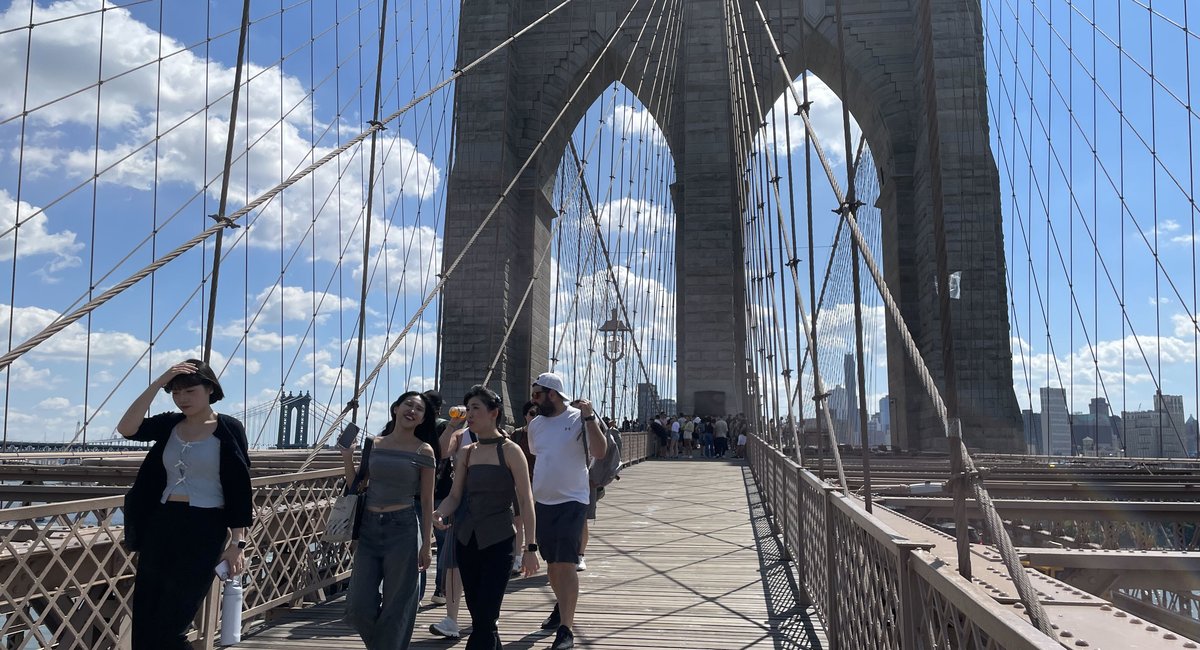
The New York City Police Department proudly boasted this week that this has been the city’s “safest summer” for many categories of major crimes. You wouldn’t know it from the week’s most prominent headlines.
In Times Square on Monday, a woman was shot and killed by police after she fatally stabbed someone and injured another. Friday morning, the NYPD shot and killed a man it says threatened officers with a knife and claimed to have a bomb on the Brooklyn Bridge.
They’re incidents in some of the city’s most iconic spaces — and it would be hard to blame New Yorkers or visitors too shocked by the violence to consider the rosier picture painted by the official stats.
And yet, when Gothamist spoke with almost 20 people Friday near the Brooklyn Bridge and Times Square, many were unaware that either incident had ever happened. None of those who knew said they felt unsafe.
“I think for the amount of people that live here, if that’s the worst crime that’s happened this week, that’s not too bad,” said Kristal Miller, an Australian visitor who walked the Brooklyn Bridge Friday. She said things are worse at home.
Generally speaking, data shows that New York City is a safe place to live and travel. Shootings, murders and other major crimes are down — though the city is continuing to see increases in felony assaults and hate crimes that buck the overall trend.
“Oftentimes what happens is that high profile incidents like these end up overshadowing the more aggregated data about the safety of the city. The data does show that New York is safer than it has been before,” said Asad Dandia, the Brooklyn Borough Historian and the founder of a walking tour company called New York Narratives.
The fear connected to major crime has often been divorced from the statistical realities. Gothamist previously reported that in 2021, all categories of major crimes were significantly lower than two decades prior — but polls found New Yorkers much more worried about crime and safety.
Perceptions of safety can also be affected by where you live. Criminal activity tends to be most persistent around ““hot spots” where safety issues persist, even as the overall safety of the city improves. And experts say incidents of felony assault can particularly increase fears of out-of-control crime.
But this week, Brooklyn District Attorney Eric Gonzalez told Gothamist the feedback he was getting from residents suggested the perception of safety was starting to line up with the statistics.
“People are telling me they feel safer than they felt before. They’re starting to believe the numbers. They’re starting to feel it,” Gonzalez said.
Dandia, who gives tours all over the city, said visitors do ask if the city is safe to freely walk around in.
“It’s well intentioned, right?” Dandia said. “They’re asking because they genuinely don’t know, or what they do know of New York is what they’ve seen in movies.”
Tom Harris, the president of the Times Square Alliance, called Friday morning’s incident, and the recent death in Times Square, a tragedy that rattled the community. But pedestrians continued to flow into Times Square throughout the week just the same — Harris said they did so in increasing numbers.
“People wanna be here. They will always come,” Harris said.
Carly Merz and her mom, Sarah Robinson, were in Times Square Friday, visiting the city for the first time. They heard about the incidents on social media.
“It could happen anywhere,” Merz said. And Robinson said she agreed.
Some New Yorkers who spend day in and day out in the city say they know that the incidents this week are outliers. But they said they’re still worth heeding.
“This should be a call to action for us to do a better job of dealing with the people who are suffering with mental illness on our streets,” Harris said. “The citizens of New York City and those suffering with mental illness are the victims.”
Koamivi Todo, who has worked for a tour bus company in Times Square for nearly a decade, said, in the meantime “we just pray [to] God to not be in the wrong place in the wrong time.”
Dandia said most of the people he interacts with know that incidents like this week’s are outliers, and that’s why they attract so much attention.
“But at the same time, it also reveals to us some of the cracks in the system,” she said.