
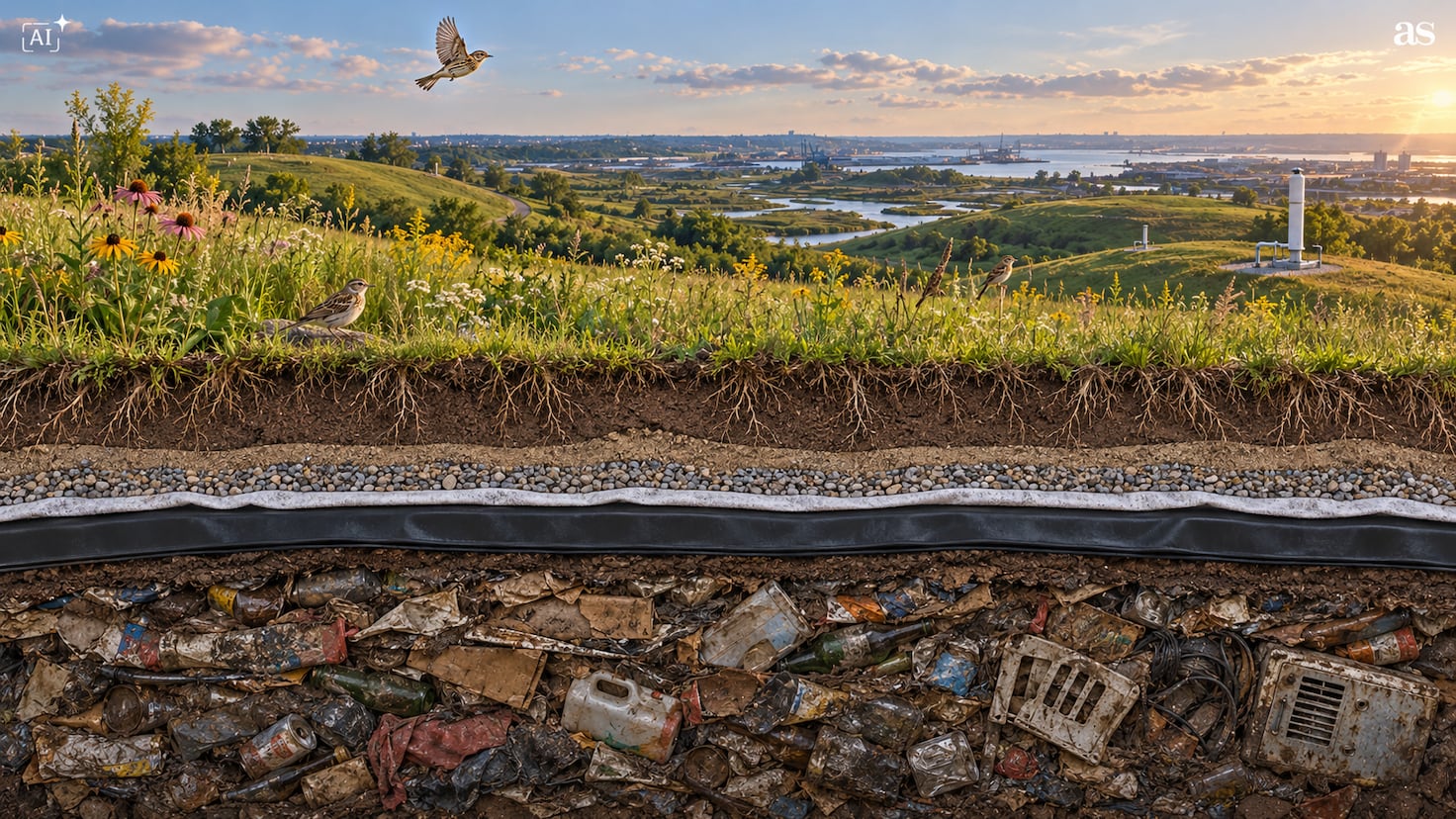
The idea of New York turning a mountain of garbage into a park may sound a bit like the ending to a children’s story about recycling, until you remember that the trash in question never actually left the area.
Approximately 150 million tons of it remain beneath Freshkills Park on Staten Island, distributed across four enormous mounds. What visitors see today are grasslands, waterways and gently rolling hills. Underneath it, though, is more than half a century of discarded mattresses, food packaging, broken appliances and almost everything else New Yorkers threw away between 1948 and 2001.
Fresh Kills was originally expected to operate for only a few years. Instead, it became the city’s principal landfill and, at one point, the largest dump in the world. At its 1980s peak, it received as much as 29,000 tons of waste a day.
The final regular garbage barge arrived on March 22, 2001. The closure was not quite final, however. Following the September 11 attacks, the site was temporarily reopened so investigators could search and sort roughly 1.5 million tons of World Trade Center material, according to the National September 11 Memorial & Museum.
What happened to the Freshkills garbage?
The transformation works because the waste has been isolated from the world above it.
Layers of soil, drainage material, geotextiles and an impermeable membrane cover the landfill mounds. Underground wells collect methane-rich landfill gas, while a separate system captures and treats leachate, the contaminated liquid produced as rainwater and decomposing waste mix.
That means this is not simply nature reclaiming abandoned ground. It is a closely managed piece of environmental engineering. The cap must be protected from erosion, trees cannot be allowed to send deep roots toward it, and gas and groundwater require continued monitoring. NYC Parks explains that these systems will remain part of the site long after the landscaping is finished.
Above that hidden infrastructure, though, something remarkable has happened.
Grasslands have spread across the capped mounds, creating habitat that has disappeared from much of the region. In 2024, researchers recorded 136 breeding pairs of grasshopper sparrows, according to recent reporting by The New Yorker. The bird is considered a species of special concern in New York.
A peer-reviewed study of Freshkills also documented three pairs of threatened sedge wrens successfully raising young there in 2020. It was the species’ first confirmed successful breeding in New York City for 60 years.
Bald eagles, foxes, deer, turtles and more than 200 recorded bird species have also used the surrounding grasslands, wetlands and creeks.
When will all of Freshkills Park open?
The project’s scale can be misleading. Freshkills Park is planned to cover 2,200 acres, around 2.6 times Central Park’s 843 acres, but most of that land is not yet freely accessible.
The first public space constructed inside the former landfill boundaries, a 21-acre section of North Park, opened in October 2023. It includes walking and cycling paths, a birdwatching tower, a wetland overlook and a waterless composting restroom. Other facilities, including sports fields and a greenway, have opened around the site’s edges.
Further development is continuing in phases, with NYC Parks currently pointing to 2036 for the wider project.
Related stories
Get closer to the game! Whether you like your soccer of the European variety or that on this side of the pond, our AS USA app has it all. Dive into live coverage, expert insights, breaking news, exclusive videos, and more. Plus, stay updated on NFL, NBA and all other big sports stories as well as the latest in current affairs and entertainment. Download now for all-access coverage, right at your fingertips – anytime, anywhere.
And there’s more: check out our TikTok and Instagram reels for bite-sized visual takes on all the biggest soccer news and insights.