
Sign up for the Slatest to get the most insightful analysis, criticism, and advice out there, delivered to your inbox daily.
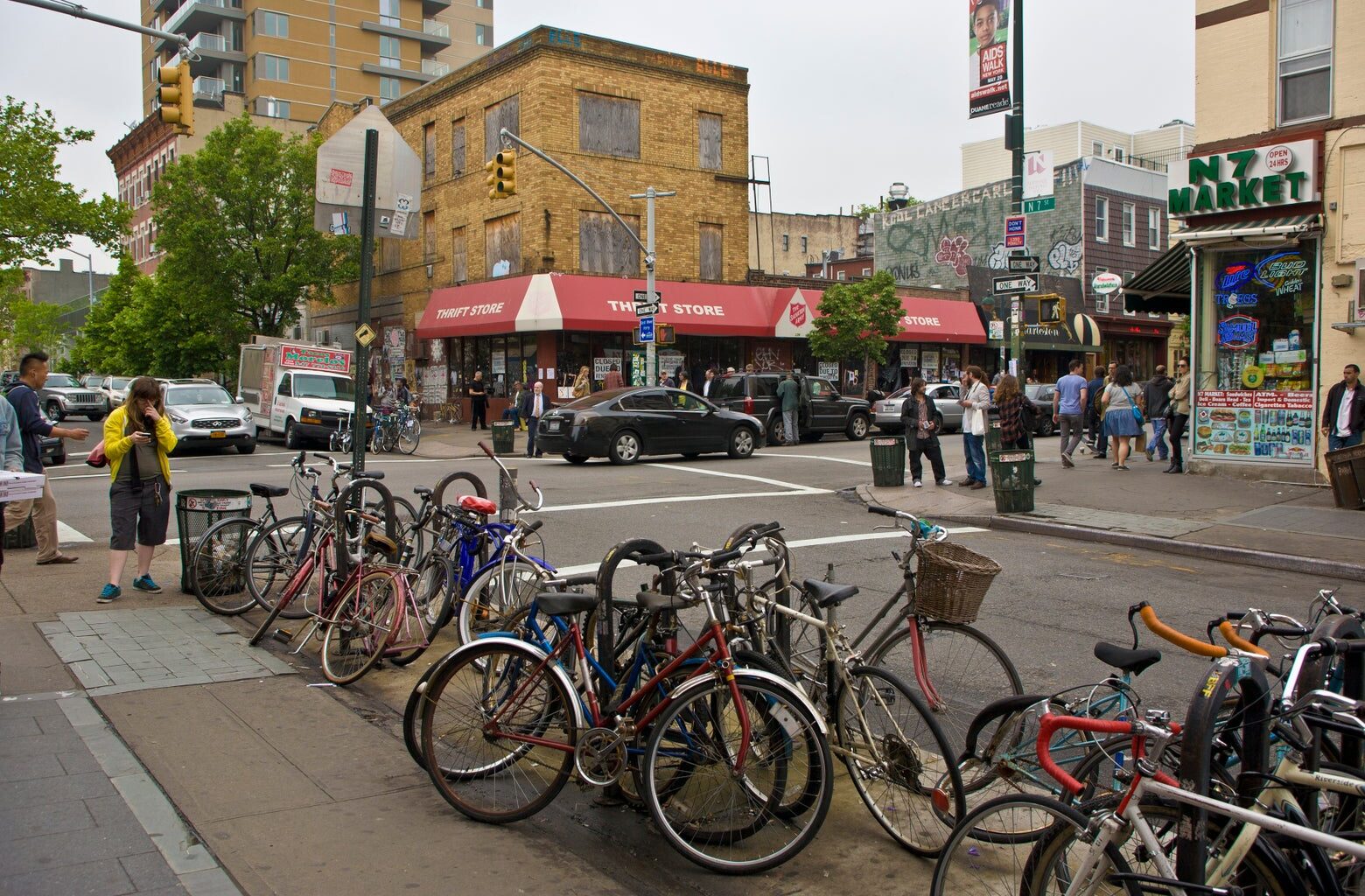
There is a place in New York City that many insist does not exist. It is primarily composed of concrete streets, old family-run stores, and a massive influx of newer, sleeker businesses with scrawled cursive logos and $7 drinks. It is called “East Willliamsburg.”
East Williamsburg, depending on who you ask, could be anything. Its geographical boundaries are contentious and ever-debated, since it has not been historically defined by government agencies, and there are no official neighborhood lines drawn, but the name has been used vaguely to refer to an industrial area of Williamsburg that developers have been trying to revitalize since at least the 1980s. For longtime residents, the neighborhood itself is about as real as Santa Claus, or the tooth fairy—“East Williamsburg” could’ve just as easily been “South Greenpoint” or “West Bushwick” or “Tatooine” or “Six Flags.” But for many, especially people who have just landed in Brooklyn, it is a very real place. More specifically, it’s a playground. East Williamsburg is a sprawling obstacle course of shops and bars, all catering to the younger new residents who have moved to New York City in order to work hard and play harder.
I have heard from haggard, decrepit millennials that it used to be different, that it used to be grungy and alternative. That’s not the Williamsburg I know. I know a Williamsburg where there’s not just one, but two Whole Foods, and one of them is a combination building with a Capital One bank. Gwyneth Paltrow is allegedly opening a Goop store, too. I know it as the “most exciting Asian American coffee hotspot,” which is a title that I feel represents both a very cool thing happening for sprouting businesses and sometimes also the fourth horseman of the apocalypse. While the neighborhood used to be renowned for flannel-clad IPA connoisseurs and a thriving indie art scene, the 2010s-era hipsters who sparked the Hasidim vs. Hipsters war have now been usurped by a new stereotype: the tech bro.
It wasn’t always this way. For decades, the wider area of Williamsburg has held a major cultural fascination for the type of millennial transplant who makes their way out to the East Coast. Williamsburg is the setting for the 2010s CBS sitcom 2 Broke Girls, the story of how a billionaire’s daughter had to flee to Brooklyn after losing all her money and start over again in a diner. It’s where Dakota Johnson apparently lives while going through her post-college identity crisis in the 2010s breakup movie How to Be Single. Williamsburg is the secret fourth girl in Lena Dunham’s HBO show Girls, so consistently featured on screen that there are Sex in the City–style crawls of all the North Brooklyn businesses that appear in the show. Former Teen Vogue editor-in-chief Elaine Welteroth wrote, about moving to the newly minted East Williamsburg to chase her big magazine dreams in her memoir More Than Enough, that “to the uninitiated, this particular block in Bushwick looked mad suspect.” During this time, the archetype of who was gentrifying Williamsburg was very clear: They were cool, they were broke, they were all mentally going through something, but they were having fun, and that’s what made it all so exciting.
But in recent years, that identity has been fractured entirely. Between 2010 and 2026, rent prices have doubled in the neighborhood, and there seems to be no slowing down. According to data from Apartments.com, the average rent price in New York City is $4,197, and Williamsburg even surpasses that—the median rent price is $5,100, according to competitor platform StreetEasy. Most of the rent increases happened post-COVID. The biggest jump in recent years happened just after lockdown, beginning in May 2021, one month after all adults became eligible for vaccines nationwide.
Part of this has to do with the fact that tech companies, specifically A.I. startups, have begun settling in the area. Amazon Music and A.I.-focused ecommerce startups Queen One and Autonomous Technologies all set up shop at a Williamsburg waterfront building with floor-to-ceiling glass windows. So did A.I. software firm Rillavoice, and Altana AI, which has a two-year contract with the U.S. Customs and Border Patrol to enforce tariffs (a job that is definitely not evil and sounds super awesome). The landmark Domino Sugar factory was gut-renovated and now serves as offices for over 30 A.I. and tech firms.
If the original-format gentrification was all about moving into a neighborhood with cheap rent, this second-wave gentrification is about moving in on taste. Sure, the desire to relentlessly pursue the New Cool has always been a thing—it’s why rich people acted as benefactors for artists in exchange for party invitations and clout—but in an algorithm-dominated world, the desire to feel unique is more acute (and quantifiably rewarded in likes and reposts) than ever. It’s even become a stereotype online, the guy who works at an A.I. defense startup, reads leftist literature, is really intense about Japanese dining customs, and laments the destruction of interpersonal interactions in our modern digital age. The currency is taste: Williamsburg effectively costs the same as Manhattan prices, but there is a thrill in living in a space that has been so famously known for hosting so many interesting people before.
Henry Grabar
YIMBY Has Gone Mainstream. Can It Stay That Way?
Read More
Williamsburg feels more bland, and it is. Tech bros are moving in, which means the area’s cultural identity is different now. This corner of Brooklyn is moving on to the next wave of gentrification: They’re culturally gentrifying the original gentrifiers, erasing the identity of precariously employed DJs who are experimenting with polyamory and microbangs. One street has become the neighborhood’s unofficial wellness avenue, where there’s just store after store of red-light therapy, bathhouses, and microneedling. Perpendicular to that, there’s a lunchtime slop-bowl corridor, offering Just Salad, Dig, Cava, and Sweetgreen in one neat little row.
But just as original-format gentrification pushes out the original community that lived there, the second wave pushes out anyone who brought swag to the table. All the handlebar mustache freaks with a Moleskine notebook and a dream have been forced to move to farther neighborhoods like Bushwick and Ridgewood, which are already skyrocketing in price, and after that, they’ll probably have to extend the train farther into the no-man’s land of Middle Village or make up another new neighborhood or something. In turn, Williamsburg has been sapped of all its affordability, and increasingly, its cool factor. Art is made when there is space to make it, and if people are under pressure to pay an average $5,100 in rent, then there’s no space for ideas to make their way to the surface. There is only space to optimize, and streamline, and organize. I walk down the street and I see an alarming number of people wearing weighted walking vests now, which is so frightening that it requires me to catch my breath every now and again. There is nothing very cool about everything becoming the same.
What Was in the Mind of the Holdout Juror in the Lindsay Clancy Trial? I Can Certainly Speculate.
Republicans’ Plan for the Midterms: Bet on Trump Caring About Someone Other Than Himself
The Lindsay Clancy Case Has Ended In a Mistrial. What Happens Now?
This Content is Available for Slate Plus members only
Trump Just Got Embarrassed by the “OG of Online Mapping”
This isn’t the only place in the country undergoing this cultural homogenization, either. Gawker asked its readers in 2011, “What’s the Williamsburg of your city?,” which touched on the core truth—everywhere, there are hip neighborhoods that are controversial because they are started by people who are causing adverse ripple effects just because they are moving somewhere new, but they also bring hipness, an idiosyncrasy that feels like a far better trade after everything’s already been beaten into conformity. In the age of social media trends, there are plenty of cities across the country that have all wound up kind of looking the same—venture capital–backed coffee shops, LED-lit workout classes, a crowded Trader Joe’s, upscale brands that hold a certain cachet among young six-figure earners for their status products and carefully curated typefaces (Diptyque, Aesop, Le Labo, Necessaire, you get the idea). What used to set Williamsburg apart from the rest was the distinctive identity of who lived there. Now, it could be anywhere.
The millennials’ Williamsburg was not perfect, but at least it was special, and in this era of tech bros sitting at the helm of the neighborhood, it risks losing all swag entirely. Perhaps, just like in the food chain, there will be another bigger predator that takes over the city, a secret third thing that turns this generic Roblox neighborhood into something even more unrecognizable. Maybe they’ll make up more names to slice up the neighborhood, and open even more Whole Foods locations. Maybe Gwyneth Paltrow will launch the Goop store and shift the tectonic plates. But none of it will be cool. Most certainly not.