

Stephen Siller, whose firefighter dad perished on 9/11 after running two miles through the Brooklyn Battery Tunnel with 60 pounds of gear on his back, doesn’t want the next generation to forget the heroism and sacrifices of that day even though 25 years have now passed.
For the past four months Stephen, has been touring the United State with a 17,000 pound, 21 foot steel beam from the North Tower to help educate the next generation about the tragedy.
“We wanted to travel the country with that steel because of the gravity it holds,” said Stephen, 25. Stephen, who was nine months old when his father — also named Stephen – died, sees himself as a bridge between the generations who remember September 11 and those who were not yet born or too young to have memories of the day.
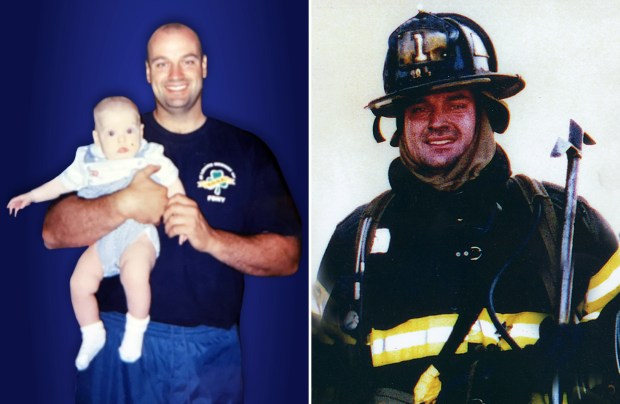 Stephen Siller (as a baby at left), whose firefighter dad (left and right) perished on 9/11 after running two miles through the Brooklyn Battery Tunnel with 60 pounds of gear on his back, has been touring the United State with a 17,000 pound, 21 foot steel beam from the North Tower to help educate the next generation about the tragedy. (T2T Steel Across America; FDNY)
“The gravity of that steel—you can’t be blind to it. What you see is so powerful that you can’t avoid it. And we wanted to expose kids who are maybe 18-years-old and don’t understand what happened that day to the gravity of it. So the steel is damaged. It’s bent. It’s rubble, but it’s also sacred. It’s a piece of American history, and it’s a piece of New York City,” Stephen said.
After the terror attacks, numerous organizations were formed to help support the survivors, first-responders, victims’ families and others impacted by the attack. The horrific losses of 9.11 inspired numerous efforts to help better the lives of not only survivors and their families, but New Yorkers in general.
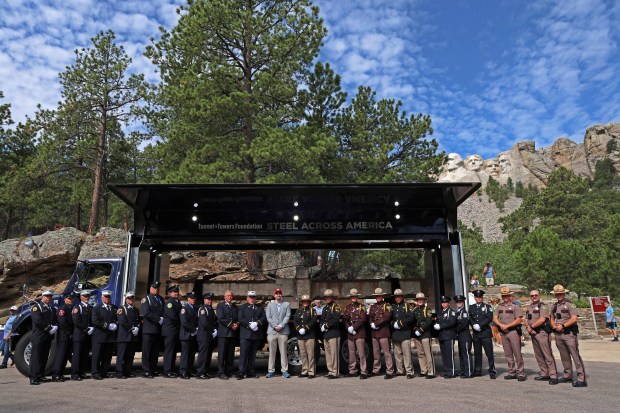 Stephen Siller has been touring the United State with a 17,000 pound, 21 foot steel beam from the North Tower to help educate the next generation about the tragedy. The beam is pictured here at Mt. Rushmore in South Dakota on July 28. (T2T Steel Across America)
Among them was Tunnel to Towers, started by the siblings of Stephen Siller to mark his heroic dash to the World Trade Center. The organization began with a charity run to commemorate Siller’s actions. The run still takes place each year on Sept. 28. Over the past 25 years T2T has grown, providing mortgage-free homes to the families of fallen service members and first-responders and granting their children scholarships to college and trade-school, among other initiatives.
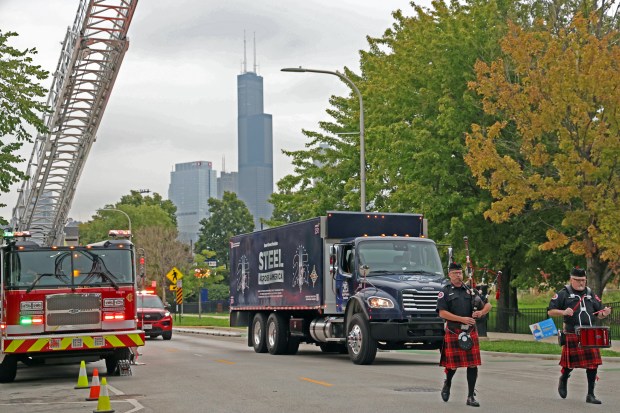 Stephen Siller has been touring the United State with a 17,000 pound, 21 foot steel beam from the North Tower to help educate the next generation about the tragedy. A truck carrying the beam is pictured here in Chicago on Aug. 12. (T2T Steel Across America)
As he travels the country, Stephen says he relates passionately to the children of fallen service members and first responders due to his own childhood and is helping to shape the direction of T2T going forward.
“We are going to be doing more work in 25 years than we are doing today. There are always going to be first responders who run into a burning building,” he said. “I’m going to do everything in my power to show up for that kid like me who doesn’t get to see his father again because he was a hero, because he gave up his life to save others.”
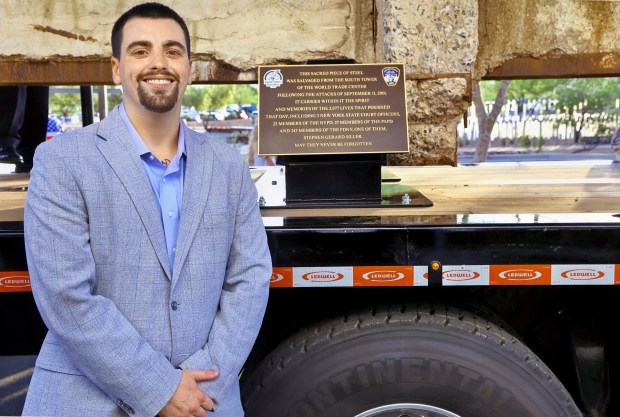 Stephen Siller has been touring the United State with a 17,000 pound, 21 foot steel beam from the North Tower to help educate the next generation about the tragedy. (T2T Steel Across America)
Mary Fetchet was also driven by loss to try and help others. She lost her 25-year-old son, Brad, who worked at investment bank KBW on the 89th floor of the South Tower.
She started a group known as Voices of September 11th, now called Voices Center for Resilience, as part of her quest to find out what happened to her son. The group has since grown into a prolific organization that supports the health and well-being of survivors, first-responders and families of 9/11 victims, helping to connect them with resources, including treatment for 9/11 related illnesses.
As she dealt with the grief of her loss, Fetchet started hosting a support group for families of 9/11 victims at her home in Connecticut, where she met co-founder Beverly Eckert. Together they lobbied Congress to establish the independent 9/11 Commission to investigate whether the tragedy could have been prevented and ensure it doesn’t happen again.
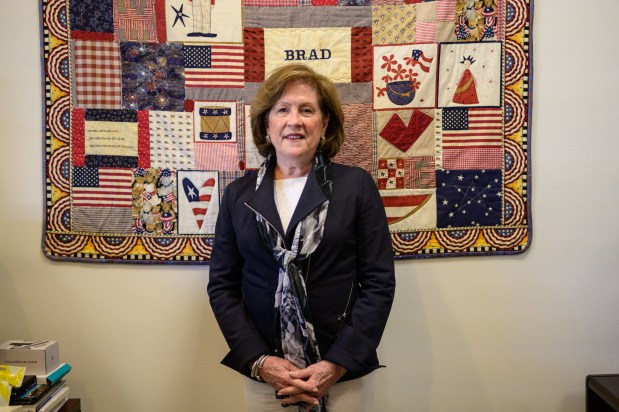 Mary Fetchet, Co-Founder and executive director of the organization “Voices of September 11” and who lost her son, Brad, in the 9/11 attacks, poses for a portrait in New Canaan, Connecticut on June 10, 2021. (Photo by ANGELA WEISS/AFP via Getty Images)
VOICES established one of the first online databases of 9/11 victims, collecting over 80,000 photographs and personal keepsakes documenting the lives of the nearly 3,000 victims for The Living Memorial Project, which became a core component of the In Memoriam exhibit at the 9/11 Memorial & Museum in New York City.
“I think our mission really, in many ways, has remained the same,” Fetchet said. “We wanted to provide information and support to the individuals that were impacted.”
Initially focused on the victims’ families, over time VOICES expanded to also serve survivors and first-responders.
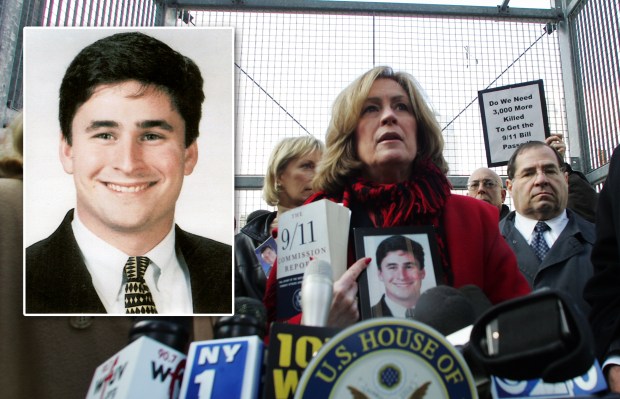 Mary Fetchet, mother of Brad Fetchet (inset), joins politicians and other family members of victims of 9/11 for a news conference at Ground Zero in 2004. (Jesse Ward for New York Daily News)
“Right after 9/11, we could never have anticipated that the 400,000 survivors or the 90,000 responders would be sick and dying,” Fetchet said. “Just this year we’ve had 3000 new people reach out to us for the first time,” Fetchet said.
“As a clinician, I felt from the beginning that there would be long-term needs. There are many unresolved issues,” said Fetchet, who is a clinical social worker. She notes that the Medical Examiner is still identifying remains of 9/11 victims in 2026.
“There’s over 152,000 now in treatment for one or more medical and psychological conditions, and there’s over 9,600 that have died since of 9/11-related illnesses,” Fetchet said. “I think the other role that we play is really sharing what we’ve learned over the last 25 years,” she added.