
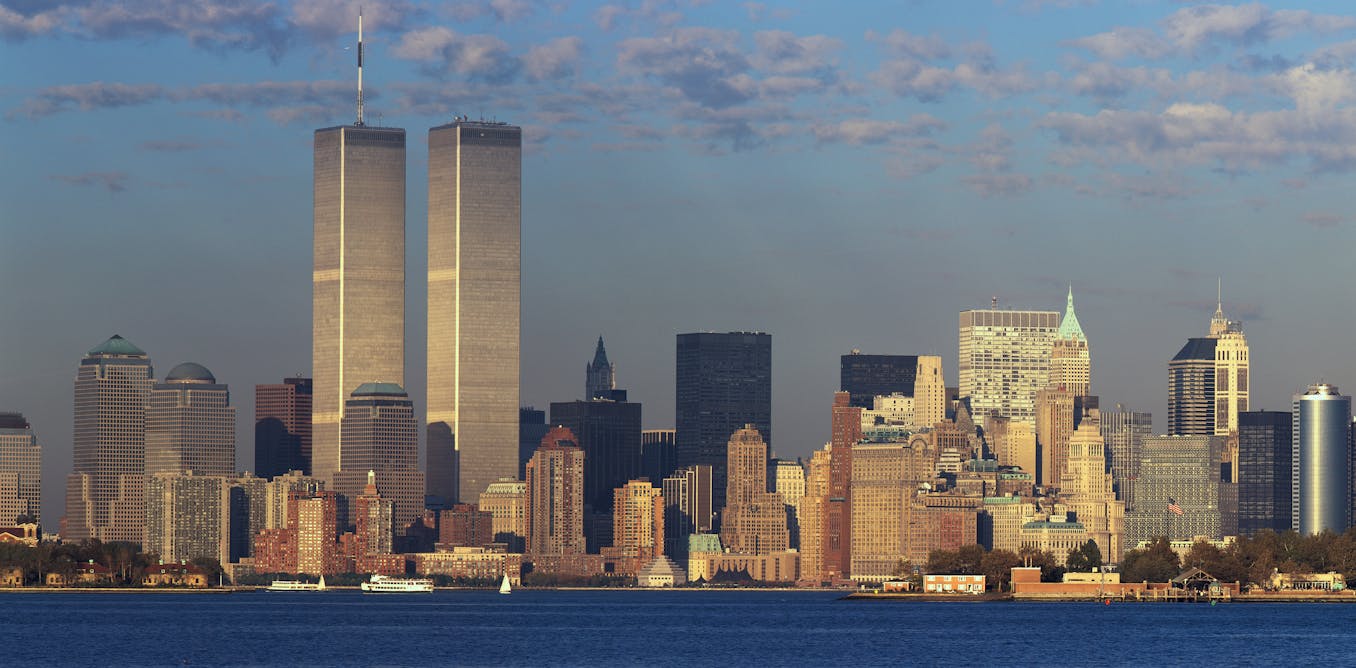
At 10:28am on September 11 2001 New York City’s skyline was suddenly and dramatically altered.
The world watched television screens in horror as first the North Tower and then the South Tower collapsed, with the death of almost 3,000 people and the devastation of an entire city precinct.
Resilient New Yorkers responded to this shocking event and its aftermath with fortitude, quickly setting in train processes for memorials and the planning and construction of new towers.
That the Twin Towers’ replacement structures were so greatly anticipated points to how profoundly the gap left by the towers was felt and to the significance of the skyline as repository of a collective civic memory.
Shaping the skyline
The image of New York’s skyline – both before and after 9/11 – is instantly recognisable, memorable for the density of its soaring skyscrapers. But the skyline presents an idealised view of the city, removed from the grittiness experienced at street level.
For those who call the city home, images of the New York skyline trigger deep-seated memories.
For others, the skyline evokes stories told through literature, musical theatre, movies – art that cements its place in our collective consciousness.
There is consistency to these narratives, and to the meanings they embody. That so many people draw similar conclusions is an indication of the strength of New York’s identity.
The competition for height was prompted by Elisha Otis’ invention of the safety elevator in 1853. This elevator, which would automatically stop in place if the chains or ropes operating it broke, invited proprietors and architects to reach beyond the standard six stories. It initiated an upwards trajectory signalling progress, business prowess and status.
An early instance of this battle occurred from the 1870s between three newspaper proprietors located on “Newspaper Row”.
The Tribune Building (1875), 11 stories with clock tower and spire reaching to 79 metres (260 feet), was bested shortly after by completion of the World Building (1890), 12 stories but a classical dome on an extruded drum extending this height to 110m (350ft).

Manhattan’s ‘Newspaper Row’ photographed in 1895, featuring City Hall, the New York World Building, the Tribune Building, and the Times Building.
Geo. P. Hall & Son/The New York Historical/Getty Images
Only 20 years later, steel frame construction enabled the glamorous Woolworth’s building (1911–13) designed by Cass Gilbert in Neo Gothic style to reach an astonishing 241m (792ft).
The Chrysler Building (1931), with an Art Deco steeple and spire adornments inspired by the Chrysler automobile reaching 319m (1,046ft), was pipped by the Empire State Building (1930–31), with a roof at 380m (1,250ft) and an antenna reaching to 443m (1,454ft).
The upwards trajectory of New York’s skyline was captured from the late 19th century through the rapidly developing medium of photography, especially through panorama. These images, together with the rise in transatlantic tourism, assisted in spreading the mythology of New York.

Midtown Manhattan photographed in 1938, featuring the Empire State Building (left) and the Chrysler Building.
NY Daily News Archive via Getty Images
The new symbols
Minoru Yamasaki was selected as the architect for the World Trade Centre in 1962, presenting a model of the 110-storey Twin Towers in 1964. The tallest, the North Tower, would stand at 417m (1,368ft), or 527m (1,728ft) including the antenna.
But the technically innovative gleaming towers were derided by many architects at the time.
In 1966, the New York Times reported arguments that “the flat-topped behemoths will destroy the beauty of the romantically spired lower Manhattan skyline”.
Yet, when they were completed in 1970–71, the Twin Towers’ pure minimalist form and coherent structural idea conferred a slender elegance.

The New York city skyline featuring the newly finished World Trade Centre in 1974.
Jean-Erick Pasquier/Gamma-Rapho via Getty Images
They quickly became the most identifiable pair of structures in a precinct considered the centre of global finance.
They were the set-pieces used to establish time and place in television and film – even replacing the Empire State Building as the structure to which Kong retreats in the 1976 remake of King Kong.
In targeting the Twin Towers, al-Qaeda terrorists had selected what they identified as most emblematic of the evil empire America. For New Yorkers, the destruction of the Twin Towers was an attack on their integrity and identity.
Shaping loss
The loss of the of Twin Towers was catastrophic – but the response was immediate. It was most important to civic and business leaders that New York reclaim its position as the site of the tallest building in the United States.
One World Trade Centre, designed by David Childs of Skidmore Owings & Merrill, achieved this prerequisite.
Opened in 2014, One WTC is a chamfered prism that rises to a height of 541m – or 1,776ft, to commemorate the signing of the Declaration of Independence – but is considered unremarkable by architectural critics.

Lower Manhattan seen from the Hudson River in August 2026, with One World Trade Center towering above the city.
Mario Tama/Getty Images
In 2031, One WTC will be joined on the skyline by Two WTC designed by Norman Foster of Foster and Partners and currently under construction.
Significantly, One and Two WTC are not on the sites of the old Twin Towers.
The slots of space where the absent Twin Towers once rose remain vacant, their footprints occupied by the 9/11 Memorial: two pools fed by 9m walls of water, flowing to a central void signifying “absence made visible”.

The 9/11 Memorial, photographed in August 2026, extends downward on the site where the Twin Towers once stood.
Angela Weiss/Getty Images
New memories
Twenty-five years on, the terrible violence of 9/11 has been incorporated into the mythology of New York.
Images of New York’s skyline now set up a condition of “before” and “after”.
An image of the skyline before 9/11 triggers memories of that terrible event, but also possibly a nostalgia for what seems a simpler time, before mobile phones and social media became pervasive, and before the “war on terror” that never seems to end.
Time will tell whether the new towers become icons. Either way, the skyline of New York endures, continuously changing while still holding its shape as a beacon of progress and accumulating associations that deepen shared cultural memory.