
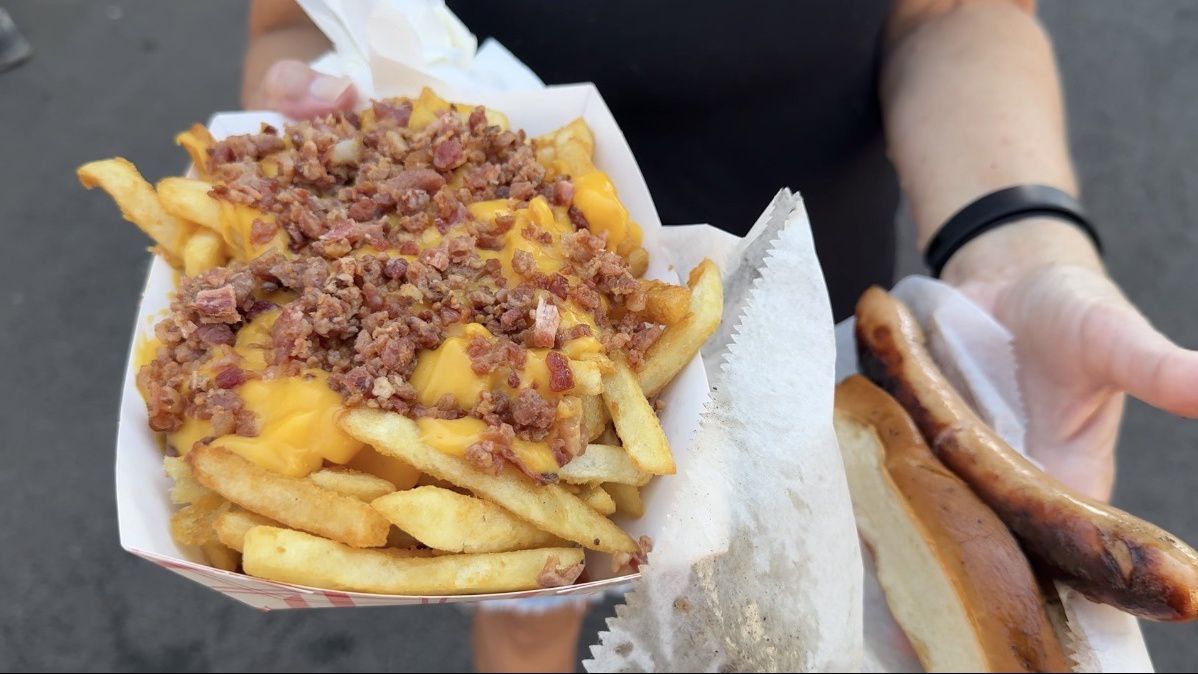
With the cost of food spiking this year, some food vendors at the New York State Fair say they are struggling in ways they haven’t in years past.
“It’s not cheap to be here,” said Dan Rescignano, co-owner of Twin Trees. “With the labor, the insurance and all that, you know, the profit margin [is] nothing amazing.”
“Prices of everything have gone up,” said Doug Sprague, longtime employee at food stand Tommy C’s. “So we’ve kept some prices the same and others we’ve had to raise a little bit.”
Even though Rescignano tries to invest in his stand each year, he said profits have lessened due to lower foot traffic at his new location at the fair.
“I sell a decent amount, nothing crazy. But, yeah, obviously the extra helps a little bit,” Rescignano said. “Nice to save when you can. It’s a lot of hard work out here. We work 16-hour days.”
Fair director Julie LaFave said vendors of all sizes do have alternative options to shelling out for high foot-traffic locations, namely the Taste New York marketplace.
LaFave said some local food producers are offered multiple days at a table in the market for free.
“We give preferential if they are a New York product or New York business,” LaFave said. “And that’s a really great way for anybody who’s a New York-grown and certified business or a producer from New York.”
For companies like Ma and Pa’s Popcorn Factory, the strategy of location value versus rent cost becomes more complex with multiple stands at the fair.
“We have four locations here. Every location is a little bit different,” said James Bell, owner of Ma and Pa’s. “They consider a high-volume area versus a low-volume area. So it all just depends on where you’re at.”
Bell, who’s worked at the fair for nearly three decades, said the fair’s a great opportunity to develop consistent local clientele.
Yet, companies like Twin Trees are in better positions in some ways now than in years past because of a retired alcohol tax the fair used to impose on vendors.
Multiple sources confirmed the fair used to require a 25% tax on all alcohol sales on top of New York state’s standard sales tax, but 2026 was the second year the state fair didn’t impose this tax.
“It’s nice to have a little bit extra money to be able to do with that,” Rescignano said of the tax.
LaFave also said 100% of wine and 90% of beer sold by stands are required to be New York-made, just one of the ways the fair tries to promote and value local food production.
“[The fair is] a little bit different than our normal daily grind manufacturing store,” Bell said. “So it gives everybody kind of a break.”
Tommy C’s, only active during the state fair and without a permanent restaurant location, also runs a special during the fair in which some specialty items trigger donations of $0.50 from each sale to the 9/11 reparations nonprofit Tunnel to Towers Foundation.