
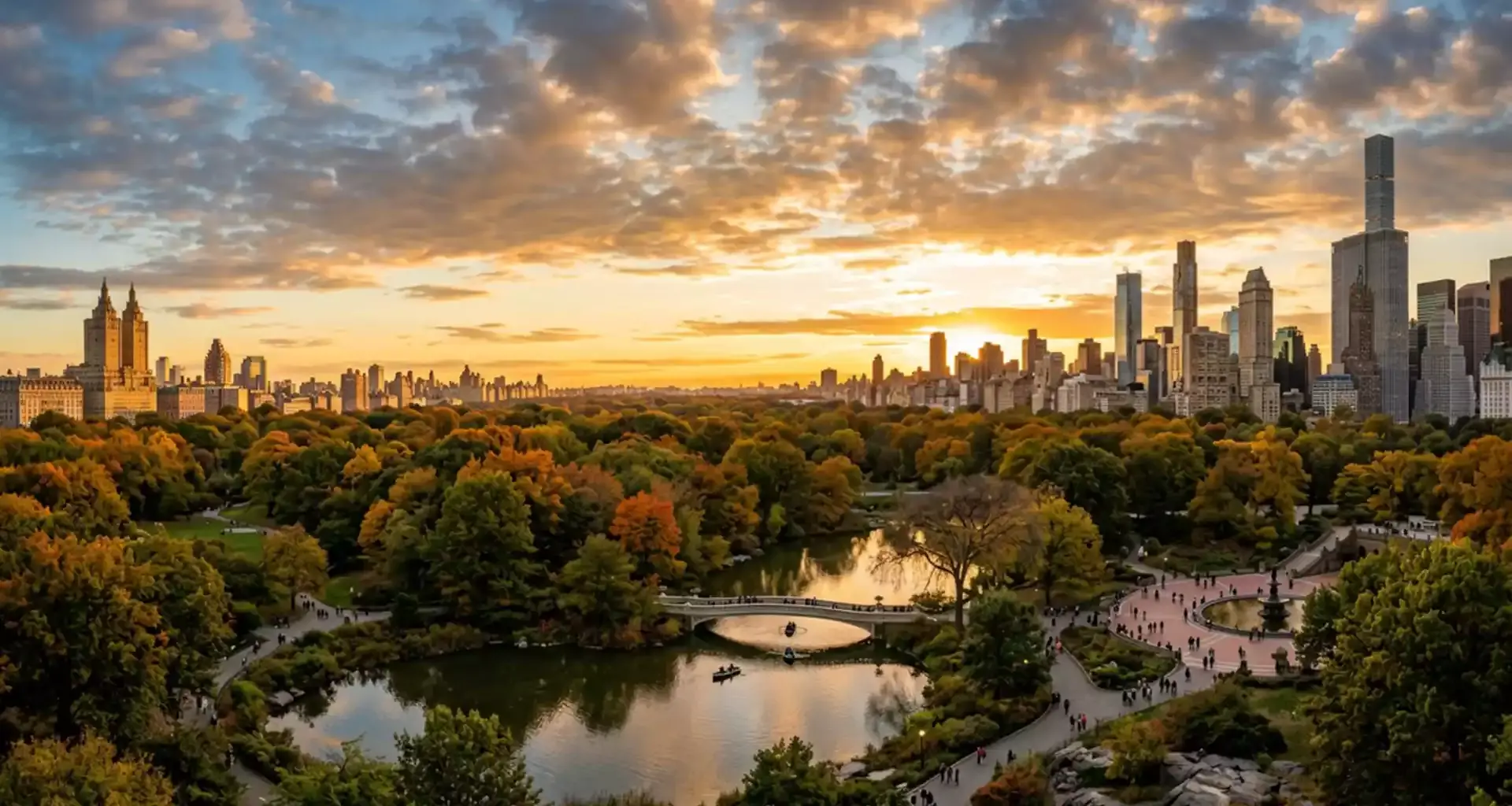
Central Park is a vast crafted landscape laid out in the nineteenth century at the centre of Manhattan, turning rough ground into meadows, lakes and woodlands for New York City. Conceived in the 1850s and shaped under the direction of Frederick Law Olmsted and Calvert Vaux, it remains a large continuous parkland framed by the street grid on all sides.
A nineteenth-century park shaped by Olmsted and Vaux
The New York State Legislature approved the creation of Central Park in 1853, setting aside land in Manhattan for a large public park.approved the establishment of Central Park The Central Park Commission then held a landscape design competition, attracting dozens of submissions for how the ground might be shaped.
Frederick Law Olmsted, appointed superintendent of the park in 1857, joined forces with British-born architect Calvert Vaux to prepare a joint design known as the Greensward Plan.the Greensward plan Their proposal won the competition in 1858, and work on transforming the area accelerated. The pair remained closely associated with Central Park and later applied similar ideas in other American parks.
Scale, layout and landscapes across the park
Central Park covers about 843 acres (340 ha), stretching between 59th and 110th Streets in Manhattan and between Fifth and Eighth Avenues.occupies an area of 840 acres From end to end it runs for roughly 4 km (2.5 miles), forming a broad rectangle of greenery within the island’s dense street grid. Within that outline, the designers arranged different types of terrain and planting to create varied experiences.
Large open lawns sit alongside more enclosed woodlands, meandering streams and broad lakes, each shaped to appear natural despite extensive earthworks.sweeping lawns, picturesque woodlands, meandering streams and broad lakes Paths twist through these landscapes, while carriage drives follow wider curves. Bridges and underpasses are used to separate different routes and let visitors cross water and hollows without interrupting the flow of the ground.
Engineering the quiet separation of city traffic
One of Central Park’s defining features is the way east–west traffic crosses the park on sunken transverse roads, set below the surface so that vehicles are largely hidden from the main landscapes.sunken transverse roads These roads follow the street grid but drop into cuts spanned by bridges, allowing pedestrians, riders and carriages to move along separate routes.
More than forty bridges and arches were designed for Central Park, many by Calvert Vaux with Jacob Wrey Mould, to remove level crossings between paths and drives.designed more than forty bridges Together with the transverse roads, these structures form a quiet infrastructure beneath the scenery, supporting circulation while allowing the main views to remain focused on rock outcrops, water and trees rather than street traffic.
Visiting Central Park: what travellers from Western Europe should knowCentral Park extends north–south through central Manhattan between 59th and 110th Streets, bounded by Fifth Avenue on the east side and Eighth Avenue on the west.The ground within the park includes undulating lawns, rock outcrops and wooded sections, with many paths and some stairways that require walking on uneven surfaces.Subway lines run along both the east and west sides of the park, with stations near entrances on streets such as 59th, 72nd, 86th and 96th.The official language is English and the currency is the US dollar.Entry requirements depend on your nationality; UK travellers can check the FCDO travel advice at gov.uk/foreign-travel-advice, Irish travellers the Department of Foreign Affairs at ireland.ie.Searching for Central Park on social platforms
These links open searches for Central Park on each platform.
Frequently asked questions about Central ParkWhere is Central Park in New York City?
Central Park is in central Manhattan, stretching between 59th and 110th Streets and framed by Fifth and Eighth Avenues.
What can visitors expect inside Central Park?
Visitors encounter open lawns, wooded areas, lakes, streams, winding paths and bridges, all arranged to create a varied yet continuous landscape.
What makes Central Park distinctive among city parks?
Central Park combines large scale, carefully shaped naturalistic scenery and hidden transverse roads, creating extensive parkland while keeping much city traffic out of sight.
Disclaimer…