
The sports world stopped cold around here after 9/11, respectfully and correctly. There was too much despair in the air, too much angst about big crowds and airline flights.
As Derek Jeter told reporters back then, during the darkest moments, “They’re still trying to find people. I really don’t think it’s the right time to play baseball.”
Quickly, though, a debate emerged about these cancellations: How long is too long? The attack had come just as the baseball pennant races were heating up, and just as the NFL season was getting started. Fans required an emotional release. Owners needed their money.
The players resisted.
Baseball commissioner Bud Selig reluctantly agreed to postpone games until the 17th. His counterpart, Paul Tagliabue, moved Week 2 of the football schedule into January. Tagliabue did not wish to make the same mistake as his predecessor Pete Rozelle, who allowed play to resume too quickly after the Kennedy assassination.
Several NFL games did not sell out when the season first returned, in part because the league lifted its traditional blackout rules for broadcasts, and partly because cheering loudly for something as mundane as touchdowns simply didn’t feel right. Fans preferred watching quietly at home.
Soon enough, however, the multi-billion-dollar entertainment machine revved back up. And when it did, there were indelible highlights that made New Yorkers remember quickly why these events had always meant so much to so many.
The Yanks and Mets reopened on the road, before the Mets returned to New York for the first live, major sports event in the city. It was a Friday night game on Sept. 21 against the Braves, and you likely recall the mind-blowing result: Mike Piazza blasted a go-ahead, two-run homer to deep left-center in the eighth inning off a fat, 0-1 fastball from Steve Karsay, a pitcher who happened to grow up in Queens.
There were 41,235 fans at Shea that night, though many more would claim to have been there.
“It was just this incredible release of emotion,” Piazza said, years later, to MLB.com. “And I think it became evidently clear that people just wanted to cheer about something. People just wanted to be together.”
Karsay experienced mixed feelings that stuck with him for decades.
“Being a New Yorker, to get to play in that game, there was a lot of raw emotion,” he said. “It’s something that will be etched in my brain for the remainder of my life. Everybody was in that situation for a reason.”
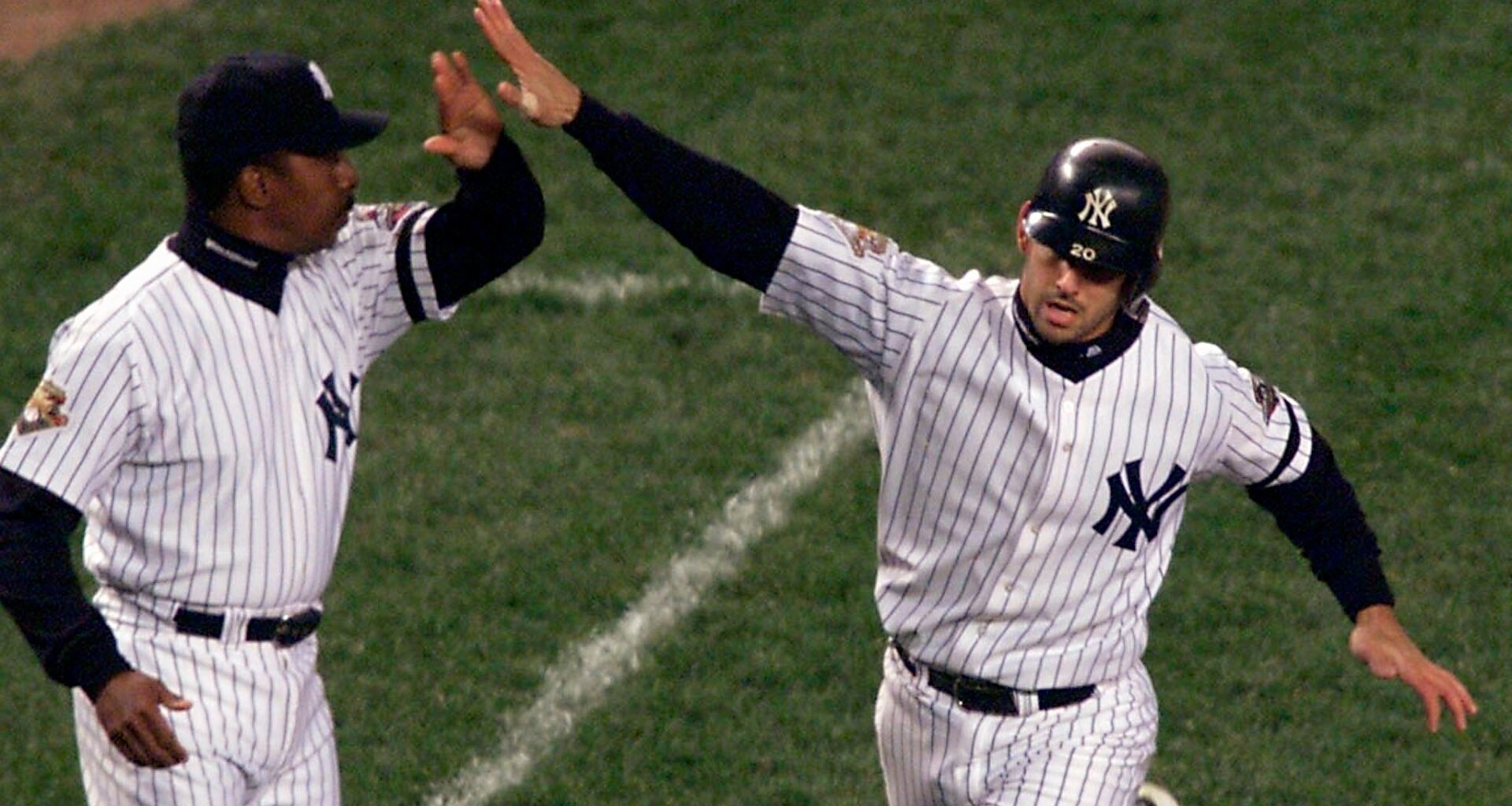
So the Mets had their moment, then left the stage for the real stars of that era. The Yankees stumbled a bit to the finish line that regular season, going 9-8-1 after 9/11. But then the playoffs started, and they became the Bombers again.
Their fans, again, became their fans.
“We returned to the bleachers soon enough, but it was clearly different,” remembered Marc Chalpin, who is the leader of the Bleacher Creature roll call these days. “Everybody was a little closer, a little more patriotic. The Yankees became a lifeline, not just to us, but to the city.”
The memories of that Yankee postseason run are now part and parcel of that autumn tapestry, alongside the recovery work at Ground Zero and the mourning for lost souls.
The dramas, the unlikely episodes, seem almost dreamlike in retrospect:
*Derek Jeter’s shovel pass to rescue Game 6 of the ALDS in Oakland.
*The walkoff homer by Alfonso Soriano in Game 4 of the ALCS against the 116-win Mariners, on the way to a fourth-straight Yankee pennant.
*George Bush’s first pitch in the Bronx, a perfect strike, before Game 3 of the World Series.
*The old scoreboard declaring, “Welcome to November Baseball,” as the clock struck midnight late in Game 4.
*Tino Martinez’ two-run, two-out homer in the ninth to tie the score against Byung-hyun-Kim in Game 4, then Derek Jeter’s winning home run in the 10th.
*Scott Brosius’ two-run shot off Kim to tie Game 5 in the ninth inning.
*The spoilsport, bloop single in Game 7 by Luis Gonzalez that stole Game 7 and the title for the Diamondbacks, a rare blown save for Mariano Rivera.
“The Yankees lost, but they still healed us. It was the right time for them to be there,” said Teena Lewis, long-time royalty among the Bleacher Creatures. “If not for the Yankees, I just don’t know…”
Lewis had worked at the World Trade Center during the first bombing attack there in 1993. She had to climb down 97 floors that day. After 9/11, when the Yankees came back home, finally, on Sept. 25 against the Devil Rays, she remembers, “I bawled the whole night.”
The local football teams never ascended to such emotional heights, but did their best. Both the Giants and Jets had lost their openers in September, before the attacks. They both faced road games on Sept. 23. The Jets won in New England, 10-3, on a Curtis Martin touchdown run. They also inadvertently created the Patriot dynasty.
Linebacker Mo Lewis hit Pats’ quarterback Drew Bledsoe hard, causing an internal injury. A fellow by the name of Tom Brady took his place, and would lead New England that season to its first of six Super Bowl victories.
The Jets lost the AFC wild card game to Oakland later that year. The Giants never got that far, finishing tied for last in the NFC East at 7-9. But they won their first game back after 9/11 in Kansas City.
Those of us who covered that 13-3 victory will not forget that eerie atmosphere. The plane journey itself was a strange odyssey. Few Americans were traveling then, especially on jets. Only a handful of passengers boarded the flight to Kansas City from Newark. A woman sitting two rows back, on the aisle, sobbed uncontrollably during the entire trip.
In Arrowhead Stadium before the game, a medley of surprisingly authentic folk tunes echoed over the loud speaker system. It included one song by Woody Guthrie, whose politics didn’t normally jibe with a Missouri football audience. The crowd passed around a fireman’s boot, seeking contributions, and the Chiefs reportedly raised more than $400,000 that day for 9/11 relief efforts in New York.
Other New York professional teams soon began their regular seasons, on schedule. The Knicks and Rangers flamed out. The New Jersey Nets overachieved all the way to the NBA Finals before getting stomped by the Lakers.
Eventually, sports events felt normal again. They regained their footing with fans.
Losses would hurt, just the right amount. Titles would lift the city, same as they had before the towers went down.
Sports can unify, we learned. Sports can heal.
To everything, there is a season.