
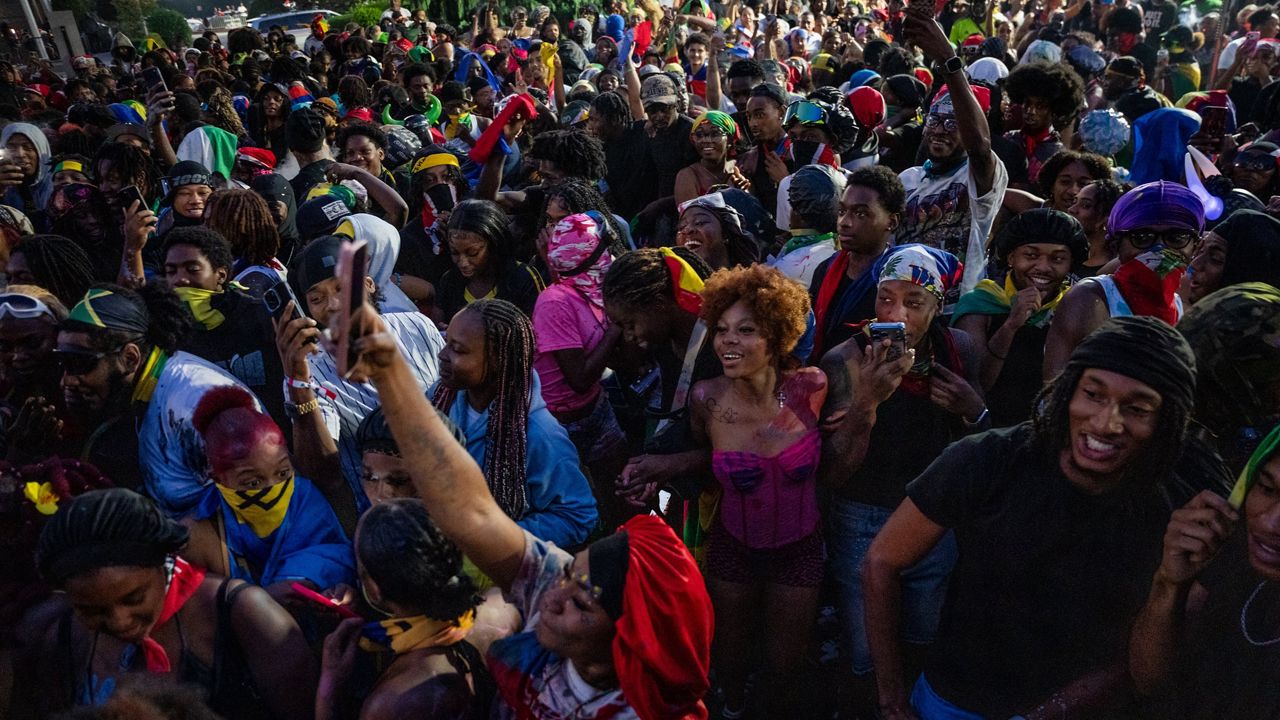
Brooklyn’s West Indian American Day parade filled Eastern Parkway with Caribbean culture, music and pride Monday as revelers gathered for one of the borough’s biggest street celebrations.
The parade stepped off at Eastern Parkway and Rochester Avenue before making its way down the Parkway to Grand Army Plaza, with participants representing the flags and colors of countries across the Caribbean.
“Cultures, the West Indies, all of us coming together, it just brings a huge group of family,” said Justin Chatelain, who traveled from the Bronx with friends.
For Nisa Spruill, who is from Harlem and attends the parade every year, the celebration is an opportunity to show pride in her roots in St. Vincent and the Grenadines.
“I just love repping my country, I love Saint Vincent and the Grenadines, I love telling people about it,” Spruill said. “A lot of people don’t know about us because we are very small, but we are very mighty.”
Spruill said she was having a great time despite getting little sleep after attending J’Ouvert, the early-morning street festival that takes place before the parade.
Chatelain, who is Dominican and Haitian, said he was excited to connect with others from the diaspora.
“I feel like my culture [is] the best culture,” he said.
A heavy police presence lined the parade route, as the NYPD worked to maintain security throughout the celebration.
“The NYPD has made sure that it’s very organized, very safe,” said Maresha Dixon, who has Jamaican roots and traveled from Connecticut for the parade.
The event also brought back New Yorkers who had not attended in years.
Samantha Tully-Cuadrado said the last time she went to the parade, she was 14. This year, she brought her 9-year-old son.
“The last time I came I was 14, and so I wanted to really bring my son. We don’t live far, so I was like, let’s go to the Parkway early,” she said.
Tully-Cuadrado, who is Puerto Rican and has West Indian roots, said the celebration was an important way to share Caribbean culture with her son.
“We’re Puerto Rican, and West Indian, Caribbean culture is something to really celebrate,” she said.
She said she especially enjoys seeing the elaborate costumes along the parade route.
“All bodies are celebrated, women look beautiful, men look happy, it’s vibes,” she said.
Edgard Cintron, who is from Puerto Rico, also returned to the parade after a three-year absence. He used to live in East Flatbush, making it easier to attend, but has since moved to Staten Island.
Cintron said he came back for the energy and music.
“Every time I hear the soca, I start dancing,” he said. “If you don’t wanna move, your body is going, yeah, move, move.”
For longtime paradegoers, the celebration is about everything from food and music to the sense of community.
“Everything, the food, the music, the people,” said Janet Coleman, a regular paradegoer who wore the colors of Grenada. “It mean a lot to me because that’s my culture.”
For Chatelain, the parade is also an expression of what makes New York City unique.
“If you’re not here every year, you’re missing out. It’s always something every time,” he said. “As we say in New York, it’s a movie.”