
Just a few days after the 9/11 attacks, then-16-year-old Faiza Ali was wearing a hijab at a Rite Aid near her home in Midwood, Brooklyn, when a screaming woman told her to leave. The woman pushed Ali’s little sister as other customers and a security guard stood by idly.
Ali Najmi remembers when his Pakistani immigrant mother stopped wearing her traditional shalwar kameez outside their home in Glen Oaks, Queens. She started covering the Quran she read on the subway with a paper bag.
And Ramzi Kassem, who volunteered as a legal translator at a nearby prison, remembers being briefly detained by a guard who suspected he might be a terrorism suspect.
Twenty-five years later, the three now hold key appointments in the administration of the city’s first Muslim mayor, Zohran Mamdani. Their paths to the halls of power show that the wave of post-9/11 Islamophobia that cast Muslims as adversaries also sparked a political awakening among a generation that went on to help Mamdani get elected.
“Islamophobia after 9/11 became a kind of institutionalized force, primarily through different forms of government repression,” said Moustafa Bayoumi, a Brooklyn College professor who has written about Muslim political organizing in New York City. “The younger generation especially decided that they had to meet those challenges head-on, and they really began organizing collectively under the banner of being Muslim American.”
Ali, 41, became a prominent activist pushing for issues affecting Muslims, including installing an NYPD inspector general and getting Eid holidays recognized on the public school calendar. She now serves as the city’s head of immigrant affairs.
Najmi, 42, helped found the Muslim Democratic Club of New York, which went on to back Mamdani and other progressive candidates and causes. He now chairs the mayor’s judicial advisory committee.
Kassem, 48, spent years fighting civil rights abuses during the federal government’s war on terror and the NYPD’s extensive surveillance of Muslim communities. He now serves as Mamdani’s chief counsel.
All three have said the post-9/11 wave of Islamophobia and government dragnet altered the trajectories of their careers. Ali and Najmi also spoke about their experiences in interviews.
Mayor Mamdani and Ali Najmi in Grand Army Plaza in January.
Ed Reed/Mayoral Photography Office
Their political awakenings mirror the maturation of advocacy groups that helped mobilize Middle Eastern and South Asian voters ahead of Mamdani’s historic win.
“We watched how our government targeted our communities,” said Linda Sarsour, a Bay Ridge-based activist who helped found the Muslim Democratic Club of New York with Najmi and Ali. “It radicalized many young American Muslims in a way that set us up to be frontline organizers.”
“It wasn’t just about defense, it was also about offense… And how do we elect better leaders who are going to defend our communities?” she added.
The post-9/11 dragnet
The day the Twin Towers fell, Kassem said he tried calling friends and family nearby, donated blood, and volunteered as a translator at a phone bank where frightened New Yorkers called in search of their loved ones.
“I could not have known then that much of my legal career would be spent standing with clients and communities who bore the brunt of government actions in the days and years that followed: immigrant New Yorkers and Muslims here and abroad subjected to registration, detention, incarceration, surveillance, torture, war or worse,” Kassem, whom City Hall declined to make available for an interview, said in a statement. “Many people who saw 9/11 for what it was — a horrific act of mass murder — were nonetheless treated as enemies.”
In the weeks after the attacks, the federal government arrested more than 700 Middle Eastern and South Asian immigrant men from across the five boroughs and beyond, detaining them in jails and prisons in New York and New Jersey — often for suspected links to the 9/11 attacks that a Department of Justice investigation later found to be tenuous at best.
Kassem, then a second-year Columbia Law student, began to accompany attorneys with the American Civil Liberties Union who visited some of the men in detention, helping as a translator and legal assistant, he said in a 2014 interview. The next summer, as a fellow at the Center for Constitutional Rights, he worked on a class-action lawsuit some of the men brought against the federal government. They alleged they were beaten by authorities while in custody and denied access to their attorneys. The parties later settled the suit, with the federal government paying out $98,000 to six plaintiffs.
In 2011, the Associated Press confirmed what Muslim New Yorkers had long suspected: The NYPD had been spying on mosques, student groups, and Muslim-owned businesses across the city, but it never produced any leads or opened a single investigation.
Kassem, by then a CUNY Law professor running the CLEAR legal clinic, sued the city in 2013, on behalf of three Muslim New Yorkers — an imam, a college student, and an Islamic lecturer — all of whom were surveilled by police informants.
Mayor Mamdani and Ramzi Kassem hosted an Iftar at City Hall in March.
Michael Appleton/Mayoral Photography Office
The next year, the NYPD shuttered its controversial unit responsible for the Muslim surveillance program. The final settlement in Kassem’s lawsuit, reached in 2017, installed a civilian monitor inside the department and barred its officers from investigating anyone based solely on their religion, race, or ethnicity.
“There is a direct throughline from that moment, and the collective realization among New York City’s very diverse Muslim communities — that basically, if you’re not at the table, you’re on the menu,” Kassem said in a recent interview.
Building the political machine
New York state education officials in 2006 scheduled the annual Regents exam on Eid al-Adha, one of Islam’s two major holidays.
At the New York chapter of the Council on American-Islamic Relations, Faiza Ali said she began fielding calls from anxious Muslim parents, asking what they should do: Send their children to school that day, or honor their faith?
Soon, worried parents and advocates formed the Coalition for Muslim School Holidays, garnering the support of more than 80 religious, ethnic, labor and other advocacy groups lobbying to have the two Eid holidays recognized on the city’s public school calendar. Ali served on the steering committee helping organize concerned parents and allies in rallies, town halls, letter-writing campaigns, and meetings with decision-makers.
In 2009, the City Council passed a nonbinding resolution urging then-Mayor Mike Bloomberg to recognize the holidays. He refused, saying that only religions with “a very large number of kids who practice” could be accommodated. The coalition estimated that 13% of the city’s public school students were Muslim.
By 2012, Najmi — by then an attorney with his own practice on Queens Boulevard — reached a conclusion while looking around neighborhoods in Queens and Brooklyn: The Muslim community was enormous, and it was radically underperforming at the ballot box.
“There’s so many of us,” he recalled thinking. “Why aren’t we voting more? Why aren’t we registering more?”
So he sent a private message on Twitter to Ali, an organizer he’d never met but had watched rally on the steps of City Hall. That message led to a dinner in Brooklyn later that year with Ali, Sarsour, and others, where Najmi pitched his idea: a Muslim political club that could flex the community’s untapped political power.
The Muslim Democratic Club of New York launched in 2013 ahead of that year’s mayoral primary. In May, the club hosted a mayoral candidate forum at NYU, and all the major contenders showed up. The forum produced a moment that Ali, Najmi, and Sarsour say they still remember: Sarsour’s daughter stood up and asked the candidates what they would do about adding Muslim holidays to the school calendar. Every candidate on stage committed to it.
“It was a powerful moment,” Najmi said. “People were taking it seriously.”
Ramzi Kassem said there was a recognition among Muslim communities that “if you’re not at the table, you’re on the menu.”
KENA BETANCUR/AFP via Getty Images
Ali called the campaign a “case study for Muslim organizing,” a lesson in engaging “people who are in positions of power to make change in your communities.”
Two years later, then-Mayor Bill de Blasio announced that the city’s public schools would close for Eid al-Adha and Eid al-Fitr starting the following school year.
From the campaign trail to the halls of power
The club’s next test was whether any of its efforts could actually help put a candidate in office. In 2015, Najmi ran for City Council in his home base in Queens, backed by the club. He lost, but the race drew a 22-year-old volunteer named Zohran Mamadani.
It was Mamdani’s first foray into local politics, he told local radio station Hot 97 last year. He said he volunteered because he read in a Village Voice article that Najmi was endorsed by one of his favorite rappers, Heems.
Najmi remembered Mamdani arriving in a fashionable ensemble, with a “million-watt smile,” walking door to door through a heavily South Asian block alongside him. He came back to canvass again and again over the following weeks. A few years later, Mamdani joined the board of the Muslim Democratic Club.
In 2017, the club backed another candidate: Khader El-Yateem, a Palestinian American Lutheran pastor running for a City Council district in Bay Ridge that is home to a large Muslim community and Arab Christian population. Najmi served as his election lawyer, and Mamdani served as field director.
El-Yateem ultimately lost a close race, but the club found a new ally: the Democratic Socialists of America, whose rank-and-file grassroots mobilization for El-Yateem impressed Najmi — marking the beginning of a partnership that would carry on for years and play a key role in Mamdani’s own campaigns.
“We had to learn how to lose to win,” said Murad Awawdeh, a founding member of the club.
He added that the Muslim Democratic Club is “not just for the Muslim community. Delivering for the most marginalized and vulnerable lifts all sails.” Awawdeh is now president of the New York Immigration Coalition.
Faiza Ali (in green), Ali Najmi (in a tie) and Zohran Mamdani at a meeting of the Muslim Democratic Club in 2018.
Muslim Democratic Club
Eventually, the wins started coming. Mamdani made a successful run for the state Assembly in Queens in 2020 with the Muslim Democratic Club behind him from the start. Najmi says the club was the first to push him to run, helped raise money for him, and Najmi served as his election lawyer for the race. In 2021, Shahana Hanif became the first Muslim woman elected to the New York City Council.
By 2025, when Mamdani ran for mayor, the club was embedded in his operation —part of the “kitchen cabinet from the earliest day,” as Najmi put it.
Zara Rahim, a former campaign and mayoral advisor for Mamdani, called the Muslim Democratic Club a “Babysitter’s Club” for the future mayor.
Facing a torrent of Islamophobic attacks on the campaign trail, Mamdani gave an emotional speech describing a classmate pressured to be an informant, a staffer’s garage spray-painted with the word “terrorist,” and a late aunt who gave up riding the subway after 9/11 out of fear of wearing her hijab in public.
“Growing up in the shadow of 9/11, I have known what it means to live with an undercurrent of suspicion in this city,” Mamdani said. “To be Muslim in New York is to expect indignity, but indignity does not make us distinct…it is the tolerance of that indignity that does,” before finally concluding “I will no longer look for myself in the shadows. I will find myself in the light.”
In his victory speech, he told the city’s more than 1 million Muslims that they would now know they belonged “not just in the five boroughs of this city, but in the halls of power.”
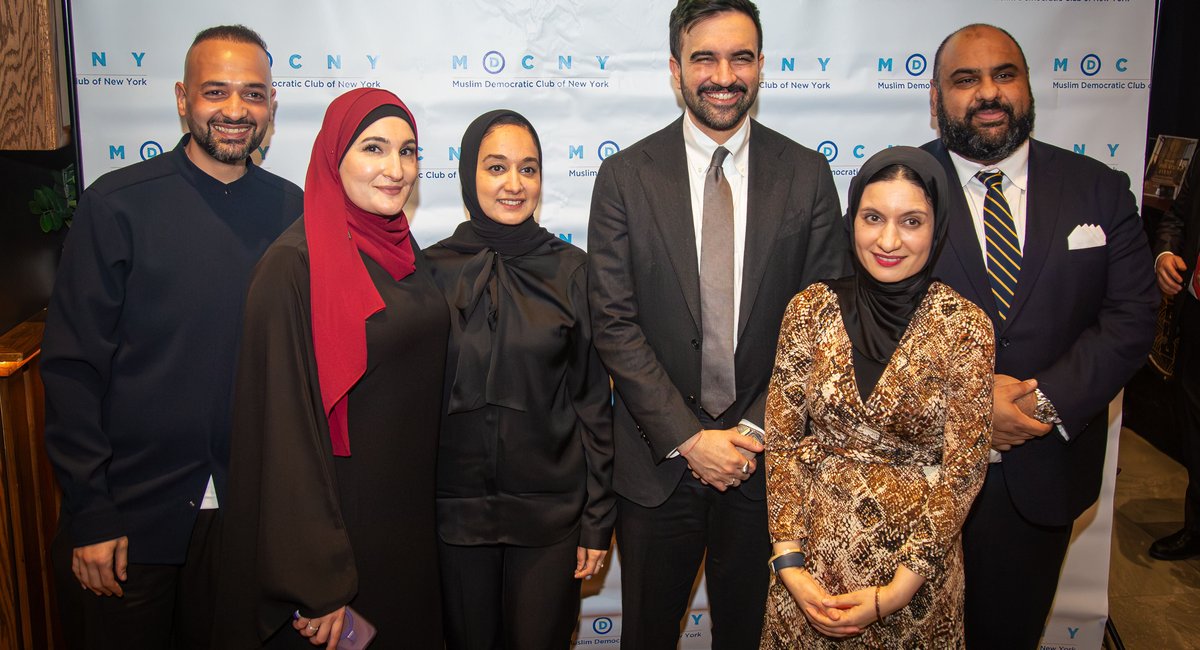
During Ramadan, Mamdani attended meals and prayers with Muslim congregations and residents citywide, including police, firefighters, delivery workers, taxi drivers, and detainees on Rikers Island. He was often joined by other Muslim officials, including Ali, Kassem, and Najmi, and they all shared a table at the Muslim Democratic Club of New York’s iftar in March.
Since Mamdani’s election, other Muslim progressives have scored major victories. Aber Kawas won the Democratic primary for a Queens state senate seat. Darializa Avila Chevalier defeated incumbent Rep. Adriano Espaillat in the Democratic primary. Abdul El-Sayed won the primary for U.S. Senate in Michigan. All ran as champions of progressive policies centered on affordability, and are vocal critics of Israel’s war in Gaza.
“ There’s a change in the ceiling of political imagination,” said Rahim. Mamdani’s win, she said “breaks the idea that Muslim identity is an electoral liability and that it needs to be managed…. I think it challenges decades of conventional wisdom about how much you have to sand yourself down to be electable.”
She added: “The promise of this moment isn’t that Muslims become a protected political class. It’s that Muslim political participation becomes ordinary. And that we get to see Muslim politicians get to succeed and fail and govern and be judged just like everybody else.”