
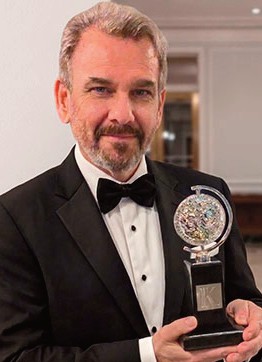

Jay Michaels is a cornerstone of the New York arts scene, with a career spanning over four decades across theatre, film, and media communications. Rising from the late-1970s Off-Off-Broadway movement, Michaels has dedicated his career to producing, preserving, and championing the performing arts. A Queens College (CUNY) alumnus, he co-founded Genesis Repertory, building a thriving Queens branch as its executive director.
His early path traversed the New York Daily News, PBS, and The Joyce Theater. As national tour manager, Michaels led iconic productions including Cats, The Mystery of Edwin Drood, and Les Misérables. His extensive Broadway promotional credits include Guys & Dolls (1992), Damn Yankees (1994), The Vagina Monologues, and Audra McDonald at Town Hall. As an elite speechwriter and marketing strategist, he has supported theatrical titans like the Shuberts, the Nederlanders, and the Weisslers, alongside luminaries such as James Earl Jones, Jon Stewart, and Hillary Clinton.
Through Jay Michaels Global Communications (JMGC), he pioneered a boutique PR model elevating indie artists to mainstream visibility. JMGC has served prominent local hubs including Queens’ Secret Theatre and Maggie’s Little Theatre and collaborated frequently with QCAN Executive Director Susan Agin on BroadwayWorld-nominated productions such as A Doll’s House and Dracula. In public affairs, Michaels serves as Chief Communications Officer for Ruben D. Cruz’s New York State Assembly campaign (District 38 in Queens). His commercial campaigns have represented BroadwayWorld Award winners and an Academy Award-winning film.
He has managed historic venues including the Jan Hus Playhouse, the Mazer Theater, and Brooklyn’s Block Arts Center and Queens Greek Cultural Center. As a communications professor, he lectures at institutions like NYU and Fordham University.
Michaels’ honors include the Jean Dalrymple Award, New York Shakespeare Lifetime Achievement Award, and a Brooklyn Borough President Proclamation. He serves on the board of the Queens Culture and Arts Network, Genesis Repertory (Chair-Emeritus), and Pace University (Honorary).
 NB: Other than the amazing diversity, what do/did you love most about living in Queens (or Queens in general)?
JM: Beyond the culinary diversity and multicultural mosaic, Queens has that “old neighborhood” feel that takes us back to our roots. Each enclave carries its own distinct personality. When we first moved here, it was recognized as a prime haven for artists seeking affordable living. My wife and I were deep in our respective lanes in Manhattan—she was working on Broadway, and I was producing high-profile events. We were thrilled (and immensely relieved) by how quick and easy the commute back home to our Astoria apartment turned out to be.
NB: How does Queens inspire you? What are some of your favorite places to be inspired in Queens?
JM: I’ve always loved visiting Kaufman Astoria Studios and the Museum of the Moving Image—and back then, every single day brought a new restaurant to explore!
NB: What advice do you have for readers who are hoping to develop their producing or directing practice? Is artistic talent innate and/or can it be taught/developed?
JM: Directing is an art of vision and translation. You can be trained to refine your technique, but the underlying fire must already be there. In many ways, directing demands a kind of mathematical precision: you have to track every minute particle of the text or frame while keeping the overarching vision crystal clear.
Producing is equally demanding. You must perceive the small details within the larger picture—and pay for them. A producer needs to feel the piece as intimately as the artists do, knowing instinctively when cutting a corner protects the production without compromising its soul. Beyond the stage, you must understand the broader culture to partner effectively with your marketing team and deliver the work to the right audience.
NB: Do you or those you work with ever get stage fright/camera shy/performance anxiety or have advice about overcoming it?
JM: Performance anxiety never truly disappears. The trick is learning to channel that adrenaline productively. In a sense, you have to yield to the tension so your survival instincts stay razor-sharp. People advocate for breathwork and centering exercises; personally, I prefer meeting the challenge head-on.
NB: What advice do you have for readers about how they can better promote themselves? Do they have to use social media?
JM: These days, virtually all promotion comes down to self-promotion. Done right, it is a highly visible, invisible art. Audiences respond when someone genuinely champions a project, when a candid endorsement cuts through the noise, and when every piece of collateral radiates authentic exuberance.
How often do you hear an exchange like this?
“Hey, did you see that new film?”
“No, not yet. Is it good?”
“Oh, absolutely!”
“Wait—did you see it?”
“No.”
“Then how do you know?”
“Somebody told me.”
Word of mouth remains undefeated.
NB: How important is personal connection and communication (networking) in your industry?
JM: In independent theater, film, and media, relationships are everything. Networking shouldn’t be treated as a series of transactional handshakes; it is long-term community building. Genuine success comes from showing up for your peers, honoring your commitments, and keeping lines of communication clear, direct, and respectful.
NB: What is the best piece of advice you’ve ever received? What is something you wish you knew a decade or two or three or four ago?
JM: Best Advice: The production begins the exact second someone says, “Let’s put on a show”—and that momentum should never drop. Early on, an Emmy-winning producer told me: Stop obsessing over the money. Love what you do. When passion drives the work, you gladly invest the extra hours, go the distance, and find genuine fulfillment regardless of the balance sheet.
Looking Back: I used to offer a philosophical, long-winded response to this question. Today, my answer is simple: be fearless and seize every opening. Imagine standing on a packed subway car when an open seat appears, and no one nearby—elderly, pregnant, or disabled—needs it. Do you hesitate before taking it? Many do. Don’t hesitate. Run for every seat.
NB: Who are some of your favorite producers, directors, actors, writers, artists, etc. with a Queens connection?
JM: Ethel Merman, Christopher Walken, Don Rickles, and the legendary Jack Kirby—the visionary Marvel artist behind so many iconic superheroes—all share the same rare qualities: thick skin, authentic grit, and singular, uncompromising talent.
NB: What are some of your favorite venues in Queens? Favorite places you’ve directed or produced in Queens?
JM: I have immense respect for the work being staged at The Secret Theatre and Maggie’s Little Theatre. They deliver the same caliber of professionalism you expect in Manhattan. In fact, The Off-Off Broadway Review, the definitive chronicle of indie theater, consistently held Queens productions in that exact high regard.
Beyond the stage? Take me to any classic Queens neighborhood diner. That’s my go-to spot every time.
NB: What do you wish more people knew about being a producer, director, PR strategist, educator, and media personality?
JM: Producing and strategic promotion are rarely about red carpets. They require relentless problem-solving, contract negotiations, meticulous logistics, and narrative development long before curtain call. To thrive in this space, you must balance profound empathy with ironclad boundaries.
NB: What is something you wish I had asked? Please let me know what that question is, and answer it. Thank you.
JM: The Question: How do independent creators sustain momentum when commercial gatekeepers look the other way? The Answer: I realized long ago that existing cultural ecosystems were simply built by other people—meaning we have the power to construct our own. If mainstream outlets ignore the work, build your own distribution engine. That has been my mandate at Jay Michaels Global Communications. We form direct alliances with podcasters (like Stage Whisper Podcast), indie arts publications (like Five Star Arts Journals), cultural blogs, streaming hubs (which is why we founded Channel Indie), and working journalists across tier-one outlets. When opening night arrives, we invite the entire media landscape; we welcome mainstream critics if they show up, but we know our dedicated core of indie champions and reviewers will be in the house celebrating the work. Independent theater and film flourish when artists stop waiting for institutional permission and start building their own streaming platforms, curated festival circuits, and collaborative repertory companies.
NB: Do you have any events or projects coming up that you’d like to promote?
JM: Upcoming Projects & Events:
Ruben D. Cruz Assembly Campaign (District 38): Directing promotional strategy and media engagement for his community-focused platform, including the Aqueduct Village and Community Plaza initiative.
Independent Screenings & Stage Debuts: Coordinating media appearances and keynote remarks for the September 11 premiere of the drama Black Box.
Global Bard Initiative & Channel Indie: Continuing international soliloquy workshops alongside digital streaming showcases for independent plays and musical theater.
TEDxAstorPlace: As executive producer for the HOW WE RISE streaming and live event, I oversee staging and event communication, my work ensures groundbreaking community ideas resonate far beyond the red circle.
A Full Slate: Managing an extensive roster of upcoming live events, stage debuts, and press previews.
NB: If you could choose only one theater show or production to represent Queens, what would it be and why?
JM: A large-scale production of William Shakespeare’s The Tempest, mounted outdoors in Flushing Meadows–Corona Park or Astoria Park. Its explorations of displacement, migration, reconciliation, and conjuring wonder from unfamiliar shores mirror the resilient, multicultural soul of Queens far better than any standard Broadway musical.
NB: What is a typical day like for you?
JM: Mornings start early with strategic media mapping, pitching collateral, and coordinating press placements for clients and civic campaigns. Midday is dedicated to academic lectures, student coaching, and communications consulting. By late afternoon and evening, the focus pivots to rehearsal rooms, tech runs, cultural board commitments, or attending live performances across the city.
NB: Can you tell us more about how your work with Jay Michaels Global Communications (JMGC) elevated indie artists to mainstream visibility?
JM: Jay Michaels Global Communications was established to afford independent productions the same strategic dignity, media polish, and press rigor typically reserved for Broadway institutions. By securing targeted feature stories, niche editorial coverage, and competitive festival placement, JMGC helps grassroots artists evolve from self-funded showcases into sustainable, critically recognized productions. We currently represent five properties that started as modest readings or workshops and are now finalizing Off-Broadway commercial transfers.
NB: What’s a wild story (PG-13) you have about NYC before the times of cell phones or social media?
JM: Back then, I had designated coffee shops and independent bookstores mapped out near every venue I worked with. Those spots served as my satellite offices—I’d nurse a cup of coffee and handle business from the payphone.
I also took strategic day jobs that served two purposes: they sharpened my marketing acumen (spanning stints at the New York Daily News, a commercial broadcast media buyer, and global philanthropic foundations) and granted me access to desk phones, high-speed copy machines, and executive conference rooms. To the outside world, my fledgling company projected the footprint of a million-dollar agency. When I launched my own firm full-time, I brought those exact high-stakes strategies and production standards directly to independent creators.
NB: Can you tell us more about serving as Chief Communications Officer for Ruben D. Cruz’s New York State Assembly campaign (District 38 in Queens)?
JM: Serving as Chief Communications Officer for Ruben D. Cruz’s New York State Assembly campaign in District 38 involves crafting messaging centered on neighborhood empowerment and working-class advocacy. Our focus is on highlighting actionable policy—including the Aqueduct Village and Community Plaza framework—and driving targeted press briefings to ensure local concerns are heard in Albany. Modern political discourse has fractured, and not for the better. My job is to demonstrate to everyday voters that Ruben has always been in their corner, rooted in an era when community accountability truly mattered.
NB: Can you tell us more about your theater work? Your awards?
JM: Maintaining a career across hundreds of stagings, festival runs, and honors requires relentless discipline, dependable creative allies, and an enduring respect for the audience.
The bottom line: the curtain never truly falls, and the house lights never really come up. Every project is simply another marker on the path. Most steps push the work forward; the rare steps back provide the sharpest masterclasses. I never rest on past honors—as much as I appreciate receiving them. Accolades are simply a cup of water offered to a marathon runner mid-stride. You drink it, keep your footing, and keep running. The work itself is the marathon, and I have no desire to see a finish line.
—Nicollette Barsamian
The Local-Express interview series was originated on July 3, 2013 by Nicollette Barsamian.