
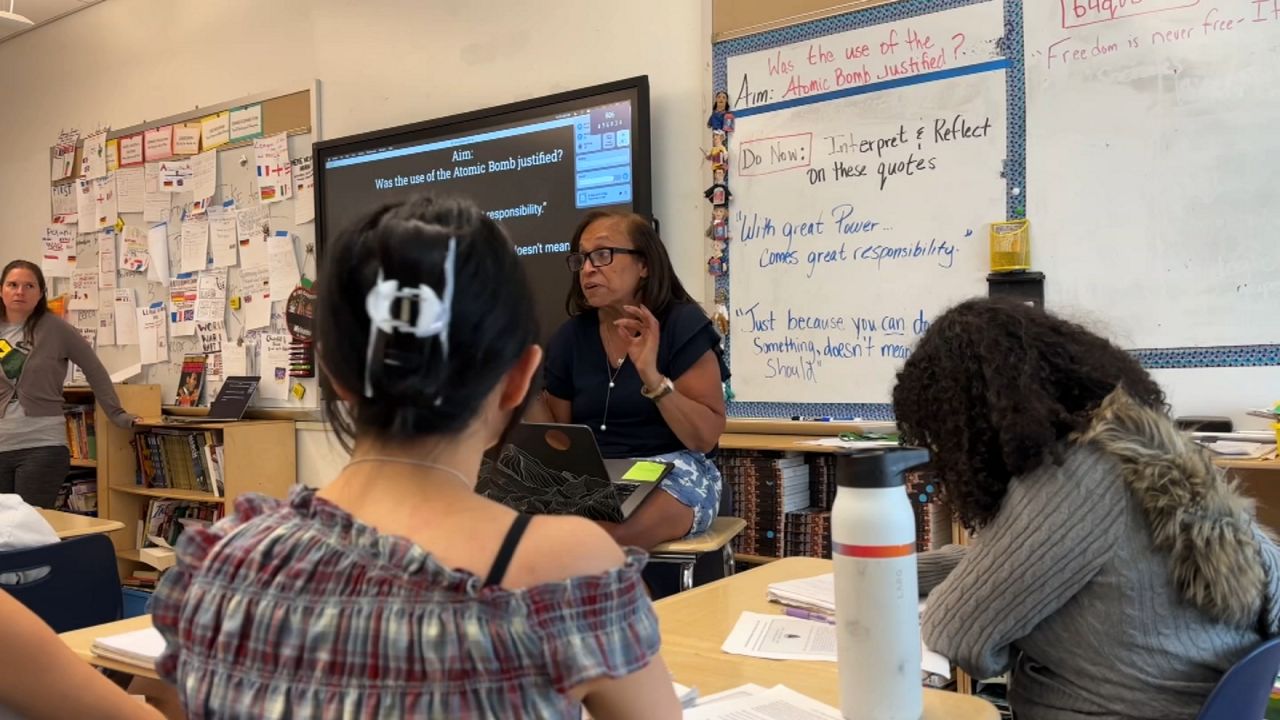
In June, Carmen Robles asked middle schoolers to debate the decision to drop atomic bombs on Hiroshima and Nagasaki during World War II, actions that killed hundreds of thousands of Japanese civilians.
“That’s you and I,” she explained to her students. “We are not military. So, bombing a school. Bombing a hospital.”
Robles teaches history. Like many New Yorkers, she has also lived through it. On Sept. 11, 2001, she left her apartment in Battery Park City and took a cab to teach high schoolers on the Lower East Side.
Her own children were heading to school, too — her fifth grader at a school just blocks from the World Trade Center.
“I was taking care of other people’s children, without knowing what was happening with my own, which was something I still grapple with today. And it’s 25 years later, and the thought of it is still a really hard one,” she said. “I didn’t know where my children were until much later in the day when I learned their story and how they found me.”
It was a difficult day that turned into tough weeks and months. Her youngest was at P.S. 89, which had to be evacuated. Eventually, her children reunited, found Robles, and they all walked over the Williamsburg Bridge. They stayed with family in Brooklyn until November, when they could return home to a neighborhood that had not yet begun to recover.
“The fires burned until, oh, I’d say February, pretty much. And I lived there. So I was going through that every day,” she said.
It was early in her teaching career, and Robles says it shaped the way she teaches social studies.
“I don’t just teach content, I teach kids, and I teach the people: who’s affected? And I think perhaps because of this event, I teach that way,” she said. “I know that every child that comes into my class has a story outside of my classroom, just like I do.”
When discussing any historical event, she says she urges students to consider the people involved and the lasting ramifications — from 9/11 illnesses and Islamophobia after the attacks to radiation sickness and anti-Asian hate in her lessons on World War II.
Robles still lives in the same apartment, and now teaches right in Battery Park City, blocks away from the reflecting pools. For many years, her students remembered 9/11. Not any more.
“My students today, it’s something in the history book,” she said.
So each September, she shares her own personal story. This year, for the 25th anniversary, she plans to ask her students to interview someone who remembers.
“My hope is that even though it is, they are removed from it, this will bring them a connection to it, understanding and a deeper understanding, because it’s not just something that happened in the textbook. It happened to people.”