
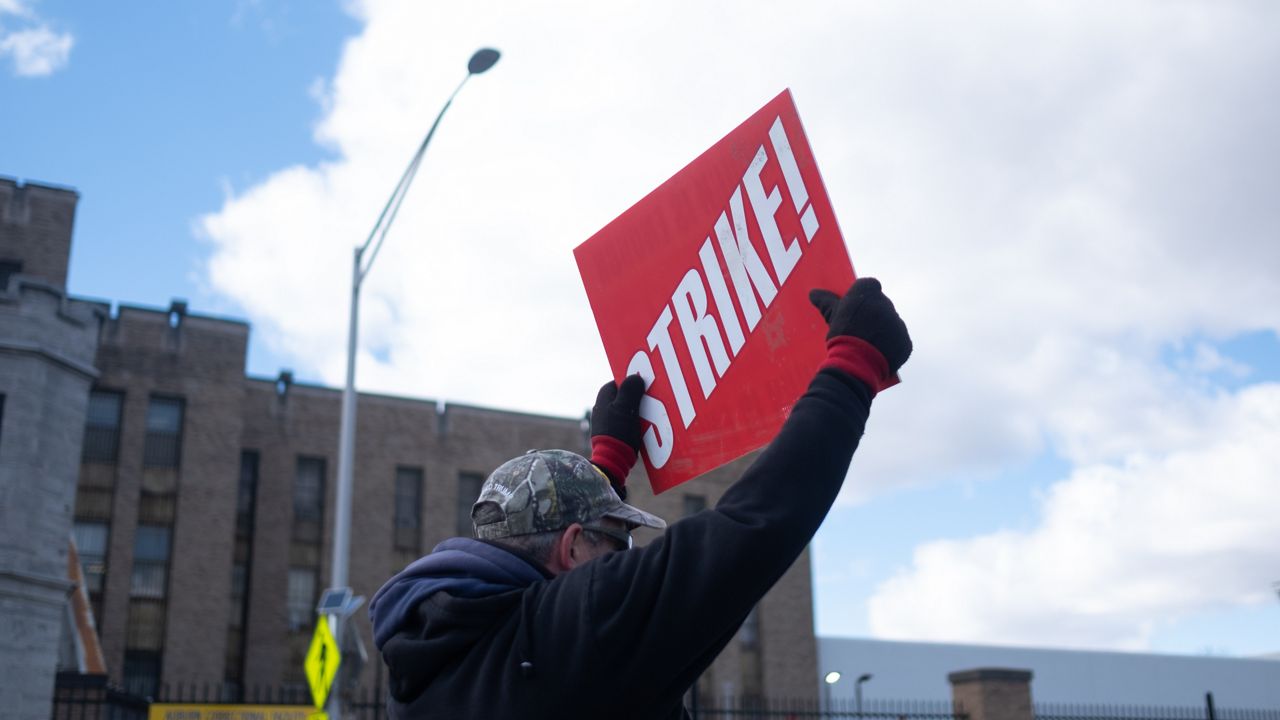
Eighteen months after the end of a three-week illegal correction officer strike that rocked New York’s prison system and exacerbated a massive staffing crisis, new data shows the number of officers employed by the state Department of Corrections and Community Supervision remains essentially stagnant.
The strike resulted in thousands of National Guard troops being deployed to state prisons under Gov. Kathy Hochul, a Democrat. Their presence continues as DOCCS works to rebuild its workforce, and the state says
DOCCS officials have repeatedly stressed that an aggressive recruitment campaign has resulted in more people graduating from the academy and additional interest in correction officer positions. But new data shows the number of officers employed by DOCCS is essentially stagnant compared with this time last year, six months after the strike and, in fact, represents a slight decrease.
“The people we talk to in these facilities who are working there don’t see help coming fast enough,” said Jennifer Scaife, executive director of the Correctional Association of New York, the state’s designated independent prison oversight organization.
Monthly reports released by DOCCS show 14,334 correction officers, sergeants and lieutenants were employed by the department in September 2024, months before the strike began the following February. That dropped to 11,319 one year ago, six months after a deal between the officers and state officials brought thousands back to work. In September 2026, that number has now dropped further to 11,113.
Scaife says DOCCS’ recruiting successes are apparently being outweighed by retention challenges.
“It appears that through whether it’s retirements, resignations, people leaving the service to find other employment they are unable to keep up with the attrition,” Scaife said.
DOCCS told Spectrum News 1 in a statement that the relative lack of change represents stabilization as the state’s “Recover, Recruit, and Rebuild” campaign continues.
“Thanks to Governor Hochul, who provided critical funding for retention bonuses, pay differentials for college degrees, and sign-on bonuses, attrition has successfully stabilized. Because maintaining low attrition is critical to increasing overall staffing numbers, these stabilization efforts have paired with intensive, targeted recruitment to produce strong results.”
But state officials acknowledge that approximately 3,000 National Guard troops remain in 32 DOCCS facilities at taxpayer expense. That expense totaled more than $500 million in this year’s budget and $1 billion total so far.
In March, one year after the National Guard was mobilized during the strike, Commissioner Dan Martuscello told Spectrum News 1 that 2,700 troops remain in state facilities. DOCCS has said repeatedly that drawdown will take place as recruitment efforts continue and ranks increase.
Scaife stressed that relying on the National Guard is not sustainable given the wide breadth of tasks within state facilities that can only be performed by a trained officer.
“It’s not a substitute and I don’t think anybody we talk to would say that it is, but we also hear superintendents say we couldn’t run this facility without the National Guard,” she said. “There isn’t a one-to-one comparison between a correction officer and a National Guard soldier. They are not authorized or empowered to do the same job as a correctional officer can do, but they can fill in gaps.“
State Sen. Dan Stec, a Republican whose district contains DOCCS facilities, implored the state to do more to address the working conditions that caused the strike in the first place, including the state’s HALT solitary confinement law.
“If you look at the legislation and you look at the policies, very little has been done to address the core issues. Don’t take my word for it, go talk to people in corrections,” Stec said. “People aren’t taking these jobs because they’re still unsafe, they’re still understaffed, they’re still catering to the criminal rather than the safety of the men and women that work there.
Scaife, meanwhile, argued that a wholesale reimagining of the state’s facilities is in order.
“Modernizing the place so people have access to the outside world, staff included, changing the physical environment so it’s not as oppressively hot in the summer, so it’s not as depressing and crumbling and decrepit,” Scaife said.
The New York State Correctional Officers and Police Benevolent Association, which represents correction officers, also blasted DOCCS Wednesday for moving to expand holiday visitation effective Labor Day. The union called the move a slap in the face to correction officers who it says are still unable to staff facilities without mandated overtime.
A spokesperson for Hochul echoed DOCCS in touting recruitment efforts since the strike.
“Governor Hochul has made it clear that the safety of all New Yorkers — including correctional staff and incarcerated individuals — remains a top priority,” the governor’s office said. “ Following last year’s illegal work stoppage and in response to the nationwide staffing crisis of corrections officers, Governor Hochul has made unprecedented investments in recruitment and retention to support staffing, and she remains committed to will continue working with DOCCS to improve conditions for staff, reduce violence and make DOCCS facilities safer for all.”