
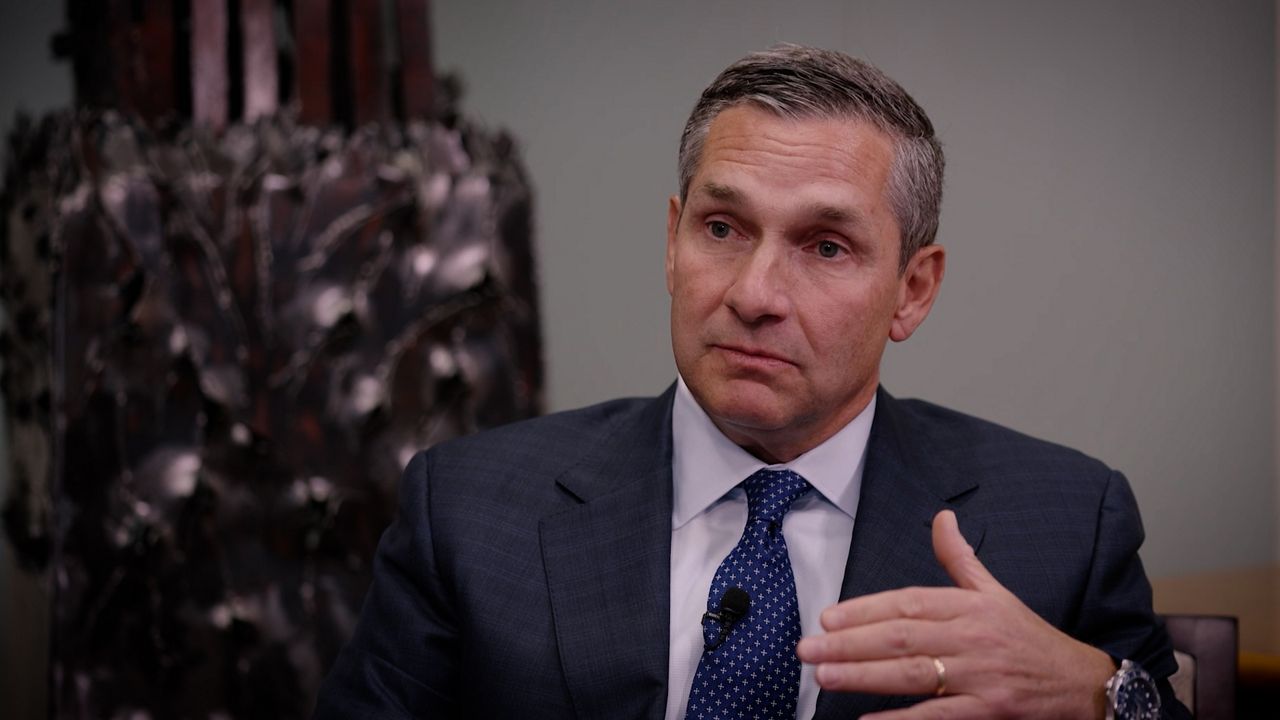
Tom Michaud went up to one of his colleagues with a simple request on Monday: Could he be ready to handle an early presentation the next day?
Michaud was taking clients to a Michael Jackson concert at Madison Square Garden and thought it could be a late night. The meeting was slated to start at 7:30 a.m. Tuesday, Sept. 11, 2001.
It was no problem, Michaud’s colleague told him. Michaud worked at Keefe, Bruyette & Woods, an investment bank with offices on the 89th floor of the south tower of the World Trade Center.
That Tuesday morning, Michaud said he knew he had a little extra time when his 4-year-old son surprised him as he was getting ready for work. Normally, he would have his wife help him out. But that morning, Michaud spent a couple of minutes with his son before getting him into bed to sleep a little longer.
Those couple of minutes were the difference between Michaud making his usual train — and, like that morning, having the doors close in his face.
Michaud took the next train, and while he was about to cross the street to get to the World Trade Center, American Airlines Flight 11 slammed into the north tower.
“I ran for a few blocks north to try to be safe in case the building fell,” said Michaud in an interview with NY1 this summer.
He called the offices at KBW and asked to speak with the co-CEO, Joe Berry, who was Michaud’s direct boss.
“While I was talking to him, the announcement came over the PA, which we listened to together,” Michaud recalled. “The announcement said, ‘There’s been an accident in the other building. Remain in place. Stay right where you are.’”
Michaud told Berry he was going to head back to the office. Berry responded that they would be there.
As he walked back, Michaud said he saw something seared into his memory: people jumping out of the north tower. He said he shut his eyes. Then he heard a loud boom.
He opened his eyes, seeing the explosion in the south tower as United Airlines Flight 175 hit the building.
“And I knew that this explosion was below where my floor was, and that my friends who I just talked to and colleagues were there,” he said. “And it was at that time that NYPD showed up and said, ‘Everybody’s got to go.’ And they started to move us.”
Michaud said he slowly walked north, knowing his world had changed and unsure what was happening with his friends and colleagues just above where the plane hit.
“And I slowly walked north and I said, ‘My world, my life has changed. New York City, everything’s changed forever,’” he said. “What just happened? Will I ever come back to New York City? Are those people still alive?”
As he walked north, suddenly the people around him gasped and stopped. They were looking south.
“I turned around and I watched the building collapse,” Michaud said.
Back in Connecticut, Michaud’s mom had no idea if he was alive. Knowing she was home alone, Michaud said two family friends went to his mom’s house to keep her company.
“Two of our family friends’ wives — I will be forever grateful — went to my mom’s house knowing that my mom was alone, knowing I worked in the World Trade Center,” Michaud said, holding back tears. “Knowing that it could be a bad ending, and knowing that they wanted to hold my mom’s hand because they knew her growing up in town.”
After the north tower was hit, Michaud had left a message at home for his wife to let her know he was OK. However, he couldn’t get ahold of her for a while after the south tower fell.
“That was a pretty emotional phone call I’ll never forget,” Michaud said about when he was able to get through.
Then he got some other colleagues who he knew weren’t in the building that morning.
“We’ve got to find everybody,” he remembered them all saying. “Why don’t we have everybody on this call take a certain number of names and contact and find out where everybody is.”
Michaud’s first call was to Dave Campbell, who worked for him in the sales office.
He called Campbell’s home phone number. His wife, Cindy, picked up, and he said it was clear she had been crying.
“I said, ‘Cindy, this is Tom. I’m calling to see if you’ve spoken to Dave today,’” Michaud remembered. “And she said, ‘Yes. He called from his cell phone to say goodbye.’”
Campbell was trapped inside the south tower.
That was Michaud’s first phone call.
He said each one after ended similarly.
“Everybody I called did not survive,” he said.
Joe Berry, whom Michaud had talked to after the north tower was on fire, was among those who died in the south tower.
“There’s no chapter in any textbook that I ever read that said, ‘What to do when terrorists kill 2,000 people and 38% of your colleagues in a terrorist attack,’” Michaud said. “What do you do when that happens?”
Their research department, sales team and trading group were wiped out, Michaud explained.
He said the remaining leadership had to decide whether to move forward as a company. At that time, KBW was in negotiations to be sold to a large financial services firm. That Friday, Michaud said there was supposed to be a board meeting about the potential acquisition.
In the end, Michaud said they would not pursue the sale and would rebuild, however long it would take.
The first priority, however, was to help the families of the victims. Then would come getting the business on its feet.
The firm established the KBW Family Fund to provide financial assistance for these families — a fund that continues to exist to this day.
Michaud said KBW employees were assigned to check in on the families of the victims — to help in any way they could. Grief counselors were brought into the offices, something that Michaud said he did not take advantage of but now wishes he had.
Michaud said he poured his heart into trying to rebuild the firm.
All their books and records were destroyed in the terrorist attacks. That first week after 9/11, they were lent office space, and Michaud said they went through backup journal entries to try to recreate their recordkeeping.
“We were asking people to do things they had never done before to help out in other departments that they weren’t familiar with,” he said.
When the markets reopened on Sept. 17, less than a week after the terrorist attacks and KBW losing 66 of its employees, Michaud said the firm was just not ready.
“We asked everybody to come in on Monday so we could get together, frankly, hug it out, cry it out,” he said.
Tuesday, he said, they were open for business again.
“It was one of the biggest trading days in our firm’s history,” Michaud said. “Our clients would call and say, ‘Are you guys open? We want you back in business. We want to support you.’”
All the while, the firm was burying its own.
“I went to 29 funerals. I went to the funeral of one of our traders, and we walked out of the church in New Jersey, waited 15 minutes and walked into the funeral of my boss,” Michaud said.
The aftermath of 9/11 had taken a toll on Michaud.
“How to balance it all as a father, as a business leader and as a friend and as a husband, all of this, was really hard,” he said.
Michaud said he lost 20 pounds after 9/11 because he wasn’t eating. And at home, he struggled.
“What my wife tells me is for the first two years, after 9/11, I was pretty much absent,” he said. “I was absent because we were trying to rebuild the firm.”
Hiring people had its challenges. Not because the firm struggled to find candidates, though.
“We wanted to remember the memory of those who were killed, but we couldn’t rob our new employees of their ability to have their own identity,” Michaud said.
“We had to let them know that was OK, and that they were joining our effort to rebuild the firm to honor those who were killed.”
Michaud has since become the CEO of KBW, which was sold to Stifel in 2013.
Over the years, the firm has worked to stay in touch with the families of the 67 people who died on 9/11.
“Not all of the families have wanted to engage as much as others. But for those who wish to engage, I think at this stage of the game, it’s really personal relationships where it was much more intense in the original years following 9/11,” Michaud said. “And then I hope the families do have some pride that we’ve been able to rebuild the firm.”
Many of the families, he said, continue to wait for their loved ones to be identified by the New York City Office of the Chief Medical Examiner.
“My colleagues who were killed that day, they weren’t soldiers,” said Michaud.
“They were going to work, earn a living and go home and see their family, was their plan generally. And they were killed.”
He said he’s nervous that 9/11 will one day be reduced to a couple of lines in a history book. That’s why he said KBW was a founding sponsor of 9/11 Day, which he said has become the largest day of service in the country.
“If you want to honor the victims of 9/11 then lean in and do an act of service or a good deed on 9/11,” he said.
He said he thinks back on 9/11 often and the trauma it caused to him and so many people he cared about. And it always gives him perspective.
“When I go through life today and I think something really stinks really hard, this is bad. I realize it could be worse. I could be back on that sidewalk at 9/11 watching that horror,” Michaud said. “So when you’ve seen what the end of times might look like, you know what other things aren’t when they aren’t the end of times.”