
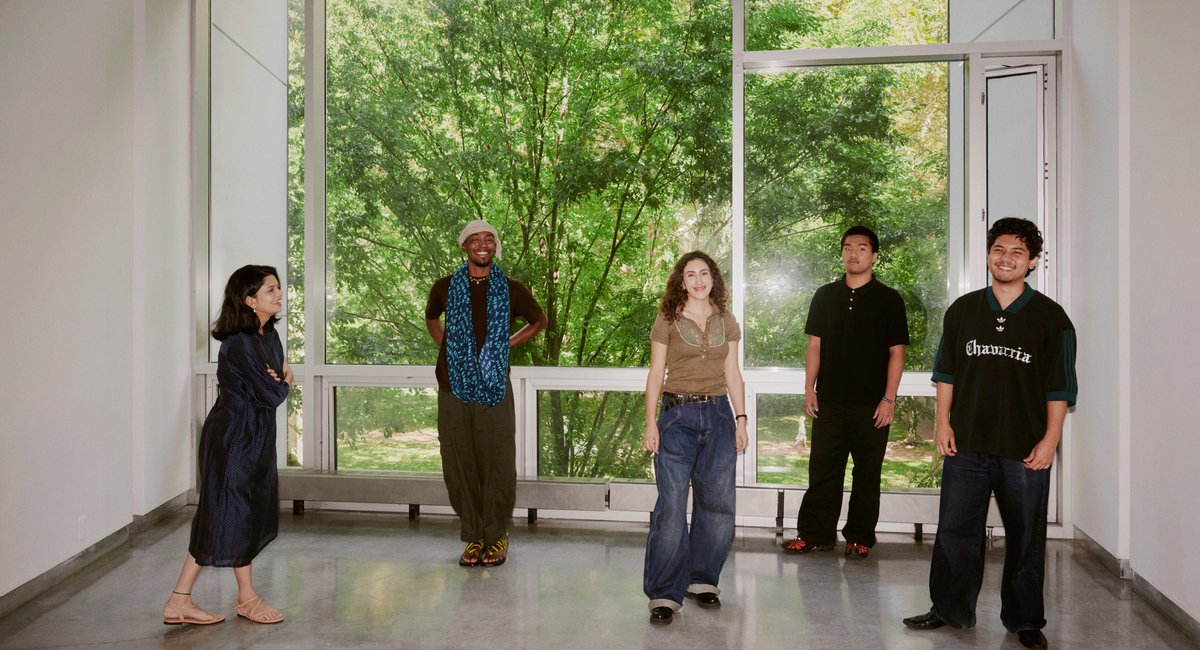
When Tabari Davis was 5, he watched an episode of “Project Runway” with his grandmother. As soon as it ended, he ran to the kitchen and grabbed a pair of scissors, sturdy tape and a trash bag. He then reached for their water jug and, using it as a makeshift dress form, fashioned a garment out of the plastic bag. It was his first original design.
“Fashion for me,” Davis said, “has always been something exploratory.”
After two decades and plenty of experimentation, Davis is attending his first New York Fashion Week as an MFA student at the Pratt Institute’s School of Design. Fashion Week spans Sept. 10-15 and will showcase the spring/summer 2027 collections of major brands, such as Ralph Lauren and Coach, and newer designers such as Conner Ives, a London-based native New Yorker known for his “Protect the Dolls” T-shirts.
With its luxurious fabrics and bold silhouettes, Fashion Week might seem like a fantasyland to the average New Yorker. But for a handful of Pratt fashion students who spoke to Gothamist ahead of the twice-yearly event, that dream is quickly becoming a reality.
Those five students met up at Pratt’s Brooklyn campus to share why they became interested in fashion design, how they’ll be participating in Fashion Week and what they make of the industry’s future.
Sophia Marquez
Sophia Marquez
Christian Delfino for Gothamist
Proximity to the Garment District convinced Sophia Marquez, 21, to attend Pratt — a school located across the world from New Zealand, where she spent much of her youth.
“New York is such an amazing fashion hub, and I just felt like Pratt was the best fit for me [because] of its focus on working with your hands,” the BFA student said.
Marquez interned at SC103, a label started by Pratt alums Sophie Andes-Gascon and Claire McKinney. The pair “are inspiring because they’re not perfectionists about their work,” Marquez said. “They love to take mistakes in stride and make that a part of their brand.”
She added, “It’s funny because it’s nothing at all like ‘The Devil Wears Prada.’”
As an intern, Marquez helped manipulate fabric into unique folds and/or shapes for SC103’s upcoming collection. She also worked on the photo shoot for their look book. She appreciated the opportunities to learn from photographers, models, and stylists, and to “just be a part of the action,” she said. After graduating in the spring, she hopes to find work at a luxury atelier and — one day, much like Andes-Gascon and McKinney — start a New York business of her own.
“The Garment District is such a special place to be connected to,” she said. “The factories and the ability to produce garments locally is really, really appealing to me.”
Tabari Davis
Tabari Davis
Christian Delfino for Gothamist
Davis, 26, charted an unusual path to a fashion career: After attending Albany State University, the Atlanta native worked in social media for Walmart. As he spent time online, he began to follow more fashion accounts and noticed that Southern designers and heritage seemed to be underrepresented.
For Davis, participating in Fashion Week “means that I get a chance to put on for my city — and put on not just for Atlanta, but for those who are living in the South who do love art and culture and fashion and want to see themselves in these spaces. I want to be what I didn’t see growing up.”
As a student of fashion communication, Davis has learned that “fashion is an ecosystem.” He is writing a thesis on Afrofuturism and hopes to explore Black women’s experiences in the industry by working during Fashion Week with Darralynn Hutson, founder of Stylists Suite, a platform that helps journalists and publicists expand their reach. Davis has plans to attend indie shows put on by organizations such as Marcus Meets Malcolm and Runway 7 that “are meant to represent people and bodies that aren’t typically seen on the CFDA and official calendars.”
“All in all, it’s a chance to push fashion truly into a direction unseen,” he said.
Yogyaan Thapa
Yogyaan Thapa
Christian Delfino for Gothamist
For Yogyaan Thapa, 20, studying fashion is a way to better understand his parents’ cultures.
“My dad is from Bhutan, and a lot of their history comes [through] in their clothing and textiles,” he said. Thapa has designed clothing using those rich textiles, and incorporates “small but dramatic motifs from my mom’s side in Thailand, where she came from in Bangkok.”
Thapa is interning with Willy Chavarria, a Mexican American designer whose luxury label also draws visual inspiration from his heritage. As a BFA student at Pratt, Thapa learns about design from start to finish. But for Fashion Week, he said, his work will be much more specific: As a member of Willy Chavarria’s production team, Thapa will help coordinate logistics.
“I think production within fashion is very shadowed over,” he said. The average person “doesn’t see the time and effort [put into] picking the color of thread that’s going to be used in New York Fashion Week, to [figuring out] how many yards we’re cutting, what look is going first, what look is going last, the attention to detail on how people organize their thoughts and stories.”
Thapa aspires to work in technical design, which he defines as being “the man in the middle,” or someone who helps turn sketches into “an actual product where you can touch and feel it.”
Parul Sharma
Parul Sharma
Christian Delfino for Gothamist
Sustainability is a top priority for Parul Sharma, 27, an MFA student who once pulled threads, one by one, out of a piece of fabric to repurpose for embroidery. She uses zero-waste patterns and keeps stitches to a minimum to “reduce waste during the production stage.”
Sharma grew up in Pune, an Indian city located a few hours inland from Mumbai. She credits her upbringing with shaping her ecofriendly habits. In India, she said, “we do a lot of things which are sustainable in nature. You don’t just wear something and then throw it away. You’ll use it as a dust cloth, a mop. You’d use a T-shirt as many times as you can.”
Sharma, who is currently interning with Naeem Khan, has reflected a great deal on the current state of the industry. It’s easy to cut corners these days, she said, but having previously worked with embroidery for an Indian atelier, she knows the value of human touch. She sees Fashion Week as a high-profile opportunity to celebrate the craft of fashion and all the effort involved.
“A lot of my work is based around craftsmanship and cultural preservation,” she said, “because the craft and communities that practice the craft are slowly dying out and being replaced by technology. I hope to give those communities a platform and bring them to the forefront.”
Kalani Ramirez
Kalani Ramirez
Christian Delfino for Gothamist
New Orleans native Kalani Ramirez, 20, learned how to sew from a Mardi Gras Indian.
He used to take field trips to the Ogden Museum of Southern Art, where Marwan Pleasant, a Black Masking Indian artist, taught workshops on fashion design. “I went there a couple of times,” Ramirez said. “He taught me about beading and using [sewing] machines.”
Ramirez carried those lessons to Pratt, where he currently is a BFA student. He interned over the summer at Willy Chavarria, where he was also in production, and will be working during Fashion Week with designer Conner Ives. He learned of the latter opportunity through other Pratt students who studied abroad in London, where Ives is based.
While it is undeniably difficult to make it in fashion, Ramirez said the industry hasn’t felt as exclusive as he expected it to be. He pointed to the successes of Willy Chavarria and Karthik Kumra — a young Indian designer whose artisanal label, Karthik Research, has a New York presence — as examples of how a diverse array of designers have been able to rise in the field.
“That’s the thing I like about New York — you get to meet so many people from many different backgrounds,” Ramirez said. “I don’t think it’s harder now to break into the industry or forge your own path. If anything, the fashion industry is starting to become more inclusive.”
A classroom at Pratt.
Christian Delfino for Gothamist