
New York City schools opened their doors Thursday with a new 2-K program officially underway, new restrictions on artificial intelligence and screen use — and a new chancellor confronting some very old problems.
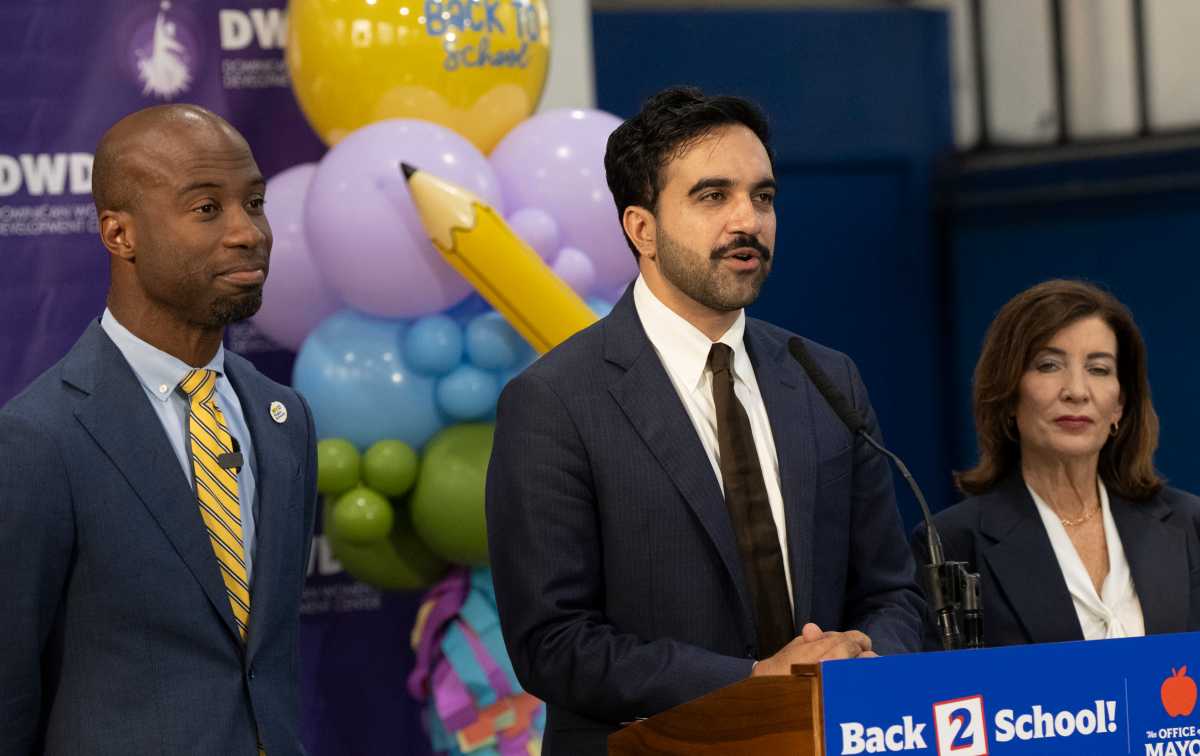
Mayor Zohran Mamdani and Schools Chancellor Kamar Samuels used the first day of classes on Sept. 10 to announce an overhaul of the school system’s procurement operation, pledging to replace decades-old contract software, train thousands of employees and speed up a process they said has long been plagued by delays and red tape.
The changes are projected to save $106.1 million over two fiscal years — $30.3 million in FY27 and $75.8 million in FY28, according to a Department of Education official.
Those savings are already reflected in the city’s FY27 Executive Budget Financial Plan, the official said. DOE expects them to come from eliminating contracts deemed unnecessary, competitively rebidding others where appropriate and strengthening management of existing agreements to better align services with operational needs and vendor performance.
Samuels said the school system’s procurement and purchasing processes have been “complex and difficult to navigate.” “We are fixing that today,” he said.
Under the overhaul, NYC Public Schools plans to train more than 10,000 employees involved in procurement and purchasing, establish procurement hubs in each borough and aim to have every procurement request or question answered within one business day, according to Samuels.
The school system also plans to replace contract-management software that officials say has not been meaningfully updated in more than 20 years.
The changes follow long-term scrutiny over how NYC Public Schools awards and oversees contracts. Unlike most city agencies, the school system operates its own procurement process, which lawmakers and advocates have criticized as lacking transparency while also being cumbersome enough that school officials have sometimes relied on smaller contracts to get resources approved more quickly.
The announcement came as the city is still working through longstanding contracting and payment problems in its early-childhood programs — problems that came into sharp focus in the run-up to Thursday’s launch of 2-K.
Just 10 days before the school year began, Mamdani and Samuels announced $43 million in funding and other measures aimed at clearing delayed contracts and getting early-childhood providers the money and supplies they needed to open.
The administration said it would nearly triple the number of staffers finalizing early-childhood contracts, restore some positions to the Division of Early Childhood Education and connect providers with interest-free bridge loans that would be processed within five business days.
The response came after funding delays left some pre-K and 3-K providers dipping into their own money or borrowing to prepare classrooms for the new school year. Gothamist reported Thursday that some providers were still waiting for money as classes began.
Asked about the delays Thursday, Mamdani said the city has registered more than 500 contracts and disbursed more than 300 interest-free bridge loans.
“For any provider that has reached out for a loan, we are turning those loans around in five business days,” Mamdani said.
Pressed later on providers having to rely on bridge financing while waiting for their contracts to be processed, Mamdani said the administration was continuing to work through the registrations.
“Our goal is to ensure that we are registering every single contract,” he said, adding that the loans are intended to make money available to providers in the meantime.
Free 2-K starts
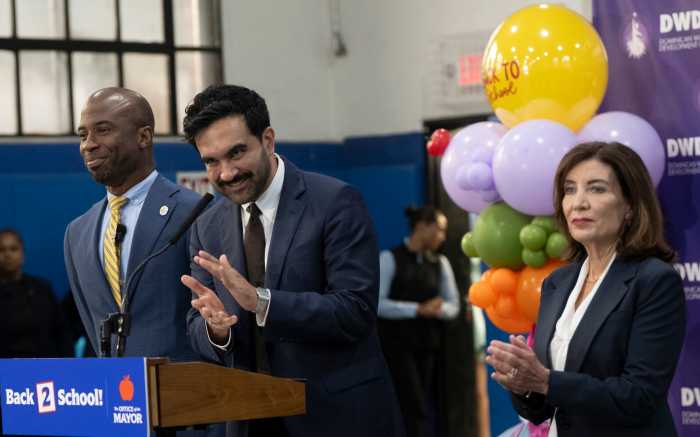 Photo by Lloyd Mitchell
The contracting problems were still unresolved as another major piece of the administration’s childcare agenda got underway Thursday, with roughly 2,000 2-year-olds beginning the city’s inaugural free 2-K program.
Mamdani, Samuels and Gov. Kathy Hochul started the morning at Mamá Tingó Childcare & Learning Center in Washington Heights, where the mayor declared it a “day of firsts.”
“For children beginning their schooling journey at places like Mamá Tingó’s and across the city this morning, today is a day of firsts,” Mamdani said. “It is the first time that they will hug their parents goodbye at the classroom door, and the first time they will form a friendship over a shared crayon.”
Demand already exceeds the number of seats available. Mamdani said Mamá Tingó alone had a waitlist of more than 100 2-year-olds and that schools had begun making offers from their waitlists.
The city plans to expand 2-K from 2,000 seats this year to 12,000 next year.
Gov. Kathy Hochul used the opening-day event to recommit state support for the expansion, saying Albany provided $73 million this year and that she is committed to $425 million in next year’s state budget to allow more families to participate.
“You don’t start something this incredible and stop it,” Hochul said.
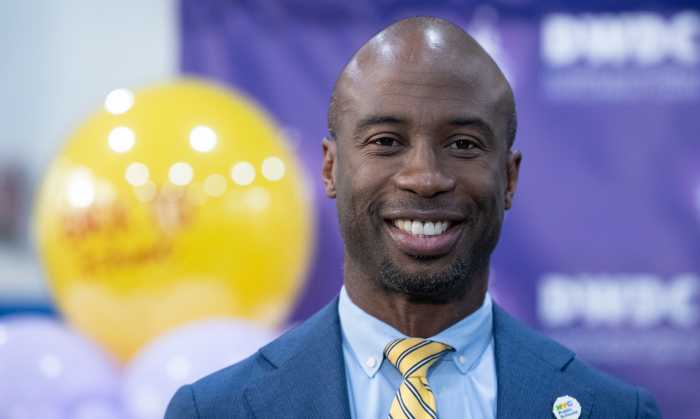 Photo by Lloyd Mitchell
For Samuels, Thursday brought another first. The longtime educator was marking his first opening day as chancellor, which he described as the school system’s “Super Bowl.”
Students across the city also returned under new restrictions on technology that the Mamdani administration unveiled eight days before classes began.
The city has imposed a one-year moratorium on most student-facing generative AI from 2-K through eighth grade, a policy City Hall says affects nearly 600,000 students. Companion AI chatbots are prohibited across all grades, while high schools will pilot five vetted AI programs under direct teacher supervision.
The school system is also reducing screen use among younger students. There will be no one-to-one device use through second grade, while NYCPS recommends daily limits of 30 minutes for grades three through five and 45 minutes for grades six through eight.
Later Thursday, Samuels brought that message to P.S. 9 Naples Street Elementary on Staten Island, where he visited fourth- and fifth-grade classrooms and a NEST classroom.
The chancellor asked students about their summers and handed out small fidget toys as he moved between classrooms. He told reporters he was looking forward to schools “connecting with kids again” and discussed the increase in children’s exposure to devices since the COVID-19 pandemic and the potential harms of too much screen time.
Asked what advice he would give parents for the new year, Samuels pointed to his own experience as a parent of two children in city public schools.
“I want to make sure our parents are present for their people and they are connecting with them and making sure they are ready to learn,” he said.
The new year also begins as enrollment continues to fall in the city’s district-run schools.
NYCPS demographic data show K-12 enrollment excluding charter schools fell to 789,918 students in the 2025-26 school year, down 21,793 students, or about 2.7%, from the year before. Kindergarten enrollment dropped more sharply, falling from 55,461 students to 52,525 — a decline of about 5.3%. Those figures are based on NYCPS’ Oct. 31 audited enrollment snapshot and do not necessarily represent enrollment as of the first day of the new school year.
School buses remained another familiar problem. Asked about recurring school-bus shortages and delays, particularly for students with disabilities, Mamdani said the city was working to get students to school through regular bus routes or, in some cases, prepaid rideshare cards and OMNY access.
He said officials were discussing procuring additional buses and training additional drivers.
When pressed on what his administration was doing differently after years of similar transportation problems, Mamdani said the school system was unwilling to accept them simply because they were longstanding.
“There is a willingness to exhaust every option in front of them,” Mamdani said, “and an unwillingness to accept something as a long-standing problem and therefore part and parcel of a school year.”