
Dr. Michael Crane treats responders at the World Trade Center Health Program’s Clinical Center at Mount Sinai Hospital.
It’s a population he’s been serving since before there was a formal program as the medical director for ConEdison when the towers fell.
“There were massive interchanges of pipelines and gas lines downtown. So many, many Coned workers went to work both on the site and then volunteered,” Crane said. “After their shift to help with the rescue and recovery. It was an extraordinary effort by very, very brave people.”
More than 59,000 survivors and 95,000 responders are registered for care, making the World Trade Center Health Program one of the largest continuous disaster-exposed cohorts followed by clinical research in the U.S.
“What we’re looking at [are] individuals who are living their lives and they’re carrying a psychological and physical burden,” Dr. Sandra Lowe of the WTC Health Program Clinical Center at Mount Sinai said. “There’s a wealth of information that we have gotten from speaking to patients.”
A study published in March found program responders are living longer than responders not enrolled in the program.
But as they celebrate the highs, they continue to help patients manage their lows. One of the most widespread outcomes among responders is depression and Post Traumatic Stress Syndrome.
“PTSD is not something that is just related to psychological symptoms,” Lowe said. “We know that people with chronic PTSD have an increased risk for cardiovascular disease, for pulmonary disease, for diabetes, and for cognitive impairments.”
Manny Foranoce is one of Lowe’s patients. He was a volunteer responder.
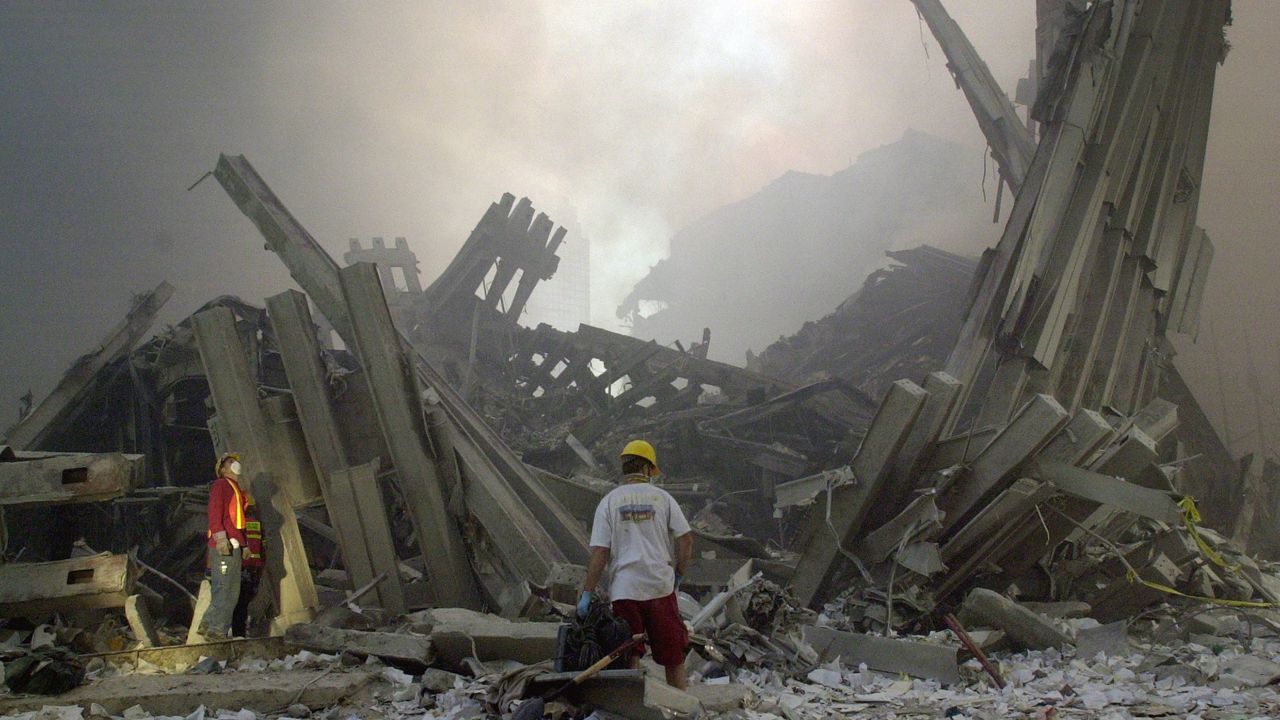
“Starting the night of 9/11, myself and 11 other guys I worked with went in and we did Bucket Brigade,” he said.
Like most others who spend time on the pile during search and rescue efforts, Foranoce soon began feeling the health impacts.
“I’ve had COPD, asthma, GERD, acid reflux,” he said. “I had to have a couple of heart surgeries. But probably the worst thing is [that] I have leukemia.”
But what he often overlooked was his mental health.
“I’m like, no, I’m fine. I don’t need any mental health or anything like that,” Foranoce said.
His perspective changed when the hidden trauma of a tragic discovery during his time in the area suddenly resurfaced at the soft opening of the World Trade Center Museum.
“All of a sudden I kind of like just like buckled,” Foranoce said. “I actually had to sit down because I couldn’t even feel my legs.”
He was triggered when he saw this firetruck — the very truck he and the brigade uncovered with the help of a rescue dog from an Ohio police team.
“Dog sits down, and the officer goes, there’s a body here. So me and my buddies start digging,” Foranoce said. “All of a sudden we hit a fireman’s boot.”
“They eventually brought over an excavator, and they dug around that area it turns out,” he continued. “There was a fire truck buried under. He was on top of the fire truck plus the eight-footed debris.”
After sharing the experience with his doctors, Forenoce realized PTSD was something to take seriously.
“There is no predictable trajectory for conditions like PTSD. So we know that some patients have symptoms early on,” Lowe said.
“Some people may not have symptoms until 10 years,” she continued. “Last week we saw five people who were coming in with PTSD that had never been certified with the program before.”
What clinicians and researchers are finding is that the connection between the body, the brain, emotions and the deadly cocktail of dust may have had even more impacts.
As the community ages, the consequences continue to ripple out.
“The types of exposures that you have, be they air pollution or traumatic, can increase your risk for dementia,” Sean Clouston of the WTC Health Program at Stony Brook University said.
And that’s what researchers at the Stony Brook University’s World Trade Center Clinic found.
“The people who were there for a long period of time never wore a mask,” Clouston said. “We’re always working in dusty conditions, they were at roughly 10 times the risk as versus someone who never really worked in the dust.”
“We’re looking at a tenfold increase in something that basically shouldn’t really happen that much,” he continued.
Clouston said brain imaging shows build-up of amyloid plaque known to cause Alzheimer’s around responders’ eyes and nose, caused by prolonged exposure to microscopic toxins in the dust around the area.
Researchers think the dust bypassed the protective blood-brain barrier.
“The dust actually gets [into] the brain itself. And then the immune system is trying to fight it off. But our immune systems hasn’t evolved to fight off pieces of metal from a building, right? So we think that maybe the amyloid is coming around for that reason,” Clouston said.
Foranoce agreed to join the brain studies.
“I’ve already gone through the second round of it, and they’re starting to see a cognitive decline,” he said.
“When you heard that, what went through your head?” NY1 asked.
“I mean, anybody hears that, it’s gonna be bad, but for myself, I live alone,” Foranoce said. “So what happens when I get that way where I can’t… I can’t bathe myself, I can cook for myself?”
“You know, you break a bone, the bone’s gonna heal, there’s a treatment for it. You lose your mind. There’s not much you can do,” he continued.
Lowe said they’re trying to prepare their patients now — for whatever comes down the road.
“It’s important to get it assessed,” she said. “There are many causes for cognitive impairment, and some of them are treatable, and you don’t want to miss an opportunity to treat something that will help reverse some of the cognitive impairment.”
The studies will continue, and Foranoce hopes it will help lead to better treatments for him — and for everyone who follows.
“At the time, you weren’t thinking about your health. All you were thinking about was, you know, we need to clear this pile up,” he said.
“I know the outcome from being there. Would I do it again? I’d do it again,” he continued. “Yeah, we would do it all over again.”
The World Trade Center Health Program is funded through the James Zadroga Act until 2090. It’s a partnership between doctors, researchers, responders and survivors that will continue to offer the world valuable information, with the potential to push healthcare forward for all.