
Two-year-old Mia was all smiles for her first week of school — a big moment for the eager child, but also for New York City, as Mayor Zohran Mamdani launched the inaugural year of free 2-K for 2,000 children.
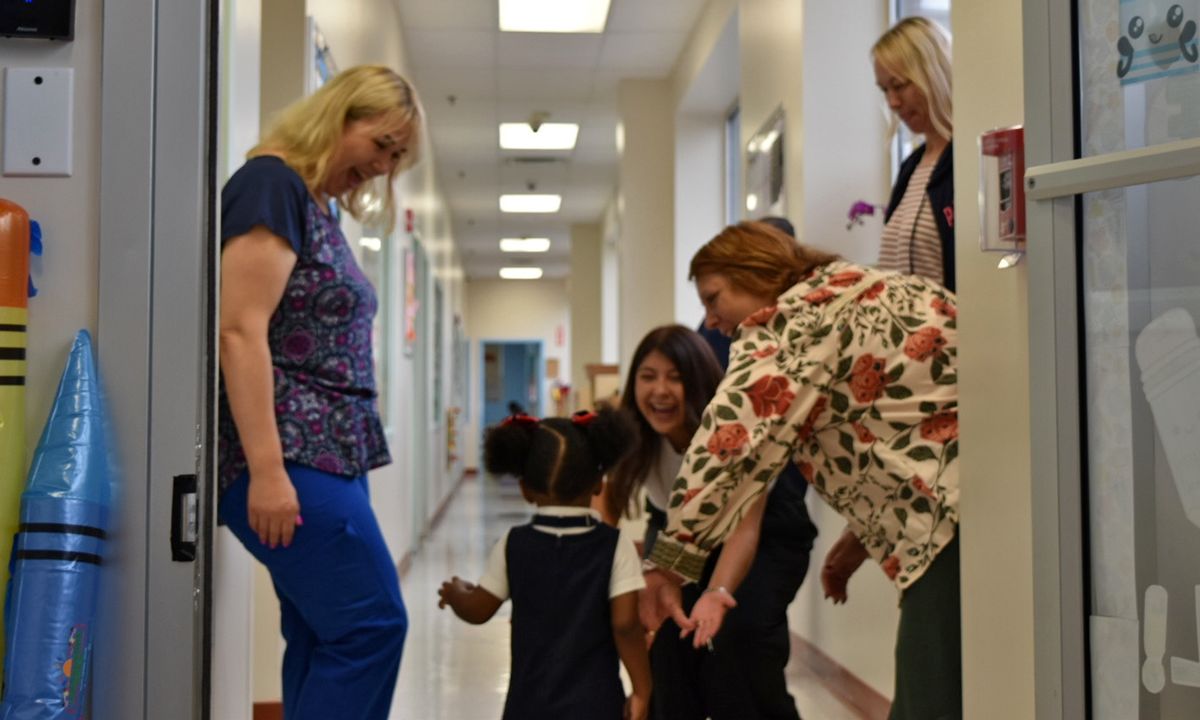
Wearing her school’s optional uniform and “ABC” bows in her hair, Mia excitedly entered the building, greeted multiple adults with “Good morning!” and hugs, and ran to the school bus balloon display for a photo opp.
“Can I see Mia?” the precocious toddler asked, wanting to approve the picture.

Mia and her aunt pose for a photo with a school bus balloon at Innovators Prep. (Amanda Geduld)
Her aunt, who dropped Mia off Thursday morning, said that when the family found out she had gotten one of the coveted 2-K slots — some 5,700 families applied — they were “so excited.” She said the rollout of the free early care and education program was a boon for the city at large — especially its toddlers.
“Sometimes at 2, if they’re not in daycare, they’re just sitting at home,” she said. “So this means a lot. It’s a wonderful opportunity.”
Mia’s new school, Innovators Prep, sits in a commercial building nestled between a hardware store and an urgent care on Church Street, in a part of East Flatbush, Brooklyn also known as Little Caribbean. It’s one of roughly 20 neighborhoods across four boroughs selected by the mayor’s office to participate in the initial 2-K rollout, based on economic need and high childcare demand.
Innovators Prep houses 24 of the 2,000 free 2-K seats, which kicked off Thursday as part of Mamdani’s signature early learning expansion plan. The weeks leading up to the launch were marked by an ongoing payment crisis, which left a number of providers without months worth of city funding and scrambling to open.
Innovators Prep is still awaiting their contract registration but just received a bridge loan from the city on Monday, Polina Ioureva, the center’s founder and CEO, told The 74. The center’s 2-K program opened two days early, on Tuesday, to align with opening day for its other early education programs, Ioureva said, and because it worked better for many of their families.
Once inside, the school is all welcoming balloons, posters, toys and music, drowning out the sounds of the city’s bustling streets.
This Childcare Program Is 100% Employee-Owned. Will It Help Retain Workers?
Mia’s aunt, who brings her niece to school because Mia’s mom is a teacher and has to be at work before the program’s 8 a.m. start, said the family fell in love with Innovators Prep on their initial tour. She described the first day drop-off as “smooth,” saying her niece is “so excited so far, and she just went right on in.”
Already school has become one of Mia’s favorite things — along with Bluey and going to the park.
Not all new learners had as easy a time separating from their grown-ups. Two-year-old Giovanni, wearing a Scooby-Doo T-shirt and construction-themed backpack, initially bounded into the building and began posing for photos and squeezing the oversized, blow-up crayon balloons in the lobby. But as soon as his mom and siblings tried to leave, he began to cry. Wiping tears from his face, he was ultimately distracted with breakfast, a toy truck and his new teacher, who came out to greet him.
“We got one in!” exclaimed one of the center’s leaders, as Giovanni headed to his new classroom, green car in hand.
Throughout the morning, the lobby of Innovators Prep buzzed with the excitement, giggles, tears, shrieks and the general organized chaos familiar to any early learning environment.

From left to right: Nicole Levine, principal; Polina Ioureva, founder and CEO; Christine Wooding, educational director; Danielle Morris, program manager, at Innovators Prep. (Meghan Gallagher)
Ioureva first opened the school in 2023, following a career as a preschool teacher, director and eventually instructional coordinator with the NYC Department of Education. In that role, she supported teachers in the same Brooklyn district she was a student in years ago and assisted with the rollout of 3-K under former Mayor Bill De Blasio.
“Now I’m able to take everything I’ve learned and bring it into the classrooms,” she said, describing her career’s many “full circle” moments. It’s been particularly exciting to see the 2-K launch from the other side, she said, and to be able to support a whole new group of families.
Emmy Liss, executive director of the Mayor’s Office of Child Care and Early Childhood Education, referred to this week’s launch as “our Super Bowl.” She said she’s already heard from many families who are “excited for what this is going to mean for their kids,” while also “allow(ing) them to save a tremendous amount of money this year.”
Mamdani’s Child Care Czar on NYC’s First-of-Its-Kind, Universal 2-K Rollout
As of 2024, the annual cost of private childcare ranged between $16,900 to $26,000 annually, according to the New York State Office of Children and Family Services. A family would need to make over $330,000 a year — the equivalent of 10 minimum-wage jobs — to afford the average cost of childcare for a single 2-year-old, according to the New York City’s comptroller’s office.
In response to questions around the delayed funding, Liss on Wednesday echoed Mamdani’s earlier comments, saying that this year’s delays “were unacceptable,” and noting that “our teams have been working around the clock over the last couple of weeks to expedite the contract registration process, get loans to childcare providers who said that they need them and just generally make sure that all providers have what they need to have a smooth opening day tomorrow.”

Mayor Zohran Mamdani and Gov. Kathy Hochul visit Mama Tingo’s Childcare Center in Washington Heights on Sept. 10. (flickr)
At the end of August, Mamdani pledged $43 million to ensure all classrooms would be operational by opening day; he also said he’d triple the number of staff working to approve contracts. The city, he said, has issued more than 300 loans and 500 contracts and was approving loans within five business days.
When asked if any centers would delay opening because of funding shortfalls, Liss replied, “At this time, we’ve been able to support all the centers who’ve reached out to us with any sort of concern.”
Still, some providers said they hadn’t received the promised bridge loans as of Wednesday and at least one Brooklyn 3-K and pre-K site sent a letter to parents saying they would be opening a week late because of funding delays, according to reporting from Gothamist. Others have taken out lines of credit in order to open their doors.
Ioureva told The 74 her center was never at risk of a delayed opening, partially due to other sources of funding she has since the site is also a 3-K and preschool. Still, she and the other leaders at her school expressed worry for providers running smaller, home-based programs, who they feared have been hit harder.
Funding and contract delays have long plagued the city’s early childhood system; they appear to be particularly brutal this year thanks to a confluence of factors, including a restructuring of the department under former Mayor Eric Adams.
Tears, Laughs & Hugs: Inside NYC’s New Free 2-K Program
Melissa Boteach, chief policy officer at the early childhood advocacy organization Zero to Three, said system problems like the ones facing the Mamdani administration are to be expected because for years “we’ve disinvested in (early education) and made it everybody’s private responsibility instead of the public good it should be” so “we haven’t really put the money into building the infrastructure.”
“But (the 2-K program is) showing that we can build big things at scale … and that’s an important reminder for people that government can do … big things that are going to meaningfully help lower costs for families and make their lives easier,” she said.
2-K Offers Are Out: 2,000 NYC Toddlers Get Spots, 5,700 Apply
The Mamdani administration has pledged that 2-K will grow six-fold next year, to serve 12,000 2-year-olds, and continue expansion until it is fully scaled, reaching all interested families, by the end of his first term. The first two years will be backed through a $500 million investment from the state, with funding beyond that still uncertain.
In the 2023-24 school year, almost 44,000 students were enrolled in NYC 3-K and just under 60,000 in pre-K.
Pancakes and ‘Baby Shark’
In Mia’s classroom later that morning, she sat among friends at a small, wooden table for breakfast. “I like to eat pancakes!” she announced. After finishing her own, she turned to another 2-year-old to her left asking, “Can I eat your pancakes?”

Anasia Allard checks in with students in her 2-K classroom. (Amanda Geduld)
Her teacher, Anasia Allard, greeted other students and moved around the woodland adventure-themed classroom. Beneath intricate vines made of construction paper that hung from the ceiling, Allard, an early educator for seven years, sang to her students and soothed some as they cried, reminding them of their breathing techniques.
Following their meal, a few students danced along to the viral hit song “Baby Shark,” before the entire class transitioned to circle time on the rug. There, Allard had all of the wiggly 2-year-olds take a seat and “catch a bubble,” a common phrase early educators use to ask students to turn off their voices and re-focus. She then sang good morning to each one, and went over the weather, date and days of the week.

Mia snacks on Cheerios from her Bluey thermos. (Amanda Geduld)
Students in the 2-K program at Innovators Prep have access to just over six hours of care each weekday, from 8 a.m. to 2:20 p.m. All families have to do is show up, and the center provides the rest, including diapers and other essential supplies. While at school, toddlers receive two meals and a snack; use of a rooftop playground; extensive programming and plenty of time for play. Students are also eligible to receive early intervention services and developmental screenings.

Students gather around Anasia Allard for circle time, where they learn about the weather and days of the week. (Meghan Gallagher)
In all, the center serves just over 100 kids, across 10 classrooms, two of which are 2-K. They currently have a 2-K waitlist of at least 200 families that at one point reached nearly 400, according to 2-K educational director Christine Wooding.
Mamdani’s expansion has also meant more 3-K and preschool kids can access programming at Innovators Prep for free, without having to navigate the city’s complicated voucher system.
Wooding said the center’s working families have already expressed how thankful they are and a number are interested in extended hours.
“They are very happy,” she said. “They have a comfortable place (where) they know their child is happy and getting the support that they need.”