
RUTHERFORD COUNTY, N.C. (WLOS) — Five days after knee reconstruction surgery, Brian Glenn was at home on crutches when his brother called to say a plane had struck the World Trade Center.
Glenn turned on the television just in time to see the second plane hit.
“That’s when I knew this is not an accident,” he said.
Twenty-five years later, the Rutherford County resident and retired New York City Fire Department firefighter is sharing his experience for the first time. Glenn served with Ladder Company 151.
“I’ve never really spoke of it, not even to my family,” Glenn said.
Before joining the FDNY, Glenn worked as a New York City police officer. He said he responded to the 1993 World Trade Center bombing after learning about it while he was at court. That experience, he said, made the collapse of the Twin Towers eight years later even more difficult to process.
“None of us thought those buildings would come down,” Glenn said.
Glenn was on medical leave when the towers collapsed on Sept. 11, 2001. When the New York City Fire Department recalled available personnel, he reported to his assigned location on crutches. He said he tried to travel with his fire company to the World Trade Center site but was turned away because of his injury.
“I said, ‘Hey, chief, I want to go with my company,'” Glenn said. “He’s like, ‘You can’t go. You’re on crutches, bro.’ So I got on the bus, and they threw me off the bus. I got on two buses, and they both threw me off.”
NEWS 13 TEAM MEMBERS SHARE MEMORIES OF THE DAY THAT CHANGED AMERICA: SEPT. 11, 2001
Glenn said he eventually found a ride in a department vehicle and made it to the site that night.
“I had to be there,” he said. “You don’t want to be hurt on the sidelines.”
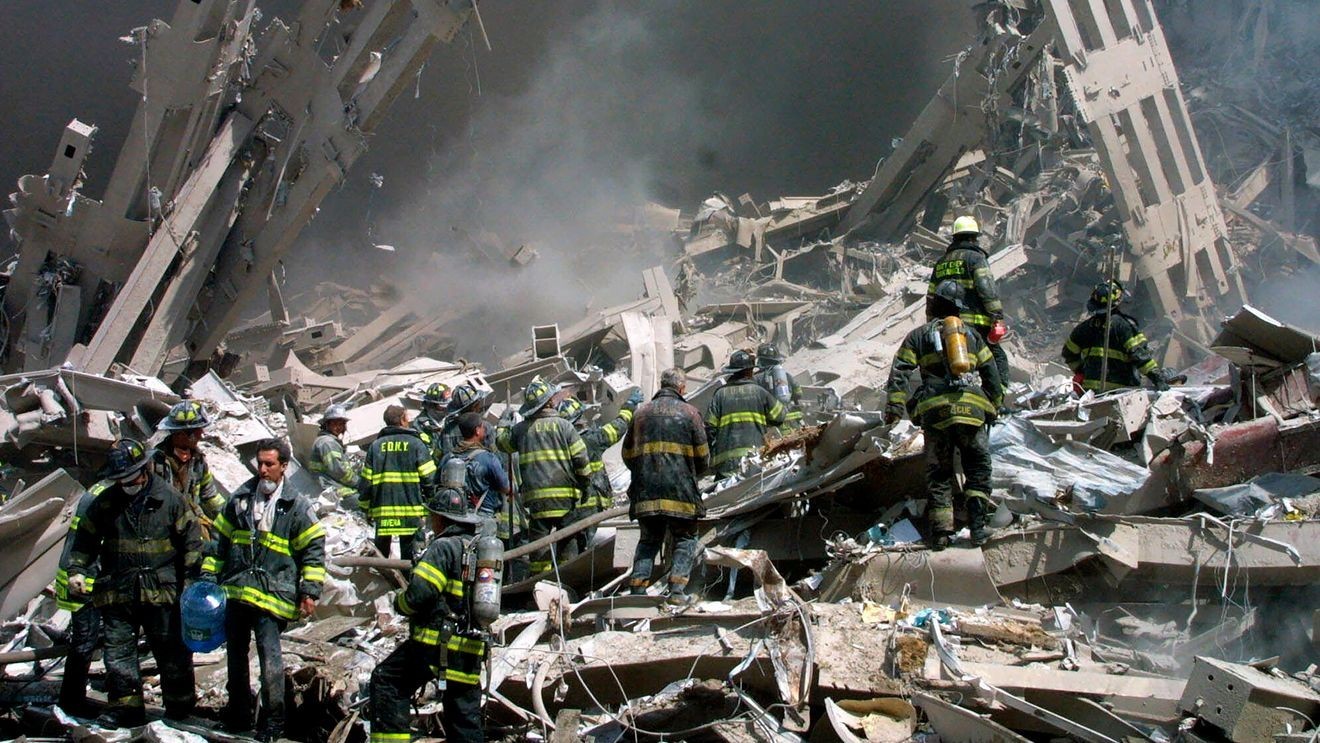
He said nothing in his public-safety career prepared him for what he saw at Ground Zero: enormous piles of rubble, firefighters working high above the ground and dust so thick it was difficult to breathe.
“There was over two million tons of rubble,” Glenn said. “It’s almost unexplainable how tall that was.”
As the days passed, the work shifted from rescue to recovery. Glenn said firefighters, police officers, sanitation workers, ironworkers, emergency medical crews and responders from outside New York worked together at the site.
“The fires had to be fought, the evidence had to be collected,” Glenn said. “The remains of loved ones and civilians had to be found.”
WNC COMMUNITIES MARK 25 YEARS SINCE 9/11
The losses inside the FDNY were personal. Glenn said he knew about 20 of the 343 firefighters killed in the attacks.
“Not only were we looking for civilians, but we were also looking for trapped brothers,” Glenn said. “You had dads looking for sons, sons looking for dads, uncles looking for nephews and nephews looking for uncles.”
For Glenn, fellow firefighters were family.
“It’s a total brotherhood,” he said. “My kids, they call this guy uncle and that guy uncle.”
He said the department attended two and three funerals a day in the weeks after the attacks.
Glenn also remembered Fire Marshal Ronald P. Bucca, who he said kept schematics of both towers because he believed the World Trade Center could be targeted again. Bucca died while responding to the Sept. 11 attacks.
The experience followed Glenn long after the recovery effort. He said he began showing signs of illness in 2005 and was diagnosed with sarcoidosis, affecting his lungs after losing lung capacity. He said doctors took him off the job he had wanted for years.
PHOTOS: TWIN TOWERS RISE AGAIN IN LIGHT AS 2,977 DRONES HONOR 9/11 VICTIMS
“A lot of us had scars and open sores on our faces from the respirators,” he said. “When I shave, I still see two scars here from mine.”
Glenn said the effects of Sept. 11 are still being carried by responders physically, psychologically and emotionally.
“It’s not over,” he said. “The guys are still suffering, whether it be physically, psychologically or emotionally from losing members.”
He said he decided to speak now because he worries people are forgetting the attacks and the sacrifices first responders made.
“I think it has, in fact, been forgotten, and it shouldn’t,” Glenn said. “We should never forget the loss and the response. We should never forget what happened that day and the sacrifice those brothers made.”
Glenn said many firefighters work second and third jobs, but pay was never why he chose the fire service.
“You don’t take this job for money. You take this job for being able to help people,” Glenn said. “My dad told me, ‘You work hard, you’re prepared to give up your today for somebody else’s tomorrow.’ That always stuck with me.”
For Glenn, “never forget” is more than a phrase.
“It’s not a slogan,” he said. “It’s an order.”