
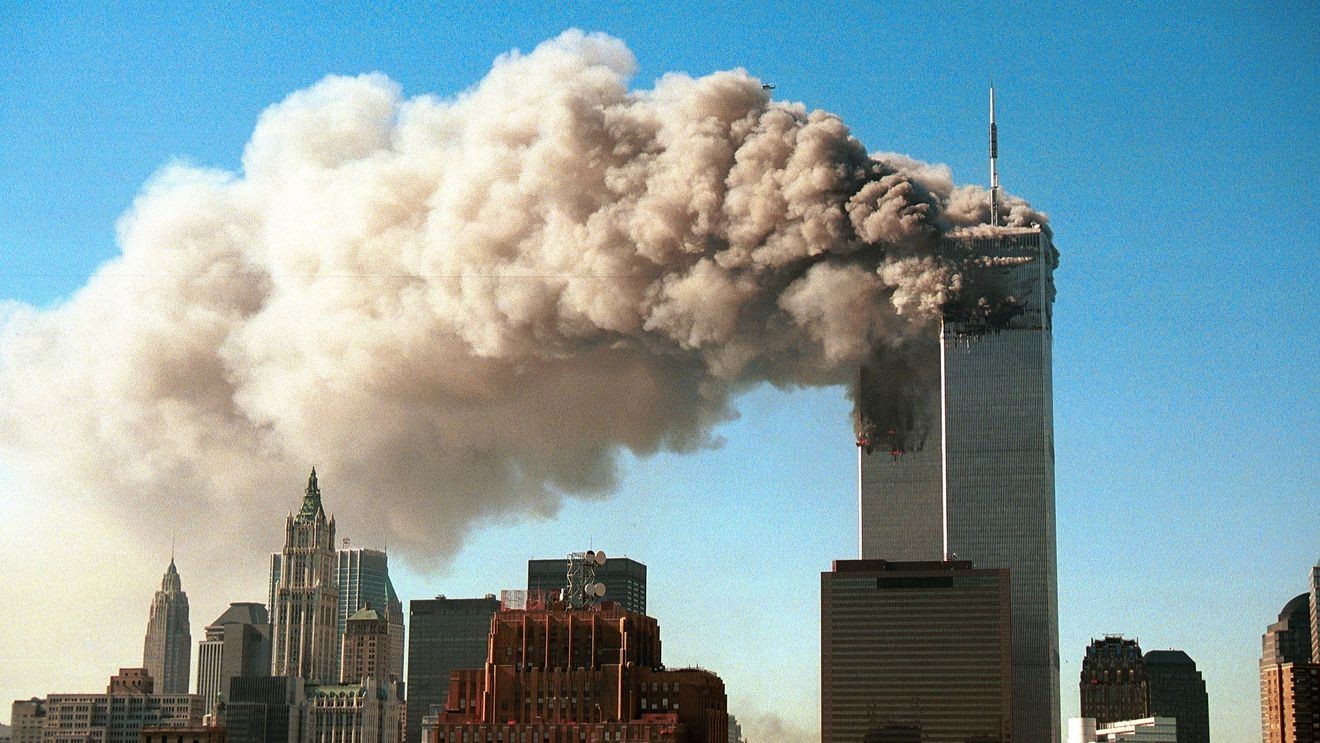
Twenty-five years after the Sept. 11 terrorist attacks changed New York City and the nation forever, retired NYPD officer Joseph Imperatrice still remembers exactly what it felt like to sit in a Staten Island high school classroom and realize his city was under attack.
Imperatrice, who went on to serve more than two decades in law enforcement and founded Blue Lives Matter NYC, was a high school senior on Sept. 11, 2001.
Speaking with The National News Desk on the 25th anniversary of the attacks, Imperatrice said waking up on Sept. 11 still brings back emotions from that morning.
“You wake up today, and you kind of have an eerie feeling that you felt 25 years ago,” Imperatrice said.
He remembered Sept. 11 beginning as a beautiful day and what was supposed to be the start of one of the most memorable years of his young life.
“My senior year, supposed to be the best year of your life,” Imperatrice said.
Then word began spreading that an airplane had struck one of the World Trade Center towers.
From his school on Staten Island, Imperatrice said students could look across Miller Field toward Manhattan and see one of the towers burning.
For many of the teenagers around him, the fear quickly became personal. Staten Island was home to countless families with parents and relatives working in Manhattan, including some who worked in or around the World Trade Center.
Cellphone service was overwhelmed, leaving students unable to reach their families.
“Every time you tried to make a phone call, it was a busy tone, or it didn’t go through,” Imperatrice recalled.
“All these kids started getting frantic,” he continued. “They’re 14 to 17 years old in high school and they’re crying and wondering, ‘Is my parent alive? Are they okay?'”
Imperatrice’s father was an active NYPD officer who had just returned home after working an overnight shift.
When Imperatrice left school, he found his father sitting at home waiting for the call he knew could come.
When a major emergency strikes New York City, police leadership can cancel days off and call additional officers to duty. Imperatrice said his father eventually received the order to return to Manhattan.
“My dad was there waiting for the phone call, which he ultimately got, saying, ‘You got to head back to Manhattan,'” Imperatrice said.
The experience would become one of the reasons Imperatrice eventually followed his father into law enforcement.
He also pointed to the leadership he witnessed from then-New York City Mayor Rudy Giuliani and Police Commissioner Bernard Kerik during and after the attacks.
“One of the big reasons is my father,” Imperatrice said of his decision to become an NYPD officer. “The second biggest reason is watching Bernie Kerik and Mayor Giuliani, their leadership skills even before 9/11.”
Giuliani’s highly visible response in the immediate aftermath of the attacks helped earn him the widely used nickname “America’s Mayor.”
“When 9/11 happened, I don’t think you could have gotten a better superhero at work, or Giuliani, to stand there, to be calm, to be the leader not just the city needed, but the nation,” Imperatrice said.
His comments reflect his personal assessment of Giuliani’s leadership. Giuliani’s broader political legacy has been the subject of significant debate in the decades since the attacks.
For Imperatrice, however, the enduring memory of that period is less about politics than how New Yorkers responded to unimaginable tragedy.
“New York City was the pinnacle,” he said. “Everyone stared at the city and wanted to be New York through such tragedy — holding up signs, loving their first responders, cheering for one another, wanting to help your neighbor.”
Today, Imperatrice worries that some of that unity has faded.
“We’re here 25 years later, and it kind of feels that people have forgotten,” he said.
The 25th anniversary is being marked across New York and the country with ceremonies honoring the nearly 3,000 people killed in the attacks and those who have died from 9/11-related illnesses in the years since. At Ground Zero, victims’ family members gathered to read their loved ones’ names, accompanied by seven moments of silence.
Imperatrice said the anniversary should remain focused on those families and first responders rather than contemporary political disputes.
“We have to stop with the politics — the Democrat and the Republican,” he said.
He specifically pointed to children who grew up without parents killed in the attacks and families that continue living with the consequences.
“So many little girls and little boys that couldn’t have their parents there for a dance recital, or to throw a baseball, or to see their first communion, or maybe even walking down the aisle,” Imperatrice said.
The health consequences also continue 25 years later. The FDNY has highlighted the lasting illnesses experienced by members who participated in rescue and recovery operations at the World Trade Center as part of its anniversary commemorations.
Imperatrice also pushed back when he was described during the interview as a hero because of his own law enforcement service.
“I don’t consider myself a hero,” he said.
Instead, he reserved that word for those who responded on Sept. 11.
“The men and women that ran to those towers that day — those were heroes,” Imperatrice said, also recognizing the passengers and crew aboard Flight 93, military personnel, paramedics, firefighters, police officers and Port Authority officers.
“Those are the people that I wake up every day, aspire to be,” he said.
Imperatrice said the response to Sept. 11 demonstrated how ordinary people could rise to extraordinary circumstances.
“Everyone that day thought it was a normal day,” he said. “Look how they stepped up. Look how they put their superhero cape on and made things so special in such a time of tragedy.”
For many Americans, memories of Sept. 11 are also inseparable from what happened the following day.
Flags appeared across neighborhoods. Strangers helped one another. First responders were embraced as symbols of courage, and communities came together despite political, cultural and religious differences.
Imperatrice said that sense of unity remains one of the most important lessons for younger Americans who were either too young to remember the attacks or were not yet born.
“You have to let them know how special it was,” he said. “You have to let them know that we have to continue to look towards the future, to not allow evil to take over like it did in 2001.”
He also argued that remembering the attacks means understanding the continuing importance of counterterrorism efforts and information sharing among law enforcement agencies.
“We’ve gotten to a point in America that nobody thinks it could happen to them,” Imperatrice said. “No one thinks that something as bad as that can happen, and it can.”
Twenty-five years later, the World Trade Center skyline has been rebuilt, an entire generation has grown up without firsthand memories of that morning and New York City has changed dramatically.
But for Imperatrice, Sept. 11 remains vivid: the burning tower visible from Staten Island, classmates desperately trying to reach their parents and his father waiting to be called back into service.
And as the country marks a quarter-century since the attacks, he believes remembering what happened on Sept. 11 also means remembering how Americans responded on Sept. 12.
“We have to look at things and say, let’s put our pride aside,” Imperatrice said. “That was when America was America.”