
This column originally appeared in On The Way, a weekly newsletter covering everything you need to know about NYC-area transportation.
Sign up to get the full version, which includes answers to reader questions, trivia, service changes and more, in your inbox every Thursday.
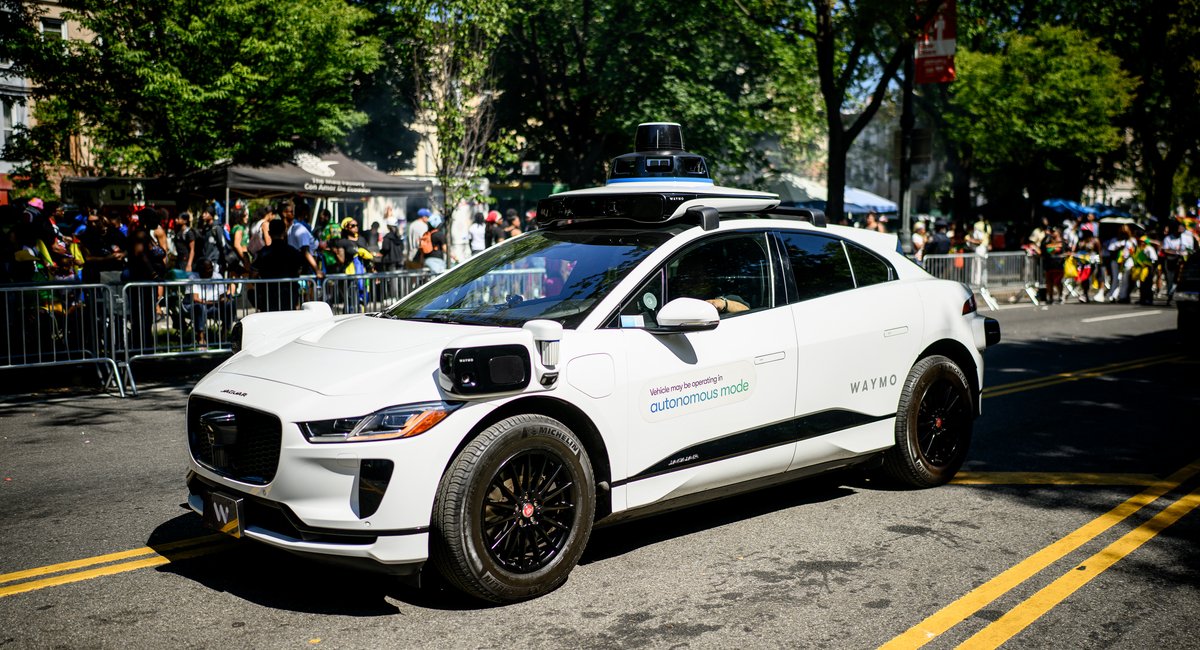
A recent kerfuffle between Waymo and a new transportation research program at Hunter College led by former city traffic commissioner Sam Schwartz reveals the deep division and distrust over the future of robotaxis in New York City.
The clash began in July, when Schwartz’s transportation research team released a flawed report that attacked Waymo’s safety record.
The researchers claimed Waymos were less safe than New York City’s for-hire vehicles. The authors then retracted the study after Waymo pointed out significant flaws in the analysis. A revised version of the report, released a few weeks after publication, found Waymo taxis had “62% fewer crashes resulting in an injury and 87% fewer crashes resulting in a serious injury or death when compared to New York City for-hire vehicles.”
“ The first study was very critical, and then on a second look, it was like, well, OK, maybe it’s not as bad as we made it sound, but there’s still problems,” Schwartz said.
Schwartz, a former taxi driver himself, is a leading skeptic of self-driving cars in the city. He coauthored a science fiction novel published last month, “Autokill,” about terrorists hijacking autonomous vehicles to murder thousands of people.
Schwartz’s retracted report and publicity surrounding his new book amounted to a one-two punch against the Silicon Valley-backed robotaxi industry.
“Public policy conversations about how to responsibly bring autonomous vehicles to the public should be grounded in accurate information, because of the incredible potential for this technology to make transportation safer and more accessible,” Trent Victor, Waymo’s senior director of safety science and management, wrote in a statement. “The past few weeks have been counterproductive to those conversations, and we’re glad the report has been corrected.”
In an interview, Schwartz threw another curveball: It turns out he had a pleasant experience riding Waymo taxis with his wife on a recent trip to San Francisco.
“I felt completely safe, and I thought they handled the road traffic quite well,” he said. “ I think they will prove to be safer than the conventional driver of general traffic, and professional drivers do have a lower crash rate per mile, and I believe that they will, at some point, be clearly safer than those vehicles.”
Still, Schwartz is hoping to avoid repeating what happened when Uber first landed in New York City, flooding the streets with vehicles and devastating the yellow cab industry.
“My concern is Waymo is behaving very well right now. I took perhaps a dozen different trips on Waymo. Never did it go a single mile above the speed limit,” Schwartz said. “Is that going to continue when we have 10 different companies that want to come into the New York market? Will they all adhere to the speed limits? Will they adhere to zones that are not meant for cars?
While promoting his novel he’s described doomsday scenarios where terrorist groups like the Islamic State hack into autonomous vehicles and turn them into weapons. He noted the obvious appeal for the bad guys: No need to sacrifice themselves in the process.
From a more practical perspective, the city must consider what happens to the thousands of taxi and rideshare drivers whose jobs could be at risk.
“ With autonomous vehicles we’re talking about not just an existential threat to the working conditions, which is what Uber’s business model has been, but an actual existential threat to the idea of this job at all,” said Bhairavi Desai, president of the Taxi Workers Alliance. “ What is gonna happen to all of those drivers and their families?”
NYC transportation news this week
A sneak peek of the Interborough Express. New renderings shared with Gothamist show stations slated for the Interborough Express linking Brooklyn and Queens via light rail that will feature multiple elevators and a modern look, breaking from the century-old subway system’s aesthetic. While the IBX doesn’t have a specific timeline for completion, officials have previously estimated service will be up and running in the 2030s.
Moving to the beat of the Second Avenue subway. When the Second Avenue subway’s first phase of construction began in 2007, lumber and construction outlet Mensch Supply had to pack up shop from the Upper East Side and move to East Harlem. Nearly 20 years later, it almost happened again.
MTA worker killed by D train near Yankee Stadium. The death of Moet McCullum, 41, marks the second deadly incident involving a flagger — a worker who signals train operators to stop or slow down near ongoing track work — with little experience since 2023.
MTA electrical substations lack proper maintenance. An agency watchdog report found the substations that power the subway’s third rail are not being properly maintained.
Curious Commuter
Have a question for us? Use this form to submit yours and we may answer it in a future newsletter!
Question from Nate in Brooklyn
For all the investment the MTA’s capital plans put into station upgrades like wider platforms or new elevators, I’m surprised I’ve never heard about new station entrances. It seems like a relatively cheap and easy way to expand a station’s catchment area and improve the commuter experience.
Answer
“I would like to point out that a new elevator is a new entrance,” MTA spokesperson Laura Cal-Rauch responded.
She added that those elevators are sometimes accompanied by new entrances “where it is feasible from an engineering and budgeting perspective.”
Sometimes the MTA works with developers that are building near stations to include new entrances in their developments, like at the 57th Street M station, the 50th Street 1 station, and a new entrance at Grand Central at 45th Street and Madison Avenue.