
Twenty-five years ago, the world changed.
Friday marked the 25th anniversary of the terrorist attacks on the World Trade Center and the Pentagon, as well as the heroic actions of the passengers and crew of Flight 93, who fought back against the hijackers before the plane crashed in Pennsylvania.
The devastation of September 11, 2001, left a lasting impression on the thousands of people and first responders who were in and around the World Trade Center that Tuesday morning. But its impact reached far beyond Lower Manhattan, touching the thousands who, without hesitation, traveled to New York City in the days that followed to help with rescue and recovery efforts.
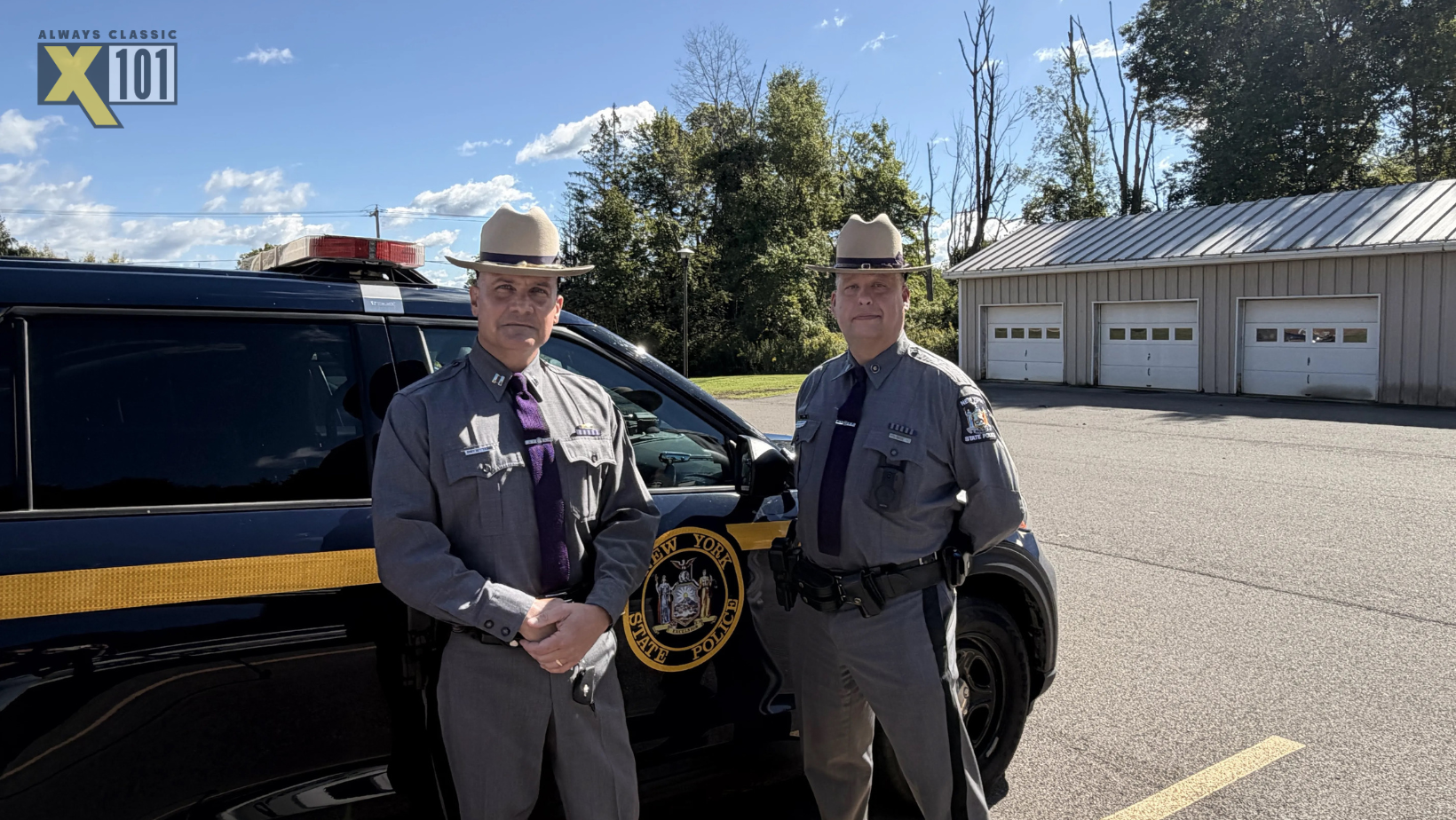
X101 News had the opportunity to speak with two New York State Troopers who reflected on their experiences 25 years ago and the mental and physical impact those experiences have had on their lives.
You can listen to our full audio interview at the bottom of this story.
Trooper Tim Neumuth was working at the New York State Police barracks in Newburgh on September 11, 2001. As news of the attacks spread, he remembers an immediate effort to determine where troopers were needed and how they could get there.
Neumuth assisted with the statewide coordination effort, including mapping routes to Stewart Airport, where troopers from across New York would gather before traveling to Manhattan in a convoy.
Stewart Airport is approximately an hour and a half north of New York City.
“The public was amazing,” Neumuth said, reflecting on the people the convoy passed along the way. “You know, we never got waved [at] so much and cheered the convoy as they were going down. There were just hundreds of troop cars because from all over the state, numerous troopers in each one. As they drove by, people just moved right out of the way and pulled over the shoulder of the road and got them down there as quick as possible.”
The response in New York City was widespread. Troopers were assigned to everything from traffic control to establishing a perimeter around the southern end of Manhattan.
“But there were also troopers that were in the morgues, over on the bridges to make sure that there were no other attacks, and some of the troopers did go down into the actual site,” he said.
Neumuth also spent time at Ground Zero. He was assigned to a post at Canal and Varick Streets, but during breaks from that assignment, he would make his way toward the site itself to help remove debris.
Before joining the New York State Police, Neumuth had served with the New York Police Department. Just two years before the attacks, he had been at the World Trade Center as an NYPD officer while working in the 75th Precinct in East New York, Brooklyn.
He remembers the disbelief of returning to a place he once knew so well.
“I remember standing there as an NYPD officer when I worked in the 75 in East New York in Brooklyn. We were there to guard the Twin Towers during a protest. And I remember, like, where did it all go? It’s just gone.”
For Neumuth, the attacks didn’t just change the skyline of New York City. They changed the people and the atmosphere of the city itself.
A city known for its hustle and bustle—and for the occasional impatient honk of a car horn—seemed to do a complete 180.
“For weeks, I mean, people were very polite and very kind towards all emergency services and to each other,” he said.
Like thousands of others who volunteered to respond, Neumuth continues to live with the physical consequences of his time at Ground Zero. He now has a 9/11-related illness that has resulted in decreased lung capacity.
Today, he serves as a School and Community Outreach Coordinator throughout the Southern Tier Region.
Despite the years that have passed, Neumuth says the importance of remembering September 11 has not diminished.
“I just don’t want anybody to forget about what happened,” he said. “This was a choice. The people that become emergency services and become police officers, firemen, we choose to do this in order to help the rest of the public. We’re the ones that run in there when this happens. If that’s something that you want to do or something that you like and you think that you can do it, please join up.”
New York State Police Captain Jason Cawley, who now serves in Binghamton, also remembers exactly where he was when he first learned a plane had struck the World Trade Center.
He wasn’t sitting in front of a television. He was working.
“We were keeping an ear to the ground. I wasn’t in front of a TV. I got dispatched to a tractor-trailer rollover accident that resulted in a fatality, and then as soon as I was done handling that accident, I went straight back to the barracks to catch up on what was going on in New York City,” Cawley said.
When he began watching the television coverage, it took only seconds for him to realize something much larger was happening.
Within about 20 seconds of watching, he witnessed the second plane strike the South Tower.
He knew then that America was under attack.
“That wasn’t an accident or a human error, it was intentional, and it was nefarious,” he said.
Cawley’s captain at the time soon instructed everyone at the barracks to leave, go home and pack a bag with enough supplies for seven to 10 days.
As Cawley was leaving the barracks, he learned the Pentagon had also been attacked.
“So at this point, nobody knew how many more aircraft there were out there or what was going on. So I drove home, packed a bag, kissed my wife goodbye, and she knew where we were headed,” he said.
There was no hesitation.
Cawley said troopers who were off duty began arriving at the barracks with their bags already packed, ready to respond.
“They weren’t ordered in, they weren’t told to come in, but they weren’t going to get kept away either. They were going to go help no matter what. Eventually they were put on orders to actually be working, but even if they weren’t, these were guys that weren’t going to be held back from going,” Cawley said.
The journey from the Southern Tier to Lower Manhattan remains one of Cawley’s strongest memories from that day.
“I’ve gone lights and sirens to an emergency before, but I’ve never quite seen anything like this. We were traveling down Route 17, the passing lane was filled with vehicles with red lights, and we weren’t taking our time, I’ll put it that way. You could almost walk from Binghamton to New York City on the top of red lights on top of troop cars and other police cars.”
Along the highways, people lined the roads and overpasses, honking their horns and cheering as thousands of first responders made their way south.
But beneath that show of support was uncertainty.
Nobody knew what was coming next.
Cawley remembers concerns that another attack could happen, potentially targeting a bridge or tunnel.
Then, as the convoy approached New York City, he saw a message that made the reality of what had happened sink in.
“We got to New York City and I saw the sign—it’s a big amber sign across the front of the George Washington Bridge—which said simply, ‘New York City is closed.’ That’s when it really hit, that the city that never sleeps is now closed,” he said.
After crossing the bridge, Cawley could see smoke continuing to rise from Lower Manhattan.
Then came the silence.
In a city of millions, the familiar sounds of New York were gone. There was no normal traffic, no crowds and no familiar city noise.
Only the quiet hum of tires.
Cawley was ultimately positioned on Canal Street in Lower Manhattan, where troopers helped close off the southern end of Manhattan as the area became what would be considered the world’s largest crime scene.
The images he saw remain vivid 25 years later.
“I remember driving on—was it 6th Avenue, the Avenue of the Americas—south of Canal Street, and we turned into a neighborhood that hadn’t been driven in since we got there. There was eight inches of fine, powdery dust with papers mixed into it, and there was an aircraft engine in the middle of the road.”
“There were no lights on, there were no people out, everything was silent in New York City. On the southern end of the island, it was a very eerie scene. My partner and I drove around also in silence, looking for people down there that we could help out or to get out.”
Those memories have never completely faded.
The smell of smoke from a house fire, burning plastic or heavy dust can transport Cawley back to Lower Manhattan in an instant.
“To process it, I embrace my scars, as we as a country also should. We should acknowledge them. I acknowledge that it transports me back there for a split second and the horror that was 9/11. I give it to God and let Him process it for me.”
This year’s anniversary was also significant for Cawley. It marked the first time he had been on duty on September 11 since the attacks.
He said he would once again relive those memories through television coverage of the anniversary.
While the memories remain painful, Cawley says his experience in Lower Manhattan ultimately became a defining moment in his career.
He had only been a trooper for three years when the attacks occurred, and he now recognizes just how traumatic those experiences were.
That understanding has helped him recognize trauma in other troopers.
“It was traumatic. I didn’t know how traumatic; it affected me for years after that. But I’ve seen other young troopers who just experienced another thing that was traumatic, either their first fatality, or if they’re involved in some other sort of critical incident, or they just saw something gruesome that really will affect them for the rest of their career.”
“I recognize that effect. I recognize that look on their face, so to speak, and we’re able to get those guys the help they need to process through the trauma that they either just experienced or they just watched somebody else experience.”
For Cawley, remembering isn’t about remaining trapped in the past. It’s about acknowledging what happened, recognizing the scars it left behind and using those experiences to help others.
After 25 years, both Neumuth and Cawley arrived at the same conclusion.
“We can’t forget.”
For Cawley, remembering September 11 is part of remembering who we are as a country.
“Especially New York can’t forget. That’s not acceptable. We are all a cumulative sum of our gray hairs, and our scars, and our good experiences, and our bad experiences. They are what make us who we are. That’s for every individual. Likewise for a country. We’re a cumulative group of experiences, whether good or bad.”
“Good—we just had a 250th birthday for this great country, and bad—we’re still dealing with a scar from 9/11. We have our gray hairs as a country, but taken as a whole, we need to remember all of the good, all of the bad, and all of the scars. If we forget that, we forget who we are, and we can’t let that happen,” Cawley said.
Neumuth believes that responsibility extends to the next generation.
“We need to teach the history to those who are younger than us to make sure that we don’t repeat that history. And to remember all those people that did give their lives and to show them that we can come together and we can help each other and be kind to each other,” Neumuth said.
Twenty-five years later, the buildings are gone, the city has rebuilt and an entire generation has grown up knowing September 11 primarily as a moment in history.
But for those who were there, those who responded and those who continue to carry the physical and emotional scars, it is more than history.
It is a memory.
It is a responsibility.
And, as both New York State Troopers emphasized, it is something we cannot forget.
X101’s Interview with Trooper Tim Neumuth:
X101’s Interview with Captain Jason Cawley: