
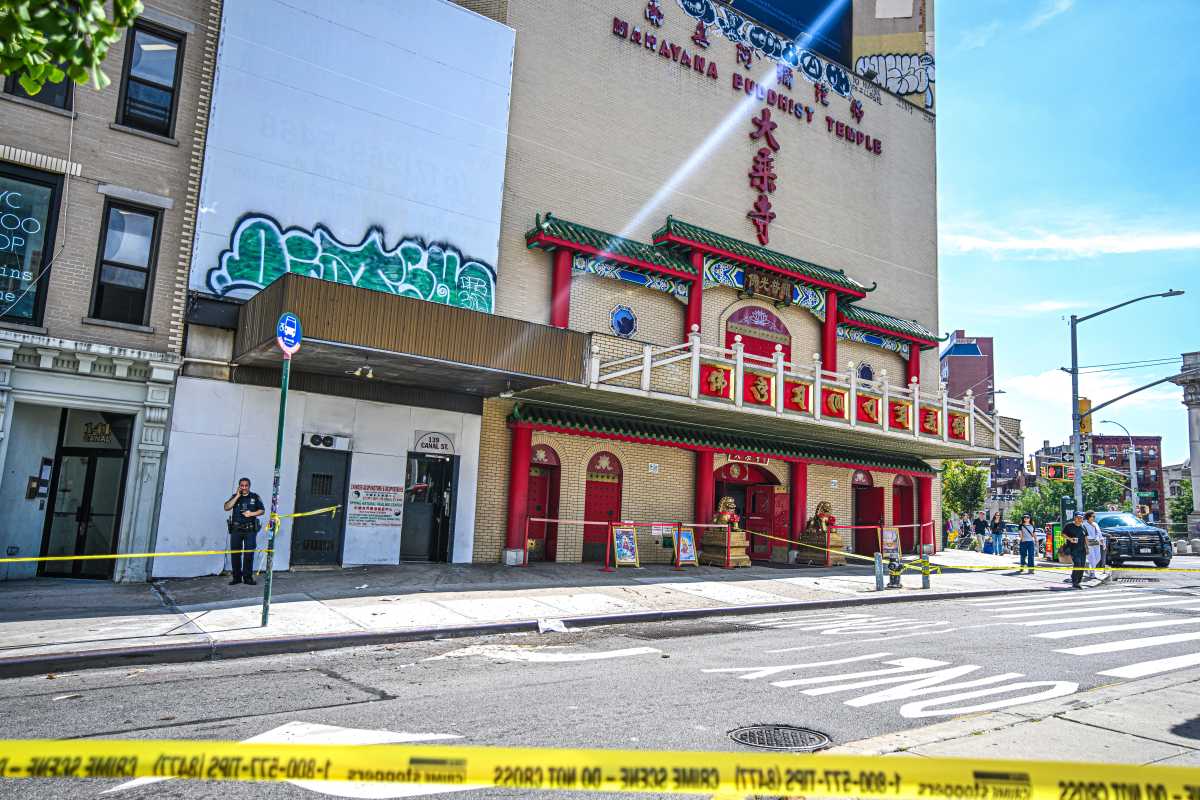
In the aftermath of a deadly crash at the intersection of Canal Street and Bowery that took one New Yorker’s life and left two others injured, safe streets advocates and community members are demanding the city immediately make the dangerous crossing safer by redesigning it and lowering the speed limit on the adjacent Manhattan Bridge.
The deadly incident took place when the 66-year-old driver of a flatbed truck stacked with wooden pallets came off of the Manhattan Bridge in the northwest-bound lane and mounted the curb on Canal Street as they turned onto Bowery, according to the NYPD.
While riding the curb, the driver struck three pedestrians, killing a 77-year-old man and injuring two women, ages 71 (believed to be the dead man’s wife) and 52, who were listed in stable condition.
The driver then collided with another truck on Bowery headed toward Hester Street.
Advocates with the groups Transportation Alternatives and Families for Safe Streets called on the city Department of Transportation (DOT) to expedite its planned redesign of Canal Street east of Broadway following the crash. They slammed the agency for prioritizing the west-of-Broadway stretch of Canal in its redesign, addressing that section this year while leaving the deadlier eastern portion for next year.
The groups also urged DOT to lower the speed limit on the Manhattan Bridge, which currently stands at 35 miles per hour, to 25 mph and add speed cameras on the crossing to enforce it.
Transportation Alternatives Executive Director Ben Furnas accused the city of delaying making critical safety improvements on Canal “over and over again” for many years.
“We are heartbroken and furious to learn that a driver has hit three New Yorkers, killing one, this morning on Canal Street,” Furnas said in a Thursday statement. “We won’t pretend this crash was anything but inevitable — if the city continues to delay critical safety upgrades on Canal Street, more New Yorkers will die.”
“Canal Street should have been redesigned years ago. The time for waiting is over,” he added.
A history of crashes at Chinatown location
The groups referenced how Thursday’s crash comes roughly a year after another one in the same area which claimed the lives of female pedestrian May Kwok and male cyclist Kevin Cruickshank.
The crashes over the past two years were just the latest of many that have led safe streets and community advocates to call for redesigning Canal.
However, DOT spokesperson Vincent Barone said the truck was traveling in the northeast exit lane from the Manhattan Bridge before crashing on Canal. He said that while the lane is not part of the agency’s planned Canal Street redesign, it is exploring more safety measures that it could install there.
Additionally, he noted that in the past year, DOT narrowed the exit roads from the Manhattan Bridge’s lower level, widened the buffer between the road and the adjacent pedestrian island, and lowered the speed limits on the bridge’s exit ramps from 35 to 20 mph all in an effort to make the exit safer.
In a statement, Barone said it “appears” the truck driver lost control of their vehicle while exiting the bridge.
“We are reviewing the circumstances of this tragic event, and our thoughts are with the victims’ families and loved ones,” he said.
Wellington Chen, executive director of the Chinatown Partnership, said that part of the challenge of the intersection between the Manhattan Bridge, Canal Street, and Bowery is that cars moving at 35 mph on the bridge must round a sharp downward curve coming off it, which makes it difficult to slow down.
“People think that the Manhattan Bridge is perfectly aligned with Canal Street,” Chen said. “No, it’s a sharp curve there, and that sharp curve is the issue. And not only is a sharp curve, but it’s a downhill slope.”
Chen said his organization has advocated for adding a flashing light before the curve to warn drivers about it.
The DOT is prioritizing the western portion of the street in its redesign due to pushback from Chinatown community opponents along the stretch who stand against the agency’s plan to repurpose parking spots in order to make wider sidewalks, according to a report from the news site Streetsblog.
Following the crash, Chen shared a message with those opposed to the project: “Give peace a chance.”
“Give it a try, for God’s sake,” Chen said, referring to DOT’s redesign.