
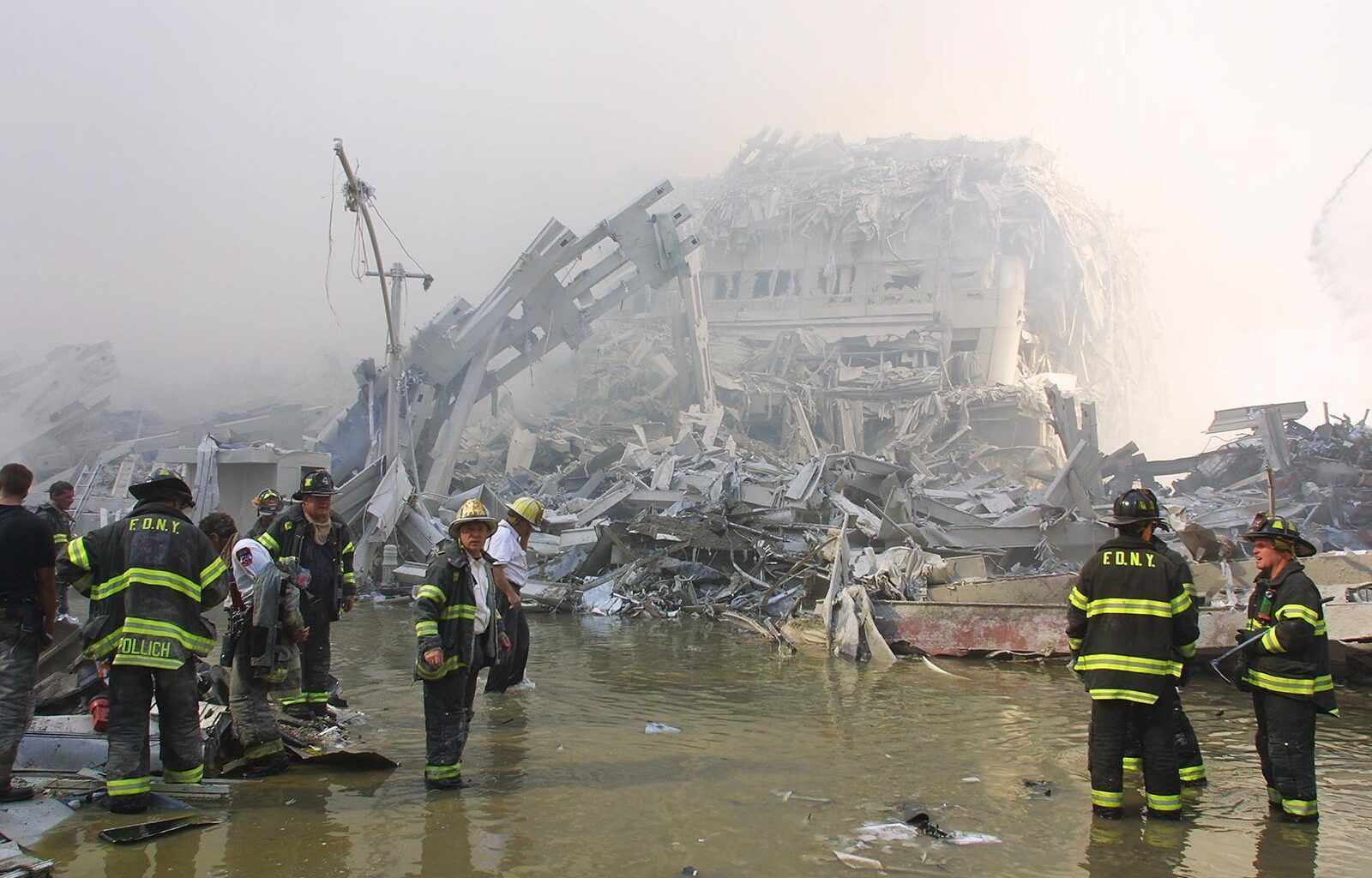
Andrew Darrow remembers the call to help look for survivors after the Twin Towers of the World Trade Center collapsed on Sept. 11, 2001.
“It was surreal,” said the Easton resident who served as a firefighter for 43 years, mainly in the Fairfield Fire Department.
“Sometimes it feels like it was 100 years ago and some days it feels like it was yesterday,” he said, reflecting on the deadliest terrorist attack on the United States 25 years later.
A day after terrorists flew two planes into the towers, Darrow arrived at the scene where the North Tower once stood. He searched through piles of concrete and steel for 24 hours straight.
“What struck me was the amount of dust on everything and the amount of papers that were everywhere on top of buildings,” he said. “It was just utter destruction. The first thing I realized is there are probably no survivors.”
And his prediction rang true.
The 9/11 attacks killed 2,977 people, 441 of whom were first responders, representing “the greatest loss “of emergency responders on a single day in American history,” according to the 9/11 Memorial & Museum.
Darrow said firefighters filled up large buckets with debris, moving them to a certain location in hopes of digging further into the structure of the collapsed tower.
But it proved difficult as the steel rods made it complicated to move in further.
“We did recover keys,” he said. “We recovered driver’s licenses. That’s all we found.”
Those living and working near the 9/11 exposure zone, including first responders, “breathed toxic air containing jet fuel, glass, fibers and construction materials and a host of known carcinogens,” according to Barasch & McGarry, the largest New York law firm representing 9/11 victims in every state, including hundreds in Connecticut.
A startling diagnosis
Darrow, 69, spent two days at the recovery site on 9/11 and continued serving as a firefighter for 23 years before he began having symptoms that were worrisome. He had difficulty urinating. He soon learned the unthinkable diagnosis in 2024: bladder cancer.
Doctors said they suspected that the cancer was present for years and a result of his rescue efforts at the WTC. Darrow said when they found the cancer, his kidney was functioning at 6%. He later had it removed.
Since the Sept. 11 attacks, 57,044 cases of cancer have been linked to the toxic air at the World Trade Center site, according to the Centers for Disease Control and Prevention’s World Trade Center Health Program.
The New York Times reported this week that while New Yorkers “were repeatedly assured that air around the fallen towers was safe to breathe,” nearly a year later, “health officials were still finding evidence of asbestos as much as half a mile away.” Darrow said he did not understand why government officials were not more forthcoming.
New York City Mayor Zohran Mamdani released 170,000 pages of city records “documenting the government’s response to the attacks,” according to Mamdani’s office.
“It was something that was kind of a poorly kept secret that the air was bad down there,” Darrow said, adding that even if he knew the air quality was toxic he still would have gone, reflecting on his call to service.
Raised in a family of firefighters, with both his father and brother serving, he referred to firefighting as the best job in the world.
“You are helping people,” he said. “It is satisfying. If you can make a save, it sticks with you and when you lose people it sticks with you.”
He said if people knew about the toxins on Sept. 11, they would have chipped in for respiratory equipment.
“I just don’t understand why they didn’t at least tell some people the truth and why they hid it for so long,” he said.
Darrow said he had two procedures for his cancer and is in remission. He must go every three months for checkups.
He is grateful for his time serving on 9/11 and remembers the construction workers and welders he met on the train bringing 3 feet long torches to help at the recovery site.
“Those are the most important people there,” he said.
‘9,600 residents have died from 9/11 illnesses’
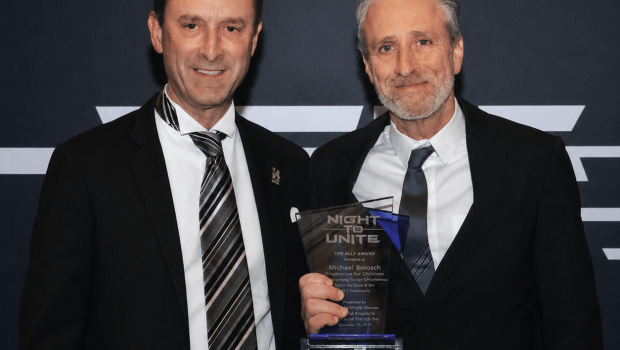 Michael Barasch, managing partner with Barasch and McGarry, who is also a Greenwich resident, has lobbied for 9/11 victims and for more funds for the Victim Compensation Fund. Comedian Jon Stewart, right, joined him in those efforts. (courtesy).
Michael Barasch, managing partner with Barasch & McGarry, who is also a Greenwich resident, said 9,600 people have died from 9/11 illnesses.
Barasch was working in his office three blocks from Ground Zero when the 9/11 attacks occurred.
“I didn’t see the first plane hit, but I did see the second plane and then the vivid memory I have, which I will never get rid of is people jumping out of buildings,” he said in an interview with the Courant. “I just kept thinking to myself why don’t they run down the stairs not knowing the airline had taken out the stairs and the elevators.”
Following the attacks, Barasch said he wanted to help victims, especially those exposed to the toxins found in the air surrounding the site.
“I represented firefighters before 9/11, so it was natural for me to hear all these guys coughing and start to lobby for them to be protected under the first Victim Compensation Fund, which was passed just three weeks after 9/11,” he said.
He said the Fund initially only provided compensation for those who died but he lobbied with many others to have those with respiratory illnesses included.
The cancer link
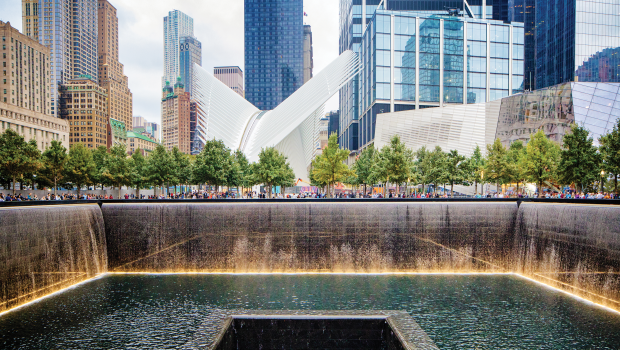 World Trade Center Memorial (courtesy)
When the Victim Compensation Fund closed in 2004, Barasch learned of numerous cases of people getting sick connected to the toxins at Ground Zero.
During that period Barasch was representing NYPD Detective James Zadroga, who developed pulmonary fibrosis, a severe respiratory illness resulting from exposure to toxins at the WTC site, according to information from Barasch’s law firm.
Zadroga died in 2006 and his autopsy report was key to acknowledging the link between the WTC “toxins” and his death, the law firm stated on its website.
Barasch said the autopsy found “ground glass, asbestos, benzene and mercury” in Zadroga’s lungs.
“If Det. Zadroga had it in his lungs, that’s when we knew what we had really been exposed to,” Barasch said. “And it explains why so many people continue to get sick and are dying now.”
Barasch said he loses two clients a day to cancers related to the toxins at the WTC site.
“I lost my secretary to breast cancer,” he said. “My paralegal, Dennis, died of kidney cancer. I’m a prostate cancer survivor. All due to 9/11 exposure.”
In the years following Zadroga’s death, Barasch’s firm continued to lobby for more aid for Sept. 11 victims.
In 2011, President Barack Obama signed the James Zadroga 9/11 Health and Compensation Act of 2010 “to extend and improve protections and services” for those impacted by the Sept. 11 attacks and expand the number of people who could access the Victim Compensation Fund, according to the CDC.
The Zadroga Act established the World Trade Center Health Program, which provides treatment and monitoring for certified WTC-health related conditions for responders to the attacks in the Pentagon, NYC and Shanksville, Pennsylvania, according to the CDC.
Barasch lobbied for more funding for the VCF with John Feal, founder of the FeelGood Foundation, union leaders and comedian Jon Stewart, which resulted in the fund extending out until 2090.
He said while the cancer cases are heartbreaking, “it is comforting when I can tell people with stage four cancer, ‘Ma’am, don’t worry, your family’s gonna be OK. Your husband and your kids won’t have to leave the house. Your kids can go to college.’”
Asked about his response to the newly released government documents highlighting that for months air toxins were present at the site, he said office workers including himself foolishly believed the EPA when they assured them that the area was safe.
“The EPA told us it was safe because they wanted to reopen Wall Street,” he said.
He recalled taking the train ride to his office at Ground Zero after the 9/11 attacks.
“When you would get out of the subway the smell would hit you in the face like a baseball bat,” he said. “It reeked. The buildings were on fire for 99 days. So we would all look at each other and say, ‘Well, they told us it was safe, but God really this is safe?’ We wanted to do our patriotic duty and get back to work like Mayor Giuliani and the president told us we should do. I feel sorry for the school children. They didn’t have a choice. I had a choice. I made a choice to believe the government.”