
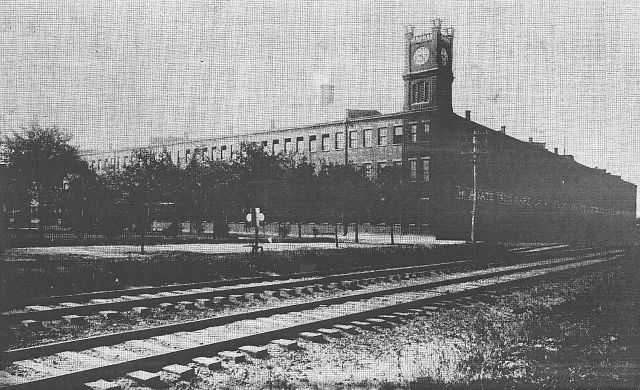
Long before Ozone Park became the neighborhood we know today, the area around what is now 95th Avenue was the heart of a thriving community known as Woodhaven Village. At its center stood a massive factory that employed hundreds, attracted immigrants from across Europe and helped transform a rural Queens hamlet into a growing industrial community.
This October, Woodhaven and Ozone Park will mark the 150th anniversary of the event that nearly destroyed that factory, and the remarkable rebuilding effort that followed. At the center of that story is Florian Grosjean, a Swiss immigrant whose vision and determination helped shape the future of both communities.
Born on Jan. 12, 1824, in the tiny Swiss village of Saule, Grosjean’s journey took him first to France and then, in 1850, to New York City. There, he launched a business importing French goods. Before long, however, he realized that manufacturing those goods locally would be far more profitable.
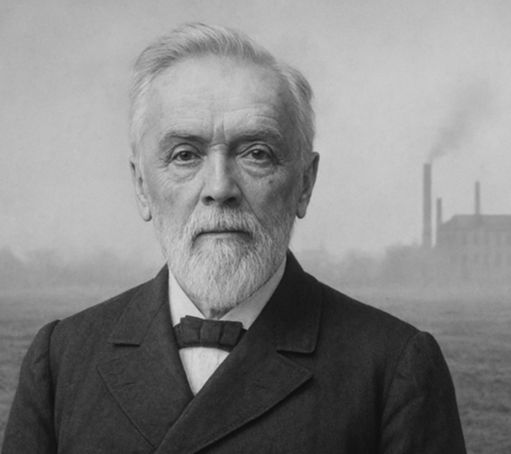 Florian Grosjean, the Swiss immigrant who came to the United States and shaped what is known today as Woodhaven and Ozone Park. Photo courtesy of the Woodhaven Cultural and Historical Society
Grosjean opened a factory in lower Manhattan, but as his business expanded, he needed more space. His search eventually brought him to Woodhaven Village, a small hamlet surrounded by the rolling hills and farmland of Queens.
Located south of Atlantic Avenue and centered along what is now 95th Avenue in present-day Ozone Park, the village offered Grosjean the room he needed. He purchased a failing chisel factory from John Sharp & Co. and transformed it into the LaLance & Grosjean Manufacturing Company.
The factory’s location near the Atlantic Avenue railroad was crucial, providing an efficient way to transport raw materials and finished products. Under Grosjean’s leadership, the company flourished. By the mid-1860s, more than 300 people worked there, a remarkable number for a village of just over 1,000 residents.
The factory became the economic engine of Woodhaven Village, attracting workers and their families and helping the community grow. Then, on Feb. 21, 1876, disaster struck.
A fire broke out at the factory, fueled by vats of molten horse fat used in the tin-plating process. The wooden structure, saturated with grease, quickly became an inferno. Despite having its own volunteer fire department, the blaze consumed the entire complex.
Grosjean’s losses were staggering, estimated at half a million dollars, a fortune at the time. But the destruction meant more than the loss of a business. Hundreds of workers were suddenly unemployed, and many feared for the future of Woodhaven Village.
Grosjean, however, refused to abandon the community. He placed all his workers on half-salary during the rebuilding process, ensuring they would not have to leave the area in search of work. Within just a few months, the factory reopened. Its new centerpiece was a magnificent stone clock tower, visible for miles and serving as a symbol of resilience and hope.
This year marks the 150th anniversary of the fire and rebuilding of the Grosjean factory.
To commemorate the anniversary, the Woodhaven Cultural and Historical Society will lead a free walking tour of the former factory grounds and Old Woodhaven Village, where much of Woodhaven’s population lived and worked in the late 1800s. The 90-minute tour will begin at 10 a.m. on Saturday, Oct. 17, with participants meeting on Atlantic Avenue at the base of the clock tower (the tour will end approximately in the same spot where we started).
Today, the area is known as Ozone Park, but in its heyday, it was the center of Woodhaven Village. Much of the village’s activity took place along University Place, now 95th Avenue. The community’s first bank and post office were located there in the old Wyckoff building, which still stands at the corner of 93rd Street.
University Place was once a bustling commercial center lined with businesses, hotels and saloons serving the many French immigrants who lived and worked in the area. Among the hotels were the Hotel de Paris, the Eagle Hotel and Theuret’s Hotel, opened by French immigrant Antoine Theuret in 1865. Theuret’s became a popular stopping place for travelers well into the early 20th century. The original building, now more than 170 years old, still stands and retains many of its architectural details.
It is easy to pass through this section of Ozone Park without realizing how much history surrounds us. The streets that seem so familiar today were once the center of a vibrant village filled with factories, businesses, hotels, saloons and working families.
And towering above it all was the Grosjean factory and its clock tower.
The 150th anniversary of the fire offers an opportunity to remember not only the disaster that destroyed the factory, but also the remarkable rebuilding effort that followed, and the immigrant entrepreneur whose determination helped ensure that Woodhaven survived and continued to grow.
For Woodhaven and Ozone Park residents today, it is a chance to look beyond the modern neighborhood and rediscover the community that came before it.