
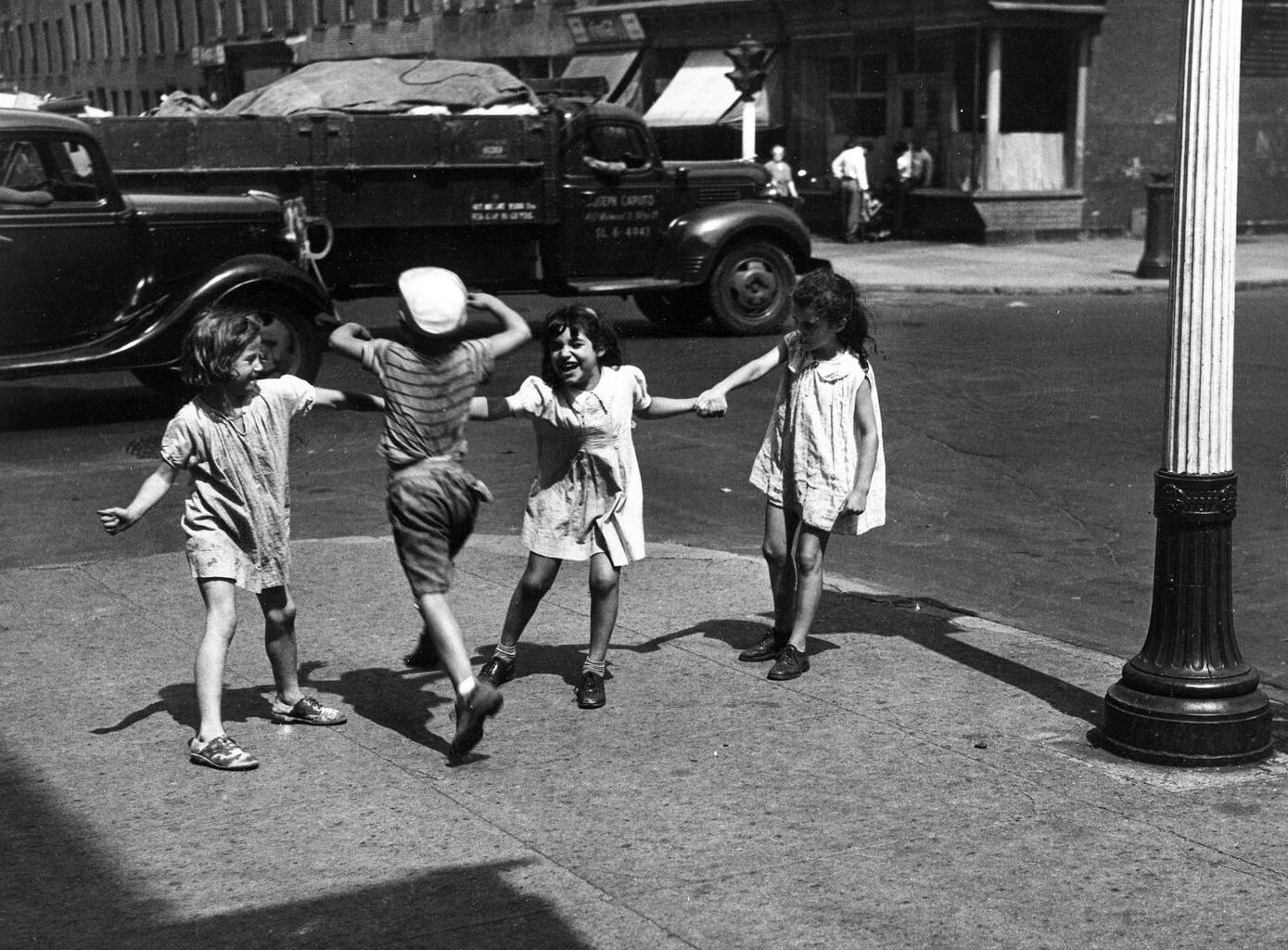
Born in Brooklyn in 1918, Arthur Leipzig traveled the world with his camera to document people and tell their stories, from Yiddish theater actors in Communist Romania to Sudanese fishermen battered by a storm.
“Chalk Games,” 1950

But it was his sensitive, evocative images of children at play on New York City streets that first won him acclaim.
And the idea of capturing these ordinary kids engrossed in stickball, hopscotch, and other popular Gotham street games in the middle decades of the 20th century came not from a teacher or a trend but from a painting by a Flemish Renaissance master.

That painting is “Children’s Games,” by Pieter Bruegel the Elder (above). Dating back to 1560, it’s a richly detailed, bird’s-eye depiction of more than 230 children playing 83 different games in a town square, from hoops to blind man’s bluff to leapfrog.
Leipzig spoke out about the effect Bruegel’s painting had on him shortly after he began documenting New York’s children’s games in the 1940s. At the time, he was a member of the Photo League, a cooperative of socially conscious photographers who chronicled the rougher edges of the Depression-era city.
“Marching boys,” 1943

“When photographer Arthur Leipzig recently saw a picture of Pieter Bruegel the Elder’s famous painting ‘Children’s Games,’ he was struck by the resemblance of games of nearly 400 years ago to those one sees today,” according to the New York Times.
The many similarities he noticed by watching children jump, run, swim, and hop from his own window proved “that boys and girls play in New York in 1950 about the same way they did in Flanders in 1560,” continued the Times.
“Divers, East River,” 1948

From the 1940s to the 1960s, Leipzig documented the children’s games he observed, as well as the dirt lots and asphalt surfaces that inventive city kids turned into playgrounds, ball fields, and game boards.
Like the cheeky youngsters in Bruegel’s painting, these New York children didn’t have specially made toys. Games could be played with chalk, sticks, hoops, or a box fashioned into a cart—most of which could be found discarded on the streets.
“King of the Hill,” 1943

Some of Leipzig’s photos share a similar vantage point with Bruegel. The first image in this post, “Chalk Games,” features a bird’s-eye view likely from the first or second-floor balcony, window, or fire escape of a building on Prospect Place in Brooklyn.
Yet Leipzig didn’t set out to copy Bruegel’s painting but take inspiration from it. He channeled its imagination and spirit from a dirt town square in Flanders to the black and white of New York’s midcentury cityscape.
“Johnny on the Pony,” 1943

Leipzig (below right photo) didn’t limit his work to children. His photos told the stories of a window washer on a skyscraper, lone pedestrians making their way under traffic lights in a storm, the romance and thrills found at Coney Island, and the joy of VE Day in Times Square.

He died in 2014 at age 96, and his children’s photos might be his best-known legacy, displaying a sensitivity to the rhythm and energy of New York’s humanity.
“The city was my home,” Leipzig said, per a quote from the Peter Fetterman Gallery. “As I look back at the work I did during that period, I realize that I was a witness to a time that no longer exists, a more innocent time.”
“While I know that the city has changed, that the streets are dirtier and meaner, the energy that I love is still there,” he said.
“Red Rover,” 1943

“No matter where I go, I keep coming back to photography New York. Of course the ‘good old days’ were not all sweetness and light. There was poverty, racism, corruption, and violence in those days too, but somehow we believed in the possible. We believed in hope.”
[Top image: Jackson Fine Art; second image: Kunst Historisches Museum; third image: Jackson Fine Art; fourth image: George Adams Gallery; fifth image: Howard Greenberg Gallery; sixth and eighth images: Brooklyn Museum; seventh image: New York Times]
Tags: Arthur Leipzig Children’s Games, Arthur Leipzig New York City, Arthur Leipzig Pieter Bruegel the Elder, Arthur Leipzig street photographer NYC, Kids in NYC playing in streets photos, New York Photo League 1940s, Photos of 1940s New York City
This entry was posted on September 14, 2026 at 1:45 am and is filed under art, Brooklyn. You can follow any responses to this entry through the RSS 2.0 feed.
You can leave a response, or trackback from your own site.