
WASHINGTON — It’s not over yet.
The Senate advanced a bipartisan deal late Sunday to end the record-breaking government shutdown, overcoming the biggest procedural hang-up that has been used to keep Uncle Sam’s lights off for the past 40 days.
In a 60-40 vote — with eight Democratic-leaning senators joining Republicans — the Senate invoked cloture to break the filibuster and move forward with a bipartisan spending patch to fund the government through Jan. 30, 2026, as well as a “minibus” package that will fully restore food stamp benefits.
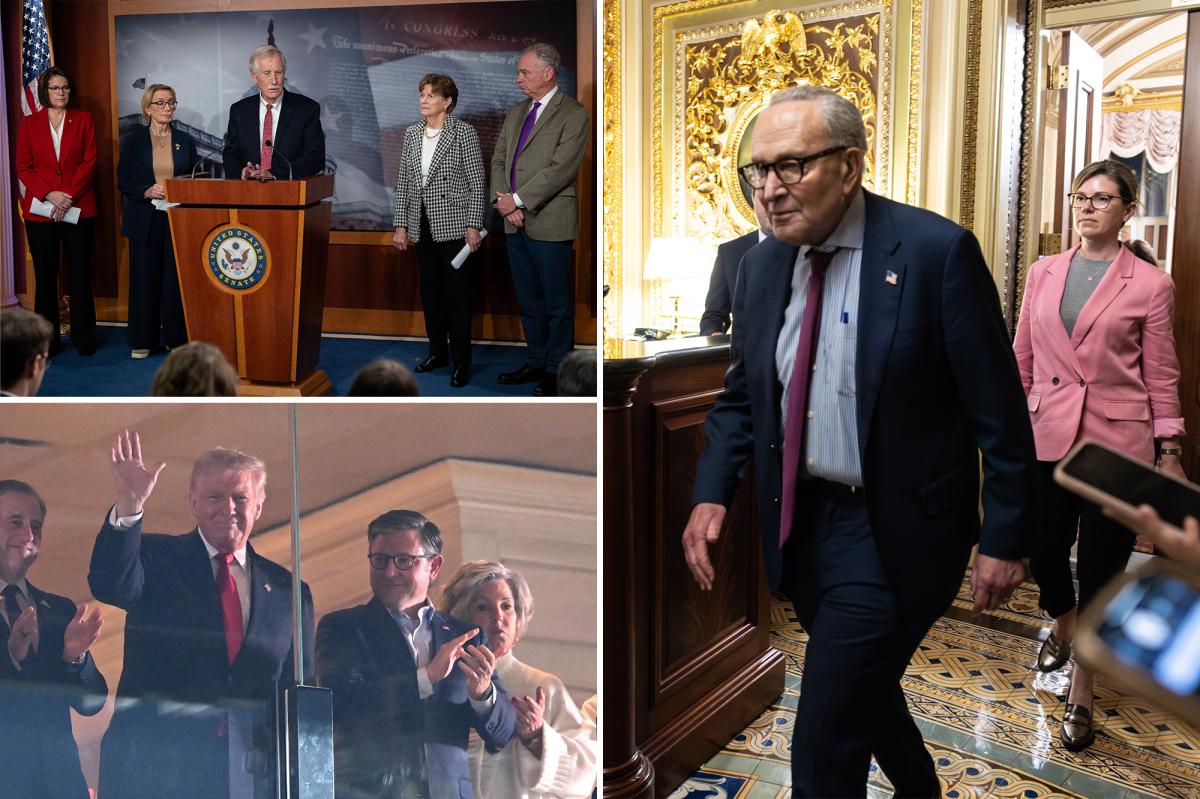
Rep. Marjorie Taylor Greene (R-GA), Washington Commanders owners Josh Harris, President Trump and Speaker of the House Rep. Mike Johnson (R-LA) look on during a game between the Detroit Lions and the Washington Commanders at Northwest Stadium on Nov. 9, 2025 in Landover, Maryland. Getty Images
Democratic Sens. Dick Durbin of Illinois, Tim Kaine of Virginia, Maggie Hassan of New Hampshire, Catherine Cortez Masto of Nevada, Jeanne Shaheen of New Hampshire, Jacky Rosen of Nevada, and John Fetterman of Pennsylvania all broke with their party and voted in favor of the package. Angus King of Maine, an Independent who caucuses with Dems, also voted yes.
Sen. Rand Paul of Kentucky was the only Republican to vote no.
While the vote marks a massive breakthrough in the weekslong deadlock over the funding lapse, it could still be a few days before the longest government shutdown in US history actually ends.
Although it cleared the filibuster, the bipartisan deal still needs to be passed by the Senate.
Disgruntled Democrats peeved by the deal and Paul, who is miffed by the measure’s ban on hemp sales, could throw down procedural hurdles that may delay it from clearing the Senate. Then it needs to get through the House of Representatives.
None of those remaining potential hurdles is likely to derail the final passage of the funding package, though they can delay it.
Senate Majority Leader Chuck Schumer (D-NY) departs from a Democratic caucus meeting on Capitol Hill on Nov. 9, 2025 in Washington, DC. Getty Images
The breakthrough was met with a revolt from many Democrats and progressive activists who whined that the deal didn’t give the party any ironclad commitments on their healthcare demands.
Since September, Senate Democrats have used the filibuster to block a House-passed stopgap measure to fund the government, leveraging the shutdown fight to pressure Republicans into extending the enhanced Obamacare subsidies that are set to expire by the end of next month and reversing their Medicaid reforms.
None of those demands were included in the package that advanced in the Senate on Sunday.
The Senate advanced a bipartisan deal late Sunday to end the government shutdown. Bonnie Cash/UPI/Shutterstock
Senate Minority Leader Chuck Schumer speaks with members of the media following a meeting with Secretary of State Marco Rubio and Secretary of Defense Pete Hegseth at the US Capitol, in Washington, DC, November 5, 2025. REUTERS
House Minority Leader Hakeem Jeffries, Democrat from New York, speaks to reporters on day 37 of the federal government shutdown at the US Capitol in Washington, DC on November 6, 2025. AFP via Getty Images
Instead, Senate Majority Leader John Thune (R-SD) offered Democrats a vote on extending the enhanced Obamacare tax credits next month — something he put on the table over three weeks ago.
But Thune has said he is not guaranteeing it will pass the Senate, and House Speaker Mike Johnson (R-La.) has made no such commitments to even take that measure up in the lower chamber.
In addition to a vote on extending the Obamacare subsidies, Republicans agreed to hire back all the federal workers the Trump administration had laid off during the shutdown and give federal employees back pay.
Senator Angus King (I-ME) speaks at a press conference with other Senate Democrats who voted to restore government funding, in Washington, DC on Nov. 9, 2025. Nathan Posner/Shutterstock
Democrats from nearly all corners of the party railed against the deal to end the government shutdown.
“It now appears that Senate Republicans will send the House of Representatives a spending bill that fails to extend the Affordable Care Act tax credits,” House Minority Leader Hakeem Jeffries (D-NY) fumed, declining to call out the Senate Dems who caved.
“We will fight the GOP bill in the House of Representatives, where Mike Johnson will be compelled to end the seven-week Republican taxpayer-funded vacation.”
“If this is the so-called ‘deal,’ then I will be a no,” Rep. Ritchie Torres (D-NY) declared Sunday in response to rumors of the deal. “That’s not a deal. It’s an unconditional surrender that abandons the 24 million Americans whose health care premiums are about to double.”
Speaker of the House Rep. Mike Johnson (R-LA) speaks during a news conference with the House Republican leadership on reopening the government at the U.S. Capitol on November 6, 2025 in Washington, DC. Getty Images
Democratic National Committee Vice Chair Malcolm Kenyatta similarly lamented that, “Any ‘deal’ that ends with Dems just getting a pinky promise in return is a mistake.”
“It would be a policy and political disaster for Democrats to cave!” Sen. Bernie Sanders (I-Vt.), who caucuses with Democrats, raged.
The bipartisan deal features two main components: a spending patch to keep the government funded through Jan. 30, 2026, and a minibus that would fund programs related to the military, veterans and the Department of Agriculture.
Significantly, the funding for the Department of Agriculture fully foots the bill for the Supplemental Nutrition Assistance Program (SNAP), which feeds 42 million low-income Americans and ran out of cash on Nov. 1.
The Trump administration had tapped into the contingency fund to keep the program afloat and partially funded for a few more weeks.
Congress is tasked with funding the government every fiscal year, which starts Oct. 1, in order to keep it up and running.
Typically, this is done through 12 appropriations bills, though Congress relies on stopgap measures known as continuing resolutions to keep the government running on autopilot while negotiating those appropriations bills.
The “minibus” component of the deal in the works on Sunday includes three of the 12 appropriations bills. The stopgap through Jan. 30 is intended to buy time to pass the rest of them.