
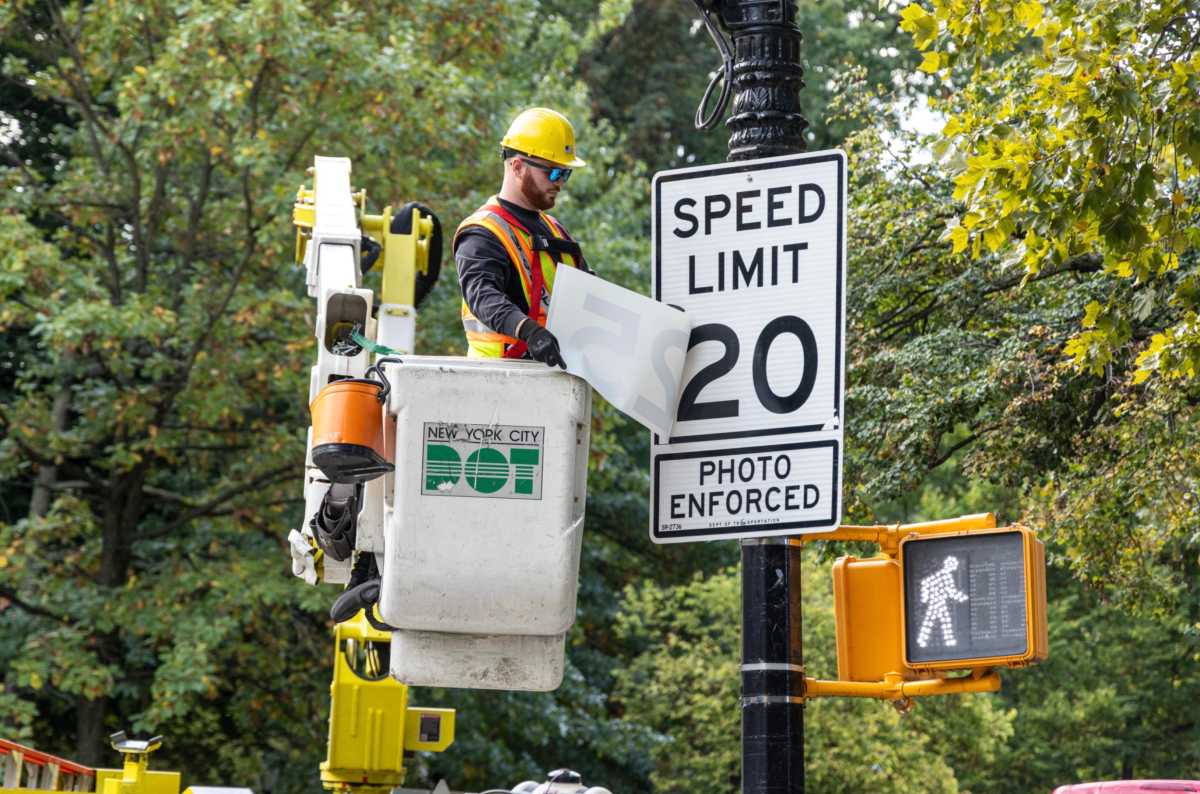
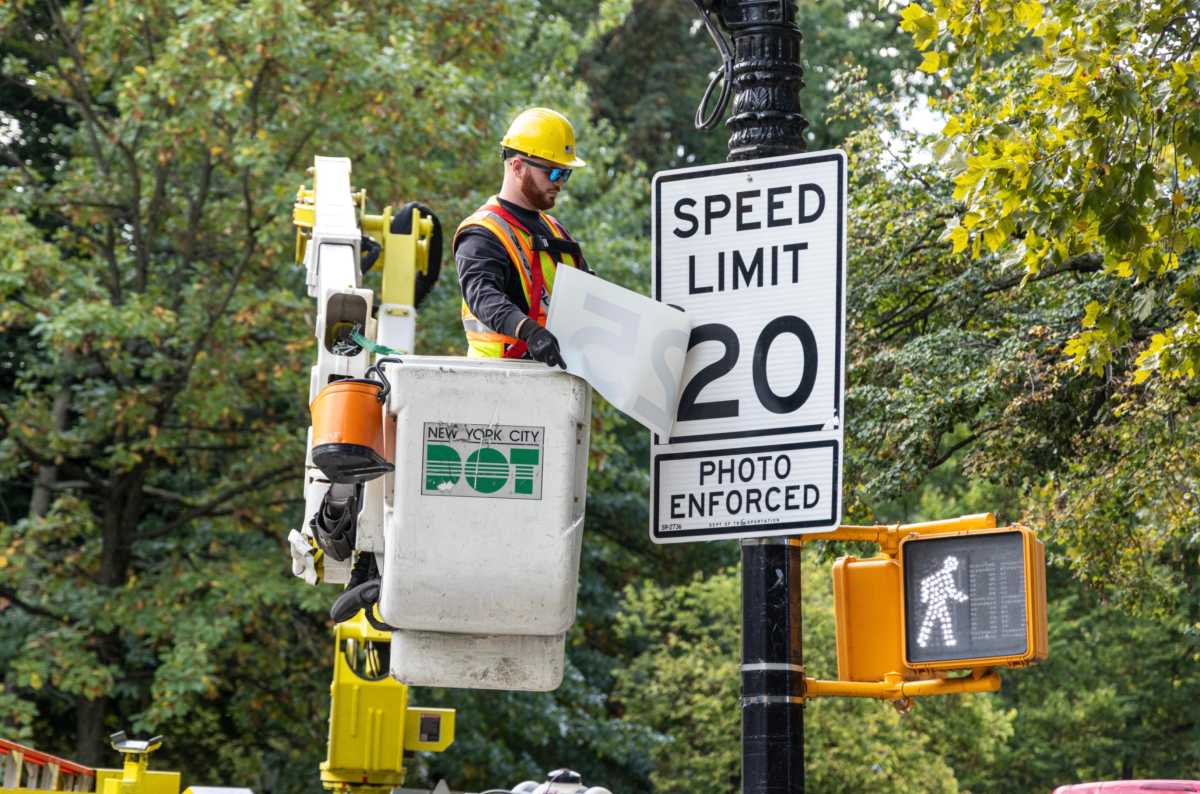
FILE – An NYC Department of Transportation worker changes a speed limit sign in Brooklyn.
NYC DOT
Queens Boulevard was once dubbed by tabloids as the “boulevard of death” because of the numerous crashes and collisions along the major Queens artery that killed dozens of pedestrians.
After many reports and public outcry over the propensity for deadly pedestrian collisions, in 2015, the city went to work installing all kinds of safety features along Queens Boulevard both to slow drivers down and to prevent jaywalking — from expanding parking lanes, to adding protected bike lanes, to retiming crosswalk signals to give pedestrians more time to walk across the wide roadway.
The effort worked; by 2024, the city Department of Transportation reported a 68% decrease in traffic-related fatalities along Queens Boulevard. Pedestrian injuries had also plummeted by 35% over those nine years.
But as the city moved heaven and earth to solve the “boulevard of death,” the street safety groups Transportation Alternatives and Families for Safe Streets say 50 other “boulevards of death” around New York City require immediate action to protect the lives of pedestrians and cyclists — and especially children.
In a damning report released last week as the city’s schools reopened, the groups pointed out that more than 2,300 schools are located within a quarter-mile of the 50 most dangerous roadways in New York City.
These streets — including Queens’ Northern Boulevard, Bronx’s Jerome Avenue, Brooklyn’s Eastern Parkway, Manhattan’s West 125th Street, and Staten Island’s Bay Street — comprise just 9% of the total lane miles in New York City, yet had 21% of all street deaths and serious injuries between 2022 and 2025.
All 50 “boulevards of death,” as identified in the report, saw 212 fatalities and 2,482 serious injuries from traffic crashes over those four years.
The groups say that the city can take action to save more lives on these dangerous roadways by fast-tracking improvements similar to what was brought to Queens Boulevard, and lowering the citywide speed limit to 20 mph on most roadways, and 15 mph in school zones.
The Mamdani administration should listen to these groups and take appropriate action, based on the needs of the communities on each road targeted in the report. Not every road is Queens Boulevard, so merely replicating what is there on every other “boulevard of death” in the city is not the answer.
A combination of measures designed to keep pedestrians, cyclists and drivers safe ought to be considered and acted upon in the months to come. The city must be careful not to enact changes that cause an adverse impact on businesses along these strips; still, we believe that, with proper outreach, it can achieve maximum street safety with minimal impact.